
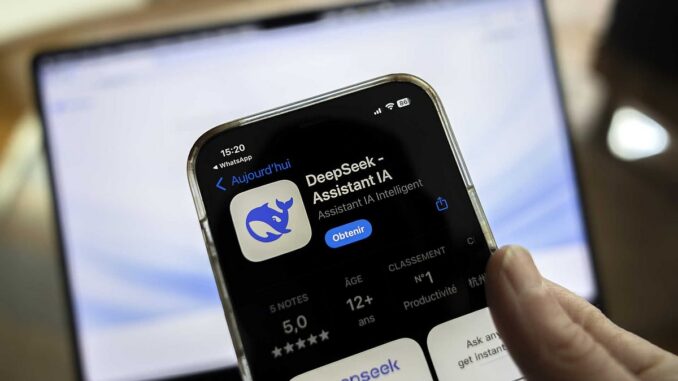
Chinese company DeepSeek is expected to unveil a large new language model this week, in a new test of China’s ambitions to compete with North American rivals in the artificial intelligence (AI) sector.
The company based in Hangzhou, east of Cihna, is preparing to launch the V4 model, described as “multimodal”, with the ability to generate text, images and video, according to the British newspaper Financial Times, which cites sources familiar with the matter.
According to the same sources, DeepSeek worked with Chinese chip manufacturers, such as Huawei and Cambricon, to optimize the new model for their latest products, in a strategy that signals Beijing’s efforts to reduce dependence on semiconductors from North American Nvidia, subject to export controls imposed by Washington.
The launch is scheduled to take place before the “Two Sessions”, the annual meeting of the National People’s Assembly (NPA), the highest Chinese legislative body, which begins on March 4, a high-profile political event that could reinforce DeepSeek’s status as a national AI champion.
This is the first major model presented by the company since January 2025, when it released the R1 reasoning model. At the time, DeepSeek claimed to have developed a system comparable to the main Silicon Valley models with just a fraction of the computing power used by competitors, an announcement that provoked a strong reaction in North American technology markets.
Since then, the company has rolled out incremental updates as domestic rivals like Alibaba and Moonshot have sought to capture demand for low-cost, open-source Chinese models.
Optimizing V4 for chips produced in China could boost demand for local semiconductors and accelerate the replacement of North American manufacturers such as Nvidia and AMD in the “inference” phase, that is, in the generation of responses by already trained models.
Nvidia continues, however, to dominate the market for chips used in the highly computationally intensive pre-training phase. The Financial Times previously reported that DeepSeek attempted to carry out this initial step on Huawei hardware, but faced technical difficulties.
DeepSeek is expected to release a brief technical note at the launch of V4, followed by a more detailed report about a month later, according to a source cited by the newspaper.
However, the North American company Anthropic this week accused DeepSeek and two other Chinese companies of resorting to “distillation attacks”, a practice that consists of training smaller models based on the results of more advanced systems, allowing performance to be replicated without using the same computational resources.
Leave a Reply