
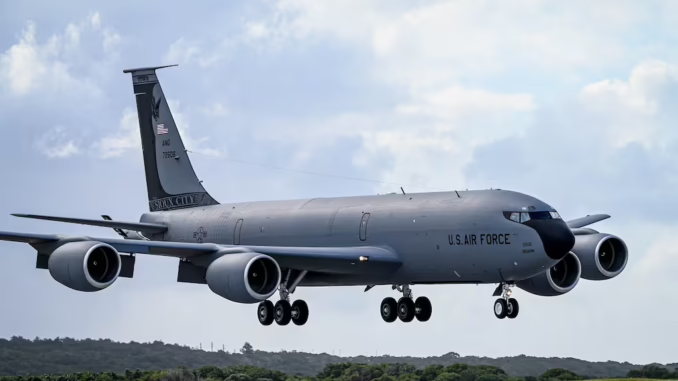
A dramatic aviation incident unfolded in the Middle East when a U.S. military aerial refueling aircraft crashed in western Iraq, triggering a large search-and-rescue effort and prompting new concerns about the safety and risks facing American forces operating in the region. The aircraft involved—a **Boeing KC‑135 Stratotanker operated by the United States Air Force—went down during a mission tied to ongoing military operations in the region.
The crash occurred in what officials described as “friendly airspace” over Iraq, and early reports indicate that two aircraft were involved in an incident during flight, though only one ultimately crashed. Another aircraft was able to land safely after the event. Military authorities confirmed that the crash was not caused by enemy fire or friendly fire, a key detail that immediately shaped speculation about what might have gone wrong.
As investigators work to determine the cause and rescuers continue searching for crew members, the crash has drawn international attention—not only because of the potential loss of personnel but also because the KC-135 tanker is one of the most critical aircraft supporting modern military air operations.
This article explores everything known so far about the crash, the aircraft involved, the context of the mission, and the broader implications for U.S. military operations in the Middle East.
Breaking News: What Happened in the Iraqi Skies
According to officials from United States Central Command, a KC-135 aerial refueling aircraft crashed on March 12, 2026, while operating over western Iraq. The aircraft was participating in a mission connected to ongoing regional military operations when the incident occurred.
Initial reports revealed several key facts:
-
The crash occurred during a military operation in Iraqi airspace.
-
Two aircraft were involved in the event, though only one crashed.
-
The second aircraft successfully landed after declaring an emergency.
-
Rescue operations began immediately following the crash.
-
Officials stated the incident was not caused by hostile or friendly fire.
At the time of the initial announcements, authorities had not confirmed casualties, and details about the crew remained limited as rescue teams worked to locate the crash site and assess the situation.
Military spokespeople asked for patience as they continued gathering information and notifying families of personnel who may have been involved.
Rescue Operations Underway
Following the crash, search-and-rescue teams were immediately deployed to the region where the aircraft went down. The remote and sometimes difficult terrain in western Iraq can complicate recovery missions, particularly when aircraft crashes occur far from established military bases.
The rescue effort is being coordinated by U.S. military personnel in the region, including forces under the command of United States Central Command. These teams often rely on helicopters, surveillance drones, and specialized recovery units to locate wreckage and survivors.
Officials emphasized that the priority was the safety and recovery of the crew, whose exact status was initially unknown.
The military has not yet released the names of those on board, following standard protocol that requires families to be notified before information becomes public.
Understanding the Aircraft: The KC-135 Stratotanker
To understand the significance of the crash, it is important to understand the role of the aircraft involved.
The Boeing KC‑135 Stratotanker is one of the most important aircraft in the U.S. military’s global airpower system. Introduced in the late 1950s, the KC-135 is designed primarily for aerial refueling, allowing fighter jets, bombers, and surveillance aircraft to stay airborne for extended periods.
Key Capabilities of the KC-135
The KC-135 provides several critical capabilities:
-
Mid-air refueling for combat aircraft
-
Extended mission range for fighters and bombers
-
Strategic global mobility support
-
Fuel transport for coalition aircraft
Without aerial refueling tankers like the KC-135, many military missions would be severely limited by aircraft fuel capacity.
This aircraft has been a backbone of U.S. air operations for more than six decades, supporting missions across Europe, Asia, and the Middle East.
Operation Epic Fury and Regional Conflict
Reports indicate that the aircraft was supporting Operation Epic Fury, a military campaign connected to ongoing regional tensions involving Iran.
While details of the operation remain classified, analysts say that aerial refueling tankers play a central role in large-scale air campaigns, particularly when multiple aircraft are conducting long-distance missions.
During such operations:
-
Fighters require frequent refueling
-
Surveillance aircraft stay airborne for hours
-
Strike missions depend on tankers for extended reach
The KC-135 that crashed was likely part of a larger aerial network supporting combat and surveillance flights across the region.
What Might Have Caused the Crash?
Although the exact cause of the crash remains unknown, officials have already ruled out some possibilities.
No Enemy Fire
Military authorities confirmed that the aircraft was not shot down by enemy forces, a significant detail because aircraft operating in conflict zones are often exposed to missile threats or anti-aircraft weapons.
Two Aircraft Involved
Another key detail is that two aircraft were involved in the incident, though it remains unclear whether they physically collided or experienced some form of operational mishap.
Possible scenarios being examined by investigators include:
-
Mid-air collision or near-collision
-
Mechanical failure
-
Refueling equipment malfunction
-
Pilot error
-
Turbulence or environmental factors
Aviation experts say that mid-air refueling operations are among the most technically challenging maneuvers in aviation, requiring extremely precise positioning between aircraft.
Why Aerial Refueling Is Risky
The KC-135’s mission—refueling aircraft while both planes are flying—requires exceptional coordination.
During aerial refueling:
-
A receiving aircraft approaches the tanker from behind.
-
The tanker extends a fuel boom, a long telescoping tube.
-
A specialized crew member guides the boom into the receiving aircraft’s fuel port.
Even minor errors in speed, positioning, or turbulence can create dangerous conditions.
Despite these risks, aerial refueling is performed thousands of times every year with high safety standards.
A Rare but Serious Incident
Aircraft losses involving the KC-135 are relatively rare, which is why this crash has drawn global attention.
Historically, the aircraft has maintained a strong safety record, though accidents have occurred over its long service life.
For example:
-
In 2013, a KC-135 broke apart shortly after takeoff due to a mechanical malfunction, killing three crew members.
While such incidents are uncommon, they underscore the risks faced by military aviators performing complex missions around the world.
The Strategic Importance of Tanker Aircraft
Military experts often describe aerial refueling tankers as force multipliers.
Without them, many modern combat aircraft would struggle to reach distant targets or maintain extended patrols.
For example, tankers allow:
-
Fighters to escort bombers across continents
-
Surveillance aircraft to monitor conflict zones for hours
-
Combat jets to launch multiple strikes without returning to base
In many ways, tanker aircraft like the KC-135 serve as the lifeline of large-scale air campaigns.
This is why the loss of even a single tanker can affect operational planning.
Impact on U.S. Military Operations
While one aircraft loss does not cripple a large military fleet, incidents like this can still influence operations.
Potential impacts include:
-
Temporary changes to flight procedures
-
Safety reviews of refueling operations
-
Investigations into equipment or training
-
Adjustments to mission planning
The U.S. Air Force typically conducts thorough accident investigations whenever a major aircraft incident occurs.
These investigations examine:
-
Flight data
-
Maintenance records
-
Crew training history
-
Environmental conditions
-
Air traffic communications
The goal is to determine exactly what happened and prevent similar incidents in the future.
Global Attention and Public Reaction
News of the crash quickly spread across international media outlets, drawing attention from aviation experts, military analysts, and the public.
The incident has sparked several questions:
-
What exactly caused the crash?
-
Were the crew members able to survive?
-
How will this affect ongoing military operations?
For families of service members stationed overseas, the news serves as a stark reminder of the risks faced by military personnel every day.
A Reminder of the Risks of Military Aviation
Even with advanced technology and extensive training, military aviation remains inherently dangerous.
Pilots and crew often operate in:
-
Combat environments
-
Extreme weather
-
Complex multi-aircraft formations
Aircraft like the KC-135 routinely fly long missions that require precise coordination with multiple aircraft.
While safety systems have improved dramatically over the decades, the risks can never be completely eliminated.
What Happens Next in the Investigation
The crash investigation will likely involve several agencies, including:
-
The U.S. Air Force accident investigation board
-
Aviation safety experts
-
Military operational analysts
Investigators will examine:
-
Flight recorders
-
Radar data
-
Wreckage patterns
-
Communication logs
The final report could take months to complete, especially if the wreckage is difficult to recover.
Conclusion
The crash of a U.S. Air Force KC-135 tanker in Iraq is a significant aviation incident that highlights both the complexity and the risks of modern military operations. While early reports indicate the crash was not caused by hostile action, many questions remain about what exactly happened during the mission.
As rescue teams continue their work and investigators begin analyzing evidence, the focus remains on the crew members involved and the safety lessons that may emerge from the incident. Tanker aircraft like the KC-135 Stratotanker play a crucial role in sustaining global air operations, making every mission—and every accident—an important reminder of the challenges faced by those who serve in military aviation.
In the coming weeks, additional details are expected to emerge. Until then, the world watches closely as officials work to understand one of the most significant military aviation incidents reported in the region this year.

Leave a Reply