
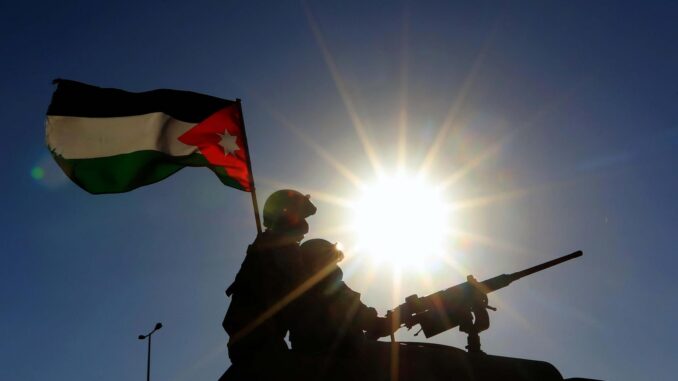
The call to prayer is heard from the citadel of Amman, coinciding with the setting of the sun. It would be an idyllic picture if it weren’t for the fact that, moments later, the anti-aircraft alarms They cover the edge. Every time Iran’s missiles cross Jordanian airspace towards Israel, alarm bells ring. It is a howl that has been heard several times a day for two weeks.
Emia 24-year-old Jordanian citizen, explains that she is not afraid when the alarms sound. “It’s something from the government to protect us from attacks,” he explains, which are not directed at Jordan. Nobody bats an eyelid when the alarms ring. Jordan, despite being in the middle of the Middle East, remains on the sidelines of the war.
The country is a clear example of the delicate situation faced by the Gulf states, which do everything possible to stay on the sidelines in the midst of regional chaos despite having suffered attacks from Iran. There have been recent attacks, for example, on Citibank branches in the United Arab Emirates and Bahrain.
As the Jordanian lawyer and political analyst explains to EL ESPAÑOL Omar Al-Jazythe position of the kingdom of Abdullah is that of try to stay out of warpreserving its alliance with the United States and avoiding a break with Israel. At the same time, avoid provoking Iran, Hezbollah or pro-Iranian groups in neighboring countries such as Iraq.
Maintaining this delicate balance is the reason why Jordan did not respond to the attacks in the early hours of Sunday to Monday, March 9 against the base of Al Azraqshared between the Bundeswehr (where 200 German troops share a base with the US Army) and the US in the east. Amman recorded 60 missiles and 59 drones launched against its territory, which were intercepted.
Although almost all countries in the region have suffered similar attacks, “the key is how these states respond to the attacks. For now, despite the fact that the conflict has escalated, It is limited to certain specific points.” says Dolores Rubio, professor of International Relations at the Complutense University of Madrid.
Furthermore, the expert explains, there are overlapping conflicts: Israel with Hezbollaha conflict in which France has intervened, offering both parties to meet in Paris to negotiate. According to Rubio, now Israel needs France – like ancient metropolis of Lebanon– to neutralize or at least negotiate, even though we distrust her for supporting the two-state solution.
There is a real, although still limited, risk of Jordan becoming directly involved in the conflict, mainly through escalation around US bases or a calculation error related to Iranian projectiles, explains Al Jazy.
Arguably, the main actors—including the United States and Iran—have strong reasons not to open a new front with Jordan, considered a fragile but strategically important buffer state for them.
However, being in the middle of the powder keg of the Middle East as a neutral country places the state in a very delicate situation. The interception of weapons destined for Israel or US basesalthough presented as a territorial defense measure, can be interpreted by Iran and its allies as a taking sides.
Failure to intercept them carries the risk of provoking negative reactions both nationally and internationally. But The temporary closures of airspace in the countries of the region represent an immense loss of income. Prolonged disruptions affect tourism, investment and trade, all vital sectors for Jordan’s fragile economy.
Furthermore,”the longer these overflights and interceptions continue, the more difficult it will be for Jordan keep the narrative that it is simply a neutral and defensive posture,” declares the analyst.
Several missteps could take the conflict to a much more dangerous level for Jordan and the rest of the neutral countries throughout the region, pushing Tehran to use capabilities that it has until now kept in reserve, explains Al Jazy.
Now that Jerusalem is under attack from Iran, damaging sacred places such as Al Aqsa or the Wailing Wallas well as force massive displacements in the West Bank could radicalize public opinion in hitherto neutral countries and cause them to actively enter the war in the region. A large-scale attack in which large numbers of civilians were killed would push them to go to war.
And finally, “if either party were to publicly declare Jordan, Lebanon or the Gulf States as declared enemies (and not just as countries hosting US bases), These countries would be forced to change their political strategy of neutrality” concludes the Jordanian lawyer.
Refugees from Lebanon, a demographic challenge
The situation in Lebanon – a country with most refugees per capita in the worldand where there are already almost a million internally displaced people – is causing syrian refugees who lived there are returning to their country of origin, still devastated by the civil war that tore the country apart for more than 10 years.
But not only them are leaving the country: the Lebanese themselves are fleeing across the land border with Syria, a transit country to access other safer states, such as Jordan.
It is these neighboring countries that really suffer the demographic challenge of hosting those displaced in this type of conflict. In the case of Jordan, for example, despite there being no official figures, it is estimated that between 50% and 70% of its population is of Palestinian origin. Only in Amman does it have three refugee camps who were born after the Nakba: Wihdat o New Camp, Jabal El-Hussein, and Baqa’a.
“Now, with the war, everyone will want to come here, because it is the safest place right now in the entire Middle East,” says Rubí (alias for this report), a 47-year-old Jordanian woman, daughter of a Jordanian father and a Palestinian mother. “In Europe they complain about refugees, but here more than half are refugees, or we are descended from them. When wars start, it is the neighboring countries that receive the displaced,” he says.
The Jordanian government is concerned about new migratory flows from the region, although at the moment there have been no large-scale movements to the territory. At the moment, “the biggest threat to Jordan is the annexation of the West Bank by the Israeli occupation,” says Al Jazy.
Leave a Reply