
This Tuesday, Iran launched new attacks on its neighbors in Kuwait, Bahrain, the United Arab Emirates and Saudi Arabia. Although practically all of them were repelled by the anti-aircraft defenses of these countries, Iranian insistence only multiplies the risks of a regional escalation.
In fact, for much of Tuesday afternoon there was speculation about an attack from the emirate of Kuwait with ATACMS missiles, although in reality it was an interception with Patriot missiles of a previous Iranian attack.
As is normal, due to their size and geopolitical importance, the Emirates and Saudi Arabia are the ones that have criticized the ayatollah regime the most for these attacks and the ones that have most strongly threatened a reaction.
It is not surprising if one takes into account that the Emirates—along with Bahrain, by the way—is a signatory of the Abraham Accords for the normalization of relations with Israel and that, since the assumption by Mohamed bin Salman of executive power in Saudi Arabia, Iran has become enemy number one.
From a traditional reading, taking as a reference the balance of forces of the last century, one might think that Israel is the only partner of the United States in this war, but this is far from the case.
The Arab monarchies neighboring Iran have long been asking the United States for moves to overthrow the ayatollahs and criticizing its imperialist will, both in the purely military and religious fields.
It must be remembered that Iran is not only a Persian country, but its leaders are Shiites, compared to the Sunni majority of the rest of the Arab countries. Only Qatar, and not always, has maintained good relations with the ayatollah regime.
Oman has also offered on several occasions to mediate disputes involving Tehran and the Western world. The rest are now much more interested in evicting the current Khamenei than in cornering Benjamin Netanyahu.
The dangers of military action
Clear proof of this was experienced during Israel’s bombings of the Gaza Strip between 2023 and 2025.
While in certain Western countries there was talk of genocide and protests in the streets, the reaction of these Arab States was much more timid.
Of course, Israel was condemned, but neither did the signatories of the Abraham Accords disengage from them nor did Saudi Arabia lead any campaign of commercial hostility as would certainly have happened in the 20th century.
In this war, the Arabs are accepting for the moment turning the other cheek so as not to burst the markets, but their patience is running out.
They know that they have a lot to lose if operations are prolonged, due to the losses that Iranian attacks on their energy infrastructure could cause and due to the uncertainty that a conflict of this type creates in countries that sell the opposite of international luxury tourism: absolute security and comfort, something incompatible with sirens and bunkers.
Of course, although Saudi Arabia and company are collaborating with the United States in the use of joint bases and the Emirates already warned this weekend that “it will not negotiate with terrorists” in the face of Tehran’s threats to attack its refineries and gas fields, the countries of the Persian Gulf have not decided to respond directly with weapons to Iranian provocations.
They have their reasons for this.
Attacking Iran in the first person would mean an escalation of the conflict that no one knows where it will lead to. It also means depending on Donald Trumpa man whose impulses can lead him to abandon the war and leave his allies alone at any moment.
What they can do is freeze Iranian assets in their banks and complicate the passage of Iranian oil overland to third countries. In fact, this is very likely to happen in the short term.
Egypt and Türkiye, for “peace”
Everything would change, of course, if Trump attacked civilian targets in Iran, as he threatened last weekend, and in turn the ayatollah regime attacked infrastructure in these Gulf countries.
In that case, it must be assumed that there would be a direct military response from these countries.
This Monday, the American president publicly congratulated the Emirates, Saudi Arabia and Qatar, considering that “they were behaving excellently.”
It is easy to imagine the Emiratis and Saudis supporting a coalition in Hormuz. It seems more difficult in the case of the Qataris.
However, this hostility is not shared by other Islamic countries. Iran has few friends in the Middle East, if not none… but at least not all are enemies.
In recent hours, Egypt and Türkiye have joined the attempts of Oman and Pakistan to mediate in the conflict. They probably know as well as anyone that this only serves to buy time for Iran to regroup, but they play with that ambiguity of serving “peace.”
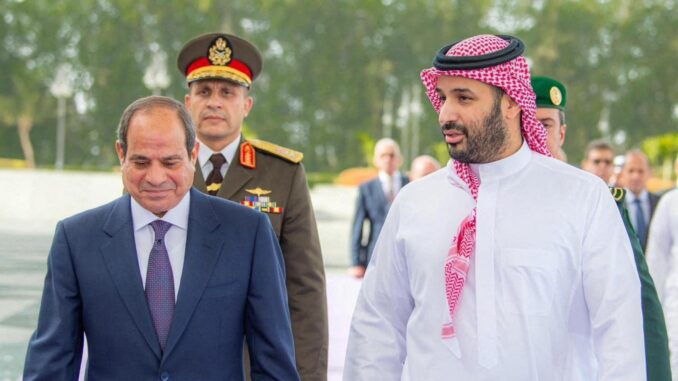
The motivations of Abdelfatah El SisiEgyptian president, are purely about stability. It was already seen in the Gaza war that Egypt was more concerned about not being affected by the conflict than about helping the Palestinians.
They fear that a resurgence of terrorism in the Middle East will damage their economy and, above all, that it will stir up their internal hornet’s nest in favor of the Muslim Brotherhood, which Iran has also supported in recent decades.
Turkey, as always, plays with the multiple tricks of being a NATO country, an ally of the United States… but at the same time increasingly inclined towards Islamism and with an excellent relationship with Russia, which in turn brings it closer to Iran.
Recep Tayyip Erdogan has supported Hamas as much as Ali Jamenei and he has no doubt that Israel is the great enemy to defeat, without nuances.
Who are Witkoff and Kushner negotiating with?
If it were for these countries, the negotiations would continue ad aeternum until an agreement similar to the one accepted was reached. Barack Obama in 2015 and which Trump himself revoked in 2018.
They do not feel that the ayatollahs are a threat, or at least they see instability as a greater threat. They may not be happy that Iran builds a nuclear bomb, but they understand that it would never throw it at them.
Israel, Saudi Arabia and the United Arab Emirates cannot say the same. For them, this is a war of survival. Moral questions remain aside.
As for the United States, confusion continues over its objectives and the current situation of its campaign. The negotiating team is supposed to Steve Witkoff–Jared Kushner He is still in talks with someone from the Iranian administration, but no one is able to say who he is or give any clue, which suggests that, perhaps, he does not exist.
The five-day ultimatum that Trump extended last Monday ends on Friday. Perhaps, then, a savage attack on Iran will be launched, a rather symbolic attack… or another supposed interlocutor will appear that will allow the deadline to be extended for a while longer. Impossible to anticipate it at this time.
Leave a Reply