
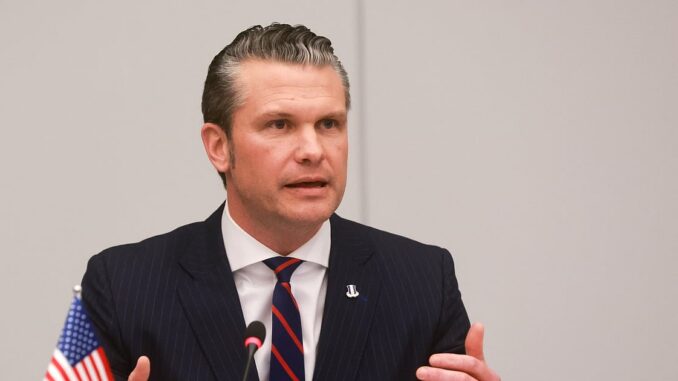
US Secretary of Defense Pete Hegseth, hosting his first monthly Christian prayer service at the Pentagon since the start of the war in Iran, prayed on Wednesday, March 25, that “every shot finds its mark.”
“Every month it’s appropriate to be here,” Hegseth told the assembled civilian and military officials. “All the more appropriate this month, right now, given what tens of thousands of Americans are doing right now.”
The Defense Secretary read a prayer he said was first given by a military chaplain to the troops who captured then-President Nicolás Maduro of Venezuela.
“May every shot find its target against the enemies of justice and our great nation,” Hegseth prayed during the live-streamed service. “Grant them wisdom in every decision, endurance for the test that lies ahead, unbreakable unity, and an overwhelming violence of action against those who deserve no mercy.”
Hegseth frequently invokes his evangelical faith as head of the military, portraying a Christian nation trying to defeat its enemies with military might.
“I pursued my enemies and overtook them, and did not turn back until they were consumed,” he read in the Psalms.
During Iran’s escalating war and global conflicts, Hegseth’s Christian rhetoric has drawn new scrutiny, including his past defense of the Crusades, the brutal medieval wars that pitted Christians against Muslims.
Declaring one’s faith is common in American public life, across political parties and religious traditions.
Pentagon aides and Hegseth defenders turn to examples from history, such as President Franklin D. Roosevelt’s support for distributing Bibles to troops.
Hegseth regularly cites George Washington, who pushed to establish the military chaplain corps, and often goes beyond the usual requests for God to bless the country or its troops.
Last week, he asked Americans to pray for members of the armed forces “in the name of Jesus Christ.”
Today, he prayed again in the name of Jesus.
Hegseth belongs to the Fellowship of Evangelical Reformed Churches, a conservative network co-founded by self-described Christian nationalist Doug Wilson.
CREC pastors attended Hegseth’s services at the Pentagon at least three times, including Wilson who preached there in February.
A lawsuit over the services was filed Monday by Americans United for the Separation of Church and State.
The advocacy group filed a similar lawsuit against the Department of Labor, where Secretary Lori Chavez-DeRemer hosts monthly prayer meetings inspired by Hegseth.
The lawsuit seeks to enforce a December public records request asking the Pentagon for internal communications about religious services, their cost, guests and any complaints received from employees.
“Secretaries Hegseth and Chavez-DeRemer are abusing the power of their government positions and taxpayer-funded resources to impose their preferred religion on federal workers,” alleged Rachel Laser, president and CEO of Americans United, in a statement.
“Even though these prayer services are presented as voluntary, there is pressure on federal employees to participate in order to please their bosses.”
Military chaplains typically provide religious services within the department of defense. As ordained clergy and commissioned officers, they minister from their specific tradition but provide spiritual assistance to troops of any faith or no faith.
Hegseth announced two reforms Tuesday in what he described as “making the chaplain corps great again.” He wants chaplains to focus more on God and less on therapeutic “self-help and self-care.”
In a video message, the Defense Secretary said chaplains would no longer wear their uniform rank but would be identified by religious insignia and argued that the move would remove the “discomfort or anxiety” service members have in seeking out officers for spiritual care.
But the defense official also said that the military is reducing the number of faith codes, or religious affiliations, that it recognizes. The military will now use 31 religious affiliations, down from more than 200 previously, which included many small Protestant denominations as well as identifications for Wiccans, atheists and agnostics.
The military is religiously diverse, and nearly 70% of troops identify as Christian, according to a 2019 congressional report.
Leave a Reply