
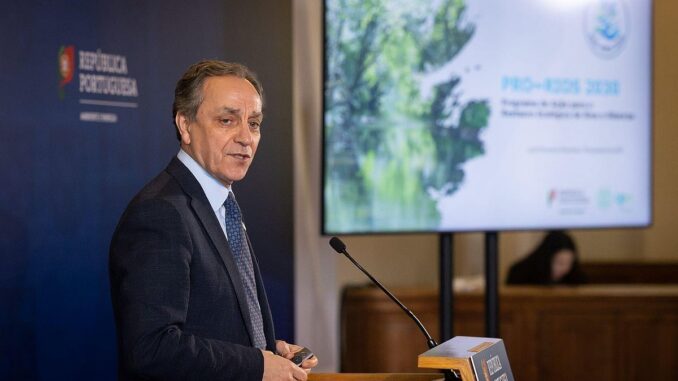
The president of the Portuguese Environment Agency (APA) indicated this Thursday, 26th, that China’s commitment to energy sustainability is seen as an example for Portugal in specific areas.
Speaking to Lusa, in Macau, José Pimenta Machado, highlighted the urgent need to adapt and look to Chinese technology as an ally, after the first months of 2026 were marked by “unique” meteorological phenomena that placed the entire national territory in a state of readiness.
January and February 2026 broke the rainfall record for the last 47 years in the Iberian Peninsula, according to the Spanish State Meteorological Agency.
“I don’t think I’ve ever seen or known a situation like what happened this year, in which the whole country was on flood alert”, said Pimenta Machado, highlighting that, unlike previous years, the events were no longer localized but affected Portugal “from the north to the south, all the way to the east”.
The Environment Minister also warned on Wednesday that adaptation to climate change is “the biggest issue” in the country and that crises resulting from climate change show the importance of warning systems.
Reiterating the minister’s position, he gave as examples of measures to be taken: “Do not authorize new constructions in risk areas”, remembering that more than 100 thousand people in Portugal currently live in areas at risk of flooding, occupying “a space that belongs to the river”.
In addition to river management, the coastal strip — which stretches for around 1000 kilometers between Caminha and Vila Real de Santo António — emerges as one of the biggest concerns, with 20% of its length affected by erosion.
“Adapting is not an option, it is even an obligation”, reinforced Pimenta Machado, pointing out monitoring and early warning systems as fundamental to “minimize the impact” and protect populations.
Present in Macau to participate in the 2026 Macau International Environmental Cooperation Forum and Exhibition (MIECF), the president of APA identified China as a strategic partner in decarbonization.
Despite being the second largest global emitter of gases that contribute to the greenhouse effect, the Chinese commitment to sustainability is seen by the leader as an example in specific areas.
“There is a very clear path to invest in the area of renewable energy, China, wind energy, solar energy, and the reduction of greenhouse gases”, observed Machado, also highlighting the electric vehicle industry, which has “very competitive prices from a technology point of view” and which could be crucial to reducing greenhouse gas emissions on Portuguese soil.
The Chinese manufacturer of new energy vehicles BYD, for example, registered 6,059 passenger cars in 2025, an increase of 94.1% compared to 2024, the brand’s first full year in Portugal, closing the year with a market share of 2.7%.
Chinese authorities have warned that the country is extremely vulnerable to the impact of climate change, recording record levels of warming and rising seas, with average annual temperatures and coastal levels reaching highs in 2024.
China’s goals are to peak carbon dioxide emissions before 2030 and achieve carbon neutrality before 2060.
The new five-year plan (2026-2030), approved this month, focuses on “boosting green and low-carbon development” and “promoting the energy transition”.
Leave a Reply