
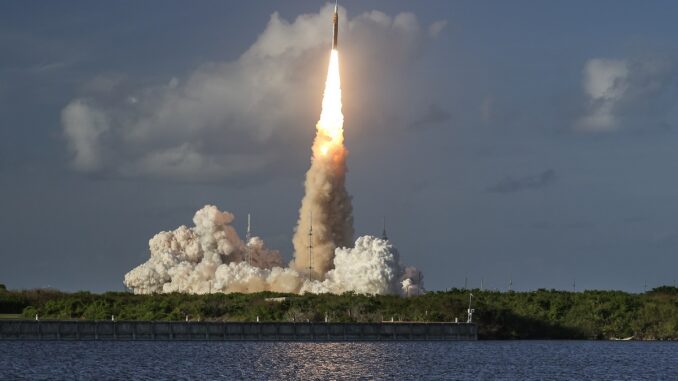
The Orion spacecraft, from the Artemis II missionexperienced a communication problem after takeoff, but it has now been resolved and will soon be placed in a high and stable Earth orbit, NASA reported tonight.
“Approximately 51 minutes into the flight, during a planned transfer between satellites, the Orion spacecraft experienced a communication problem which caused a temporary partial loss of them,” said Jared Isaacman, administrator of the space agency.
Communication problem with the Orion ship
In a press conference, he indicated that the crew could listen to the experts from NASA on Earth, but they couldn’t hear the four astronauts.
“There were no problems with the vehicle itself. Communications with the crew have already been restored,” he said.
NASA: The Orion spacecraft separated successfully
About the status of the mission, which took off at 18:35 local time (22:35 GMT) from the NASA facilities in Cape CanaveralFlorida, Isaacman stated that the Orion spacecraft, which will transport astronauts to lunar orbit, “successfully separated from the core stage and its solar panels have been deployed.”
“Soon, the crew will execute the apogee lift burn, placing the spacecraft in a high, stable Earth orbit,” he explained.
The capsule It will orbit the Earth for about 24 hours to test the systems and decide whether to continue the path to the Moon, which would take another four days of travel, as explained by NASA.
How long will the Artemis II mission last?
The mission has a expected duration of 10 days and would mark the return of humanity to lunar orbit after more than half a century.
The last astronauts to travel to the Moon – and land on the moon – were the members of the Apollo 17 in December 1972.
Artemis II crew
The Artemis II crew is made up of Commander Reid Wiseman, Specialist Christina Koch and pilot Victor Glover, all three from NASA, as well as Jeremy Hansen, from the Canadian Space Agency (CSA).
This is the second mission of the Artemis program, after the unmanned flight of 2022and precedes the next missions, in which astronauts wait pisar the Moon in 2028 and will begin to establish a permanent presence on the natural satellite.
Leave a Reply