
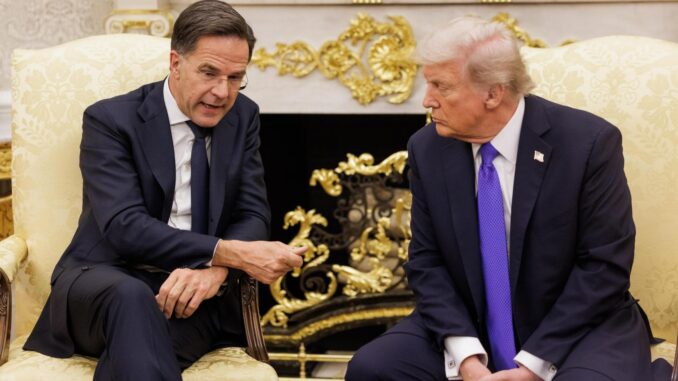
The I’LL TAKE is entering the worst crisis in its 77-year history after the clash of Donald Trump with its European allies for refusing to enter the unilateral war between the United States and Israel against Iran, a fracture that threatens to definitively blow up the Atlantic Alliance.
In recent days, the United Kingdom has restricted the use of its bases to bomb Iranian targets; Spain has closed its airspace to all US military traffic; and France has banned American planes with military supplies for Israel fly over their territory.
For its part, Italy has rejected that planes with weapons intended to attack Iran land at the Sigonella base in Sicilywhile Poland has declined to send a Patriot air defense system to the Middle East.
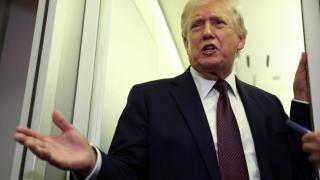
After this accumulation of rudeness from his allies, Trump has warned in several interviews this Wednesday that he is seriously considering pulling the US out of NATO, which would leave Europe without the security umbrella that Washington has provided since the end of World War II.
“NATO has never convinced me. I have always known that they were a paper tigerand Putin also knows it, by the way,” argues the White House tenant.
“If in the end the Gulf countries – or even Turkey – help Trump against Iran and Europe does not do so, Trump will have the best possible excuse not to contribute more to NATO,” he explains to EL ESPAÑOL. Alicia García-Herreroresearcher at the study center Bruegel.
It is not the first time that Trump has made threats of this type. On the eve of assuming his first term, he described NATO as “obsolete” and denounced that its partners took advantage of the United States to avoid spending what they were entitled to on defense.
At the 2018 summit in Brussels, the real estate magnate already threatened to leave the Alliance. “I’m leaving this meeting. There is no reason for me to continue here,” he told his partners, according to what he said. the then secretary general, Jens Stoltenberg.
However, this time Trump has launched a concerted offensive on all fronts against the Alliance, involving his entire administration and from which it seems difficult to turn back.
“We will have to rethink whether NATO is fulfilling its role or whether it has become a one-way street in which the United States limits itself to helping Europe, but when we need the support of our allies, they deny us the use of bases and overflights,” he denounced. the secretary of state, Marco Rubio.
“When we ask for additional help or simply access—use of bases and overflights—we encounter reluctance, obstacles or hesitation,” complains the Secretary of Defense. Pete Hegsethwhich leaves the decision to apply Article 5, the collective defense clause, in Trump’s hands.
“The president has pointed out that it is difficult to talk about an alliance if there are countries that are not willing to support you when you need them,” has reported.
“This is by far the worst crisis NATO has ever faced“, writes Ivo Daalder, who was US ambassador to the Alliance during the presidency of Barack Obama.
“Never before an American president had suggested—much less openly stated—that The US will no longer be there to help“Nor had five of the six largest European allies hindered the United States’ ability to carry out military operations elsewhere, even if they did not agree to them,” notes Daalder.
“Military alliances are based, at their core, on trust: the certainty that, if I am attacked, you will come to my defense. That trust has been eroding for years under the leadership of Donald Trump. Has it finally broken completely?“asks Obama’s ambassador.
At the moment, NATO remains silent in the face of Trump’s new barrage. In his last appearance, the Secretary General, Mark Rutte, justified the initial refusal of the European allies to the war in Iran in that they were not consulted or notified in advance.
Even so, he assured that they are already preparing to participate in the reopening of the Strait of Hormuz. The reality, however, is different: no country is willing to send ships while hostilities continue.
Despite redoubled pressure from Trump, the Europeans remain firm in their refusal to get involved in the war, although they insist that they will do everything possible to preserve the transatlantic link and NATO.
“Whatever the pressure on me or others, and whatever the noise, I will act in the British national interest in the decisions you make. That is why I have been absolutely clear: this is not our war, and we are not going to allow ourselves to be dragged into it,” the British Prime Minister said this Wednesday, Keir Starmer.
In a radical shift from the historically privileged relationship with the United States, Starmer now defends that “our long-term national interest demands strengthen cooperation with our European allies and with the European Union” in matters of Security and Defense.
“Let me remind you what NATO is. It is a military alliance focused on the security of the Euro-Atlantic region,” declared the French Deputy Defense Minister, Alice Rufus.
“It is not designed to carry out operations in the Strait of Hormuz, which would constitute a violation of international law,” he concluded.
“This is not the first time he has done this and, since it is a recurring phenomenon, you can judge the consequences yourselves,” a spokesman for the chancellor said with a touch of irony. Friedrich Merzreferring to Trump’s threats.
“It is not my place to comment on the words of the American president. I just want to make it clear, on behalf of the German Government, that we are, of course, committed to NATO,” he added.
Leave a Reply