
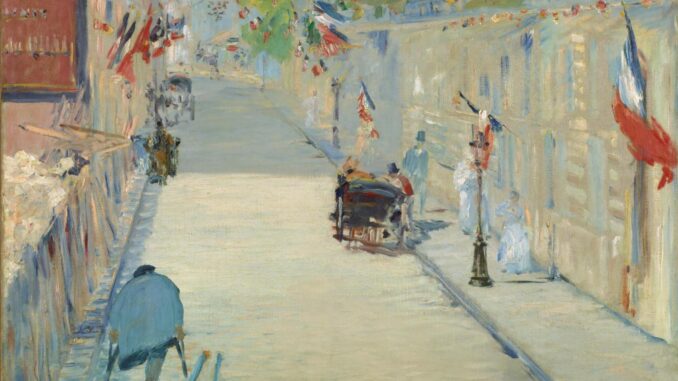
History has undertaken to show (there have been examples in recent years) that in complex human discourse they are compatible in terms of simultaneity or temporal proximity, terror and beauty, blood and poetry, hatred and imagination, salvation and creation, war and art. Que in cruel moments, flowers, genius and unrepeatable workssmart ideas, renovation of languages.
Paris in ruins
Sebastian Smee
Translated by Efrén del Valle. Taurus, 2026. 448 pages. €24.90
This contrasts with the dramatic valve Paris in ruins (Taurus), Sebastian Smee’s book (Adelaide, 1972) related the birth of Impressionism in a city marked by conflictdestruction, political and civil enfrentamiento and the recent memory of siege and violence.
In this choral story, Smee discovers two protagonists, Édouard Manet, a republican, admirer of Velázquez and Goya and a central figure in the Parisian pictorial landscape of the time, and the melancholic and tenacious Berthe Morisot, who was his pupil and model. The only member of the Impressionist group which opened a new chapter in the history of art with the famous exhibition of 1874 in the old studio of the photographer Nadar on the Boulevard des Capucines.
They are against the official art system and their annual, exclusive and reactionary salon. They want to describe the world in a different way, without asking, with freedom and urgency, without language or thematic theories, free from the styles of romanticism, classicism and realism. Huian de los asuntos históricosmythological and religious people to observe the life of a modern city.
Pintaban under the open sky, right above the bed. They founded the poetics of light and the aesthetics of volatility. They understood the ambiguous and seductive truth about the unfortunate and the transitory. There is a moving world full of ephemeral elements, on the verge of disintegration.
Manet and Morisot were against the official art system. I would like to describe the world differently, without asking, freely and urgently
The fourth part of the exhibited works belonged to the integrated group of Monet, Pissarro, Renoir, Sisley, Degas, Cézanne and Morisot. They were there the artistic offspring of Manet, the official leader of the groupwho preferred not to participate in the disturbing exposure and advised his friend who would soon join him. She who was in love with him and when she fell in love with her brother Eugène, disobeyed him.
At the suggestive intersection between art and culture history, biographical gender, and social and military history, this book transports the reader to a vibrant, tragic, and contradictory Paris. Smee, art critic and 2011 Pulitzer Prize winner, plantea the relationship between Manet and Morisot as the protagonist of the storywhich unfolds in a dizzying dynamic of slides in the political, military, artistic and sentimental spheres.
Berthe Morisot: ‘El Sena en Bougival’, 1884
After the terrible successes of 1870 and 1871 (The Terrible Year after Victor Hugo), the new painters “wanted to explore the physical world through color and light”. Paris emerged from chaos, and in the words of the author “we cannot interpret Impressionism with clarity without understanding the impact that this tumultuous time had on the main artists of the movement”. War, siege, civil enfrenteamiento. Light in the ruins.
It is the seismic, renewed and intense Paris of Victor Hugo, Courbet, Gambetta, Thiers, Goncourt, Haussmann. The end of the Second Empire of Napoleon III, whom Manet hated. City of Light and Darkness. The growing tension between France and Prussia resulted in war, declared shortly after the closing of the Salon in 1870.
As Zola noted, the people of Paris were in euphoria, but the French Imperial Army never arrived in Berlin. The Derrota de Sedan (national humiliation at the fact that the French built a mythology of patriotic valor) marked the end of the Second Empire.
The Prussians began their advance on Paris and prepared a siege while President Thiers attempted to maintain unity with the country in which the Third Republic had been proclaimed. Victor Hugo returned after 19 years of exile. Bismarck is the capital. Months of uproar, cold and cold, resistance, bombardments, hot air balloons and mensajeras Palomas. Not much, Paris was a city of pleasure and spectacle.
Berthe Morisot: ‘A orillas del Seine en Bougival’, 1883. Museo Nacional de Oslo
Manet, Degas and other artists joined the National Guard. Frédéric Bazille dies in a game against the Prussians. The Black Armistice of 1871 called for little less than the complete surrender of France. The population was torn between food and discontent. For the izquierdistas, treatment and peace terms are equivalent to a treat.
In this environment, the Central Committee of the National Guard occupies key positions and resides in the Hôtel de Ville as the de facto government opposite the Thiers government. It’s a municipality.
That was a coup d’état and what followed civil war. “It’s not easy to explain what City was,” admits Smee. “Basically it was an improvised city government”, radical and with little repetition. He counts on the support of Courbet, Manet, Degas and Morisot (who was his father’s favorite conservator).
París desangraba, while Bismarck followed amenazando. An urban war of immense crueltya city of the name whose situation caused “moral distress and sedition” in a foreign country. The recapture of Paris by Thiers’ forces began “a period of profound assessment that would last for decades” in an exhausted and weakened France.
Between the events of 1870 and 1871, which led to the destruction of areas in Paris, some artists (like Morisot) were slow to react. Manet suffered from depression. Very few people have tried to describe them. But in their paintings, they brought up as a sincere heartbeat in compositions that convey beauty and happiness, the feelings of “impermanence”, existential fragility and transience that recent experiences have evoked in the collective soul. Transience of light, human life, social relations, life.
Manet and Morisot intensified their participation and the return of painters such as Monet, Degas or Renoir to the art system and the rancid and authoritarian character of the Salon gave rise to the Société Anonyme, which somehow quería to relive the ideals of the community in the field of art. Another way to paint and see the world.
You are looking for alternative y On April 15, 1874, the first Impressionist exhibitions were inaugurated which were celebrated as early as 1886. Many Parisians avoided the performance for political reasons. The others were forced to return.
Leave a Reply