
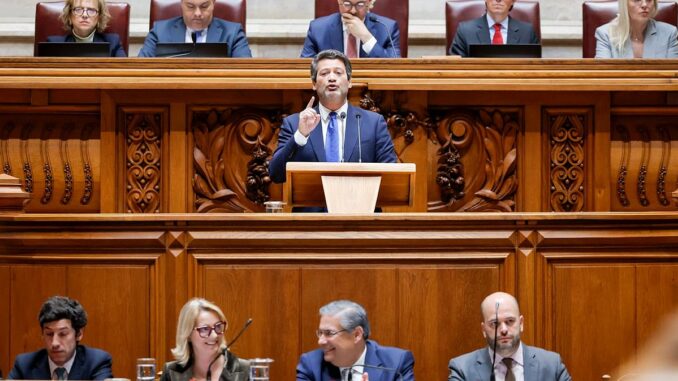
The Minister of Parliamentary Affairs, Carlos Abreu Amorim, reduced opposition parties’ criticism of the lack of measures to alleviate the impact of the war on the cost of living to “inconsequential noise”. In an urgent debate requested by Chega, and which began with André Ventura accusing the Government of preparing to raise another 50 million euros with the tax on petroleum products (ISP) in 2026the Government defended that it will not “follow the path of ease” and will maintain prudent management of an unpredictable crisis.
In a debate that began with the lead of the resources of Chega, the Liberal Initiative and the Left Bloc to the orders of the President of the Assembly of the Republic, José Pedro Aguiar-Branco, who did not allow for debate and voting on the legislative initiatives that aimed to change the minimum ISP limits and apply the intermediate VAT rate on gasoline and diesel, André Ventura accused the State of profiting from the increase in fuel prices. “Money that should be in Brazilians’ pockets is in the State’s coffers,” said the party leaderwhich contrasted the examples of Greece and Italy, whose governments took measures to limit the price of fuel and food.
“The country will not forgive if, while prices increase dramatically, this Parliament remains indifferent”, continued Ventura, who made a reference to the constitutional argument put forward by José Pedro Aguiar-Branco to not admit proposals – with the president of the Assembly of the Republic absent, on an official visit to China, it was vice-president Rodrigo Saraiva who led the work in the plenary session -, saying that “there is no brake rule that hinders people’s dignity and well-being”.
The parliamentary leader of the PS, Eurico Brilhante Dias, then intervenedwho not only responded to Ventura’s reference to the gypsy community, when he said that there will be no public housing for its members “as long as the Portuguese do not have decent homes” – “you may not believe it, but there are people of gypsy ethnicity who are Portuguese”, recalled the socialist -, but questioned the reason for the urgent debate scheduled by Chega.
“There is only urgency to try to make the Portuguese forget that the main culprit is their friend [Trump]whose inauguration it was”, said Brilhante Dias, adding that the Portuguese who go to the gas stations feel “the price of André Ventura and his friend”. Minutes earlier, the leader of Chega had admitted that “maybe Donald Trump is to blame” for the rise in fuel pricesbut countered that former socialist Prime Minister António Costa “has much more blame for the misery he caused to the Portuguese”.
In the remaining interventions, the president of the Liberal Initiative, Mariana Leitão, argued that the problem experienced by the Portuguese is as cyclical as it is structuralleading the Portuguese to “reach the end of the month counting pennies” for decades. For the party leader, the common denominator is “a State that consumes too much, allows little growth and appears as the solution to the problems it creates”.
Criticizing the Government for having limited itself to making “a small reduction in the minimum ISP limit”, continuing to “make money from the increase in fuel prices”, Mariana Leitão referred to her party’s proposal, which was not accepted by the President of the Assembly, to reduce the collection of this tax to zero, “if necessary”, to offset gains resulting from the increase in fuel prices.
With Filipe Sousa, from Juntos pelo Povo, calling on Parliament to “forget the brake norm”, and the communist Alfredo Maia defending control of fuel prices and the setting of maximum prices for bottled gas, the Government responded with the need to “choose between inconsequential noise and the consideration and sense of State” when Portugal is experiencing “hours of distress”.
Accusing the opposition parties of presenting “responses overflowing with precipitation”, Carlos Abreu Amorim highlighted that a few days ago the Minister of Finance, Joaquim Miranda Sarmento, made a proposal for the creation of a tax at European level on extraordinary profits of energy companies. And the Secretary of State for Energy, Jean Barroca, defended that “we are more resilient than we were in 2022” to “protect those most exposed”, ensuring that “it is not the State that is profiting from the war”.
This mention led to André Ventura questioning the Government for presenting in the context of the European Union a proposal to tax “profits that fell from the sky” that the PSD parliamentary group considered to be untimely in 2022, when it was presented by Chega in the Assembly of the Republic. Without a direct answer, the Minister of Parliamentary Affairs defended budget balance, “because it is from this that we can anchor the necessary responses to this moment of distress without putting our public accounts in danger”.
Centrist deputy João Almeida said that it makes no sense to question the relevance of the urgent debate, especially because “what one day seems taken for granted is called into question the next day”forcing the Government to have to “adapt the response to this unpredictability”. Representative of one of the parties in the coalition that supports the Government, he also said that none of the deputies involved in the debate demonstrated that the public coffers collected more tax revenue from the increase in fuel prices than the reductions applied to the ISP.
For your part, social democrat Emídio Guerreiro said that the government “has been acting, within the limits of its resources”, but warned that only a negotiated solution between the United States and Iran can resolve “the situation we are experiencing”. And, in this sense, he welcomed the ceasefire announced this Wednesday, lasting two weeks.
After blocker Fabian Figueiredo challenged the PSD to be inspired by what is being done by the Spanish government, instead of “leaving all the effort to Portuguese families”, and deputy Patrícia Gonçalves, from Livre, considers it “ironic” to see Chega speak out against the consequences of the war started by Donald Trump, Eurico Brilhante Dias took the floor again to recall that the then opposition leader Luís Montenegro said that the tax on excessive profits of energy companies was a demagogic measurewith the socialist parliamentary leader committing, even so, not to do to the Government “what the PSD did to the PS when it was Government”.
The debate ended with André Ventura quoting Pedro Abrunhosa, who is far from being the Chega leader’s biggest admirer, reminding Brilhante Dias that not only “you have to be calm”, but also “not to give your body for your soul”. This is to add that “the PS sold its soul a long time ago”, rebelling after seeing its bench present “measures that they were not able to apply”, even estimating that António Costa’s governments have not done a third of what they now demand from Luís Montenegro’s Executive.
Leave a Reply