
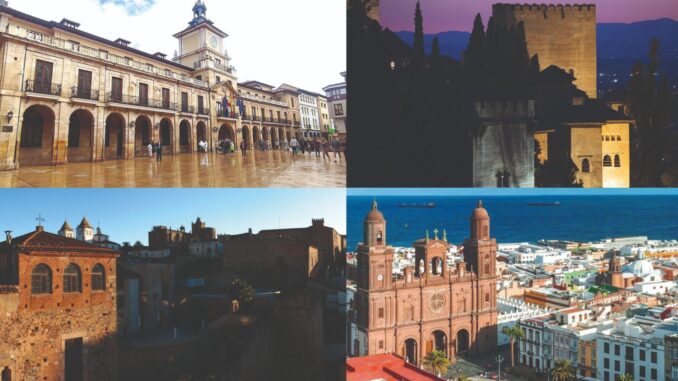
The Spanish cities of Cáceres, Granada, Las Palmas de Gran Canaria and Oviedo have been selected as finalists to become the European Capital of Culture in 2031, said the chair of the expert commission Tanja Mlaker, who announced the event.
The appointment was made by a commission made up of six independent international experts: those appointed by the European institutions involved in the European Capital of Culture and two Spanish experts appointed by the Ministry of Culture.
The selected citizens will have to take new months to perfect their candidacy and the commission will want to meet again next December.
In his speech at the Ministry of Culture, Mlaker praised the “passion and compromise” presented by the new candidacies: Burgos, Cáceres, Granada, Jerez de la Frontera, Las Palmas de Gran Canaria, Oviedo, Palma, Potries (Valencia) and Toledo.
Granada
Lave is the emblem of Granada’s candidacy. A reminder for one who can be honored at the Puerta de la Justice, a Nasrid symbol that is associated with access to the Muslim paradise. And this is one of the strongholds of the city’s unique historical and cultural heritage. But there is much more, as Marifrán Carazo, mayor of Granada, explains: “With the Alhambra group at the head, we live every day just like flamenco. We are home to great musicians like Manuel de Falla, universal poets like Federico García Lorca, without forgetting all our Christian history, Arab, Jewish…”. Combining the present and the past, we find the University of Granada, one of the most prestigious training centers in Europe and the focal point of the candidacy.
It will arrive in 2031 on the fifth century. On paper, as a promoter and disseminator of knowledge, he is the real reason for the Granada lemma. “It’s a project of the future, because it’s not just about presenting advantages to those we count on, but rather about designing a project to transform the city into a short, medium and large area,” assures the mayor, who is thinking, among other things, about integrating the AVE into the city. Meanwhile, Granada began to teach the world with cultural events such as the Goya gala or the inauguration of the Flamenco Bienal.
Oviedo
The territory, which has been recognized three times by UNESCO for its heritage (thanks to its pre-Roman monuments, cider culture and Camino de Santiago routes), is now up to the task of recognizing its capital as the epicenter of European culture in 2031.
And that is why the entire principality has been transformed by the initiative, which will have its headquarters in Oviedo, but will count on activities distributed in different places of the autonomous community. Ayuntamientos like those of Gijón, Avilés, Siero, Mieres and Langreo have shown you their willingness to actively participate in the project.
Shepherd’s fiesta. Photo: Irma Collin.
According to our follower Natalie Álvarez Simó, artistic commissioner of the candidacy and former director of the Centro Condeduque, the city of Asturias will present itself with a program in which diversity, transversality and interdisciplinarity will be the protagonists and “where everyone will gravitate towards the space”.
The candidacy is presented as a future plan in which the association seeks to “update the articulation of its cultural structure”. “Our vision – asserts Álvarez – extends to a legacy beyond the year 2031, which will soon emerge in a new cultural paradigm.” All this was done with the aim of Europe and is part of the European tejido. De ahí su lemma “Puxa Europa”, in which they reinterpret the traditional “Puxa Asturias” and give it a European touch.
Cáceres
The marriage between nature and historical heritage is the hallmark of the Cáceres property. The candidacy that, according to Iris Jugo, coordinator of Cáceres 2031, “was born from the whole territory, not just from the city. We are a capital that is being built internally in Spain, in dialogue with Europe, and which is based on a very strong idea: that culture can change the destiny of the territory”.
A project that is formulated on the basis of the transversal concept of “Transculture” and that is organized in three great ways. “Terra: a culture that is born from what we are, from our heritage, our knowledge and our biodiversity. Camino: culture as travel, learning and openness. Cáceres as the core of historical routes and as a bridge between the countryside and the city, between Spain, Portugal and Europe. Cycle Y: culture as transformation, sustainability, creative economy and innovation,” explains the coordinator.
And precisely that in this city, a first-class historical-cultural offer such as the Helga de Alvear Museum, the Ruta de la Plata, the Old Helmet – declared a World Heritage Site in 1986 – or the Teatro Romano de Mérida – which joined the project, as well as 40 others throughout the region, are the natural landscapes of areas with natural sites such as de Monfrahegé or de Monfraheg.
Las Palmas de Gran Canaria
Only one out of every twenty Europeans is an Islander. This exception is Las Palmas de Gran Canaria, one of the two candidate Spanish island cities. The information and status of the Canary Islands as a European outermost region (RUP) lead to the technical team of the candidacy for to re-emerge as part of a different Europe: “Rare islands are now at the center of the story, so we ask ourselves: will the island and the remoteness of the periphery allow us to think about a more connected and resilient culture? Our initiative seeks to rethink Europe from the margins.”
In this way, the Canarian city claims to repeat a story that relates to the past in the Aegean islands: “A possible capital shared between Las Palmas de Gran Canaria and the city of Malta opens up the opportunity to highlight a diverse and interconnected cultural force for future hope in the European Union”.
The birthplace of the bastion of Spanish letters Like Benito Pérez Galdós, Las Palmas de Gran Canaria, with this candidacy inspired by the New European Bauhaus, proposes to “integrate art, culture and knowledge into people’s lives. It is an invitation for citizens to update traditional ways of life while experimenting with new ways of urban life”.
Leave a Reply