
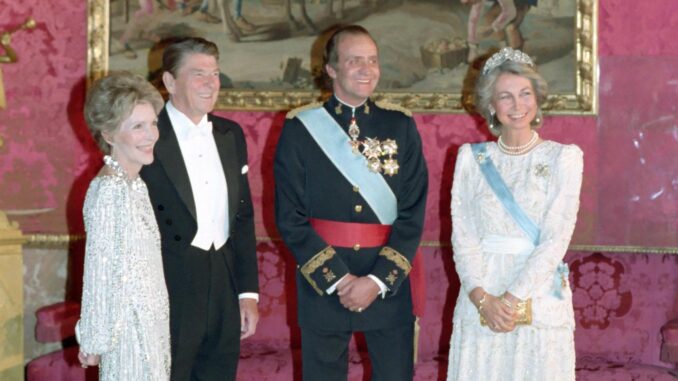
Charles Powell (Madrid, 1960) has an extensive academic career in Great Britain and Spain. The transition and the character of King Juan Carlos occupy their investigation. Currently, any front-seat study is controversial, and Powell is well aware of that. His position is historiographically solid because he tries to explain paper king during the international complete phase without hiding the faults and scandals of the monarch.
King Juan Carlos I and projection outside of Spain
Charles Powell
Translated by Eva Rodríguez Halffter Galaxia Gutenberg, 2026. 632 pages. €34
The Spanish-British historian used sources preserved in the official archives of Europe and the United States, together with memoirs or diaries of Spanish and foreign personalities who were related to Don Juan Carlos; of asymism, the investigation is supported by a rich secondary bibliography. Overall, the author has prepared an extensive and detailed text.
He claims to seek a better knowledge and understanding of the leadership and political views of Don Juan Carlos, marked by his instinct or what was popularly called “campechanía”. It could be compared to Powell’s arguments, which we are actually getting ahead of a survivor accustomed to hostile contexts from a very young ageSince Franco’s time, the institutional establishment of a new democratic regime has been established.
The historian is clear when he does not enter into assumptions about the character of the king until he is able to trace the nature of his participation in Spanish diplomatic activity.
The first thesis is that Don Juan Carlos began to act externally in politics when he was named Franco’s heir. It is clear to Powell that since 1969 the Spanish prince has had in his mind the need for Spain to create a democratic system. It was not clear when or how this radical change occurred.
Therefore, the author prudently warned that the young don Juan Carlos was paying attention to a specific plan and did not attribute to him the status of an occult democrat. Only an adventure that, from the first moment of the trip, allowed the prince to establish contact with the leaders of the European democracies and the administration of the EE.UU. and the cultivation of personal and political ties, the basis for which special diplomacy, both informal and institutional, would develop.
Powell presents a rigorous study of the foreign policy practiced by the Royal Honorary
The influence of the international context was intense, conditioned by the French war. North American support, recognition of the European powers, negotiations on joining the EEC and OTAN, and the impetus to consolidate the Ibero-American Commonwealth of Nations were important. All these people are converted into the cause of the state jefe. The sovereign applies to these negotiations, as well as the ratification of international treaties and the resolution of broken (Mexico) or non-existent (Israel) bilateral relations.
The approval of the constitution limited the legal powers of the monarch and above all his manipulative power was more overshadowed by La Moncloa’s personal relationship with La Zarzuela. The tacit agreement was this the king takes over the extended parcels of external representationuntil the law reserves the competence of the government. Powell is clear that this game required a fluid relationship between state and government, as was the case during the presidencies of Adolfo Suárez and Felipe González.
Finally, Powell introduces a rigorous study of foreign policy as practiced by an emeritus royal. The author does not hide his sympathy for Don Juan Carlos, but he does little to hide the scandals that robbed him of his popularity. Juicio, with which I confide to the reader.
Leave a Reply