
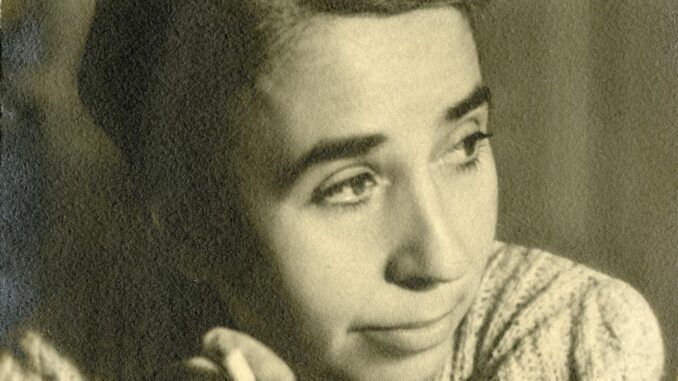
A librarian originally from Medina de Pomar (Burgos) to transfer to him the only Spanish citizen raised by the American Activities Committeenothing in the biography of Ernestina González Fleischman interests. She was a graduate of Unamun, confidante of Buñuel, Dalí and Lorca, companion of Victoria Kent in the student residence and active propagandist of the anti-Francoist movement in New Yorkwhere he was investigated by the FBI on various occasions.
It was an article from La Vozrepublican periodical that existed in New York from 1937 to 1939, which I gave to Ana María Díaz Marcos, professor of Spanish literature at the University of Connecticut, after the example of this woman who gave a speech on December 19, 1937, entitled Mujeres a la lucha at Teatro Royal Windsor de la Gran Manzana. In González He called for the active inclusion of women in the game against fascism“not with romance, but with reality, for a better life, for freedom, bread and work”.
A combative and compromising woman who came to New York to meet Leo Fleischman—the first North American volunteer to die in the Spanish Civil War—was also a great mystery about which virtually nothing was known. “I was struck by the power of his discussion and decided to investigate what happened to those words. There were also so many Spaniards going to the theaters in Manhattan at that time. And the moment I moved a little further, I came across a photograph from which I appeared to be leading a demonstration of three women who had come to Washington to ask for an arms embargo and that the democratic states would help Spain.”
What started out as a small blog entry eventually grew until it was converted to engrossing book who managed to publish Renacimiento under the title Ernestina Gonzalez. The anti-Francoist impulse. A possible biography, thanks in part to declassified FBI archives for those who entered the cathedral.
Friend of Generation 27
Díaz Marcos points to various reasons to explain that the life of this woman, who lived on the outside against the Franco regime and was the protagonist by sending articles to the press, simply crossed the line. “For me, I was exiled for twenty years to the United States, but it was because they were also exiled from there during MacArtism. They combine in a series of circumstances that make it impossible for us to overcome it and in Spain – he comments on it from now on the American continent by telephone -. In fact, the one who was a woman and who, given that he is a journalist, could not be his novel speaker, painter or activist.”
Author of the book “Ernestina González, the anti-Franco impulse” (Renacimiento).
no embargo, Nothing in this woman’s life looks boring. The librarian and journalist Ernestina González began her studies at the University of Salamanca, where, after her mother María Luisa, she seemed to be associated with the Hijas of Unamuno, but after a short step from the Castellan city, she moved to the University of Madrid. Graduate of Residencia de Señoritaswhen she joined the team of Lorca, Buñuel, Dalí and José Moreno Villa, she joined María Luisa, at the same time as Victoria Kent, preparing her views as a librarian.
“Buñuel recalls in his memories that Ernestina was the only woman who was ordained as a member of the Foundation of the Order of Toledo, with whom she went to the city from the end of the week without being able to play theater, sing, drink or eat out of pocket,” says the catechesis, who also shares a funny anecdote with the filmmaker, the filmmaker and the filmmaker from his end of the night.
However, some of these friends with time and the ideological compromise of Ernestine, who I have never forgiven Dalí for his opposition to Franco’s regimewhich leads us to say: “The artists who applauded the assassination of Federico are the tonadillera known for ‘Argentinita’, the painter Salvador Dalí and the pianist Iturbe”.
This fragment, according to Díaz Marcos, “comes from an article where Ernestina stands against the reason why they represented The Café de Chinitas – a popular song about a local Malagan myth that Lorca harmonized in 1931 -. She maintained a friendship with Buñuel, but with Dalí, although it is certain that they were many young friends in Madrid, he continued.
Political despair
After living in a student residence and spending some time in Paris researching an undefended doctoral thesis, the young woman became a Spanish lecturer at the University of Lincoln in Nebraska. “But Lincoln felt that in those years it was smaller than Salamanca, and life in such a small town might not have worked very well because you were in New York that year,” comments Díaz Marcos, who describes it based on an FBI report. “a young girl who smoked in her dorm and attended parties”. It was there, on Gran Manzana, that he met Leo Fleischman, a mining engineer, whom he married in 1932.
However, I still don’t have to fear my more militant spirit. “Neither she nor her husband were very ideological until they changed in Spain. They were involved in the Republic, in the Popular Front, including the Asturian Revolution in 1934, where they were covering for French journalists to tell the story of repression among the revolutionary mines.”
However, it was among the tragic failures of her husband, the victim of an explosion in a city factory in 1936, when he began his most active career as a librarian who, animated by his wife and cousin, traveled again to New York to work in activism and propaganda against the Franco regime until his death. “Sabémos, Lt tracking those who held part of the FBIwhich were often discussed with humanitarian organizations and with congresses”.
And this has been done smoothly and efficiently enough over the course of two decades. “Everyone insisted on his charisma. In the 1940s, journalist Joseph broke away from him “car de ametralladora”. She was a very slim and not very tall woman, but the whole world decided that she had changed. Five times bigger when he took the podium and started speaking in favor of the republic,” he explains.
It is strange that thanks to your age in the United States, which today holds rather González. The Un-American Activities Committee judged that it refused to share documentation on donors to the Republican cause, the first to what ignited the cathedratica tuvo was a verbatim transcript of that juicio. “She shows tremendous courage and is not loved, including questioning the relevance of the questions.”
“We’re talking about 1946, but she’s been tracked ever since,” says Díaz Marcos, who, encouraged by his companion, requested his archives from the FBI. “How surprised I was when 600 folios of the declassified document turned up 15 days later. It was only 40 pages long. It was being investigated for a huge medical case at the time, involving a murdered person that was being talked about by all the people affined to a group of people in New York.”
Juzgada por el Macartismo
The cathedral thus discovered that Ernestina had been under almost constant surveillance since moving to the city, partly because of her relationship with communists and union leaders. “In various ways I got certain insights that brought me into a more international world because of the concerns that existed about possible Soviet espionage in the United States. It was a circle of people who fought in the Spanish Civil War against certain groups of the Izquierda, who exchanged with people from Mexico and from the Soviet Union, where Ernest’s mother was also living at the time — where another possible biography is being worked on —.”
A sea like a sea, a juicio before the Comité de Actividades Anti-Americans, granted González and his friend Manuel Magaño the special distinction of being “Spanish naturalized Americans brought to Juicio, summoned to make a statement in Washington and who were sentenced to three months in prison, tras refusing to present documentation of donors and other fugitives”.
“Both, like the rest of our comrades convicted of this case, have agreed to offer their documentation to the government or the Citizens’ Society, but not to the Committee, because with the bruge crowd, humbler people could potentially have the same problems as them. Remember, many faced enormous problems living and working in the United States after serving time in prison.”
“It is a crime to aid and defend the victims of the fascist Franco, who, with the help of Hitler and Mussolini, destroyed all of Spain, harmed a thousand citizens and destroyed the democratic institutions that are so guilty,” he declared in a press release for all three of them, all men and women. five women who were part of this select group.
For this reason, González he went into exile in Mexico, from where he continued his support of Republican prohibition before returning to Spain where he failed in Madrid in 1976.
Leave a Reply