
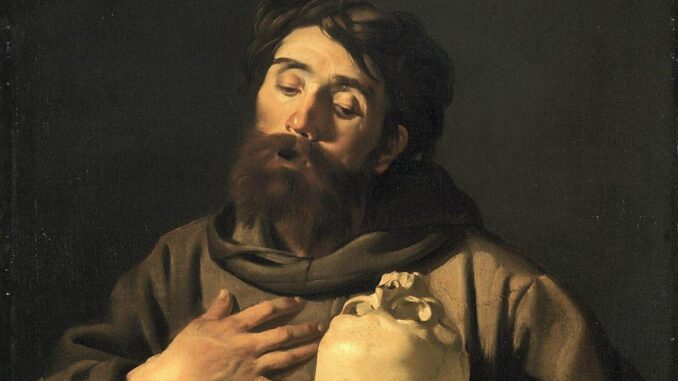
Tradition says that in 1206 it hijo de un rico mercader de Asístwenty-year-old Francisco, stole a bundle of money from his father, went to Foligno – barely twenty kilometers away – and sold him the goods for a considerable sum. On his return he donated the money to the church; specifically to the poor clerigo of San Damiano who took care of repairing the temple. Furious at the disappearance of his dreams, his father sent him after him. But Francisco hid in an abandoned wine bar, from where a friend secretly fed him during the rededor of the month.
San Francisco de Asis
Jacques Le Goff
Translated by Eduardo Carrero
Akal, 2026
216 pages. €18
Then the young man decided to step in and take responsibility. Their paisanos, to the democrat and dirty verl, took them back to the place: they made fun of her and threw bars and stones at her. upon entry, the father went looking for him, grabbed him and brought him to his house. But a few days ago his compassionate mother freed him; He fled to the bishop’s house, where he revealed his irreversible inner transformation: he learned everything he had, gave up his clothes and preached his renunciation naked.
With that gesture, the future saint saddled up separation from the world, which was considered to be plagued by vanity. The conversion was completed in the following two years: first to besara hare; Later, in the chapel of San Damiano, the voice of God said to her: “Francisco, repair my house, which, as you see, is in ruins.”
According to his early biographers, it took Francisco a while to fully understand the sense of his persecution. I should have it the hermitage of Porciúncula, “the most quería place”, today considered the cradle of the Franciscan movement. In this humble speech I asked the priest to read the 10th chapter of Matthew where Jesus prescribes material renunciation – in gold and silver, but also in anything other than tunic and sandals – and invites you to come home and enter it.
At this time, 1208 or 1209, Francisco chose a single tunic, the roughest and most revolting cloth, which contained a cord and a crucifix, and he turns into a missionary. “Había naacido Francisco”, describe Jacques Le Goff (1924–2014) at the end of the episode description, “and I cannot give birth to Franciscans”.
Editorial Akal now, in anticipation of the celebration on October 3, the 800th anniversary of the saint’s death, restores the main texts dedicated by the prestigious French medievalist one of Christianity’s most charismatic and influential figures.
The book includes four independent studies, written at different times, that deal with San Francisco’s personality and legacy from different perspectives: the first, from 1981, analyzes the historical context in which his character arose; the second, from 1967, forms the core of the book and the details biography of the saint, simple and instructive; the last two, published in 1973 and 1981, of a more specialized nature, added vocabulary and cultural models of the XIII centuryand a critical analysis of the main biographies of the saint, all of which are conditioned by the cult of his person.
PUSH critical approach to ancient texts It is the most interesting part of Le Goff’s analysis, it can allow us to read the Franciscan legacy at the same time and to distinguish with some clarity between truth and propaganda. Three phenomena, highlighted by the historian, were decisive in the orientation of Francisco de Asís: “The life of the classes, the rise of the laity and the progress of the money economy”.
Francisco, a merchant’s boy, was socially situated between the popular classes, to which he belonged by origin, and the aristocracy, with which, thanks to family wealth, he shared his culture and way of life. According to Le Goff, esto le hizo “particularly sensitive” to social and political conflictsfor the same person participated before his conversion.
San Francisco has lost its wisdom, believing that science is, according to Le Goff, “a form of posture”
Without this biographical context, one would not understand, for example, horizontality In this discussion I directed everything to the laity, but they gathered ricos and poor people, nobles, people of more or less culture, merchants, kings, princes and even children. “The Saint is here, the Saint is here,” he cried in the squares before he appeared; and as soon as the apparatus was there, the crowd sought to see it, touch it, and listen to it.
Francisco experienced a period of profound change in his mentality. In addition to the use of money, the division of labor and the salaried employee were expanded. With the normalization of money came an energetic connotation (although over time the Franciscans adapted and integrated its use within their own order).
Fundador de los hermanos menores supported it absolute begging (“the sublime summit of this extreme poverty, which has made you, my strangest hermanos, heirs and kings of the heavenly king”, he wrote); to the votes of the people we added to the vote obedience and chastity. On the other hand, he asked his followers, as Jesus did in the Gospel chapter he learned in the Portiúncula: who leave their family and join the family.
Even if the work is written – very little in fact: two rules Willcards, prayers, some liturgical texts – the Italian saint brought his missionary cases exclusively by example and, like his brothers, devoted their lives to itinerant preaching. EN 1219, he took him to Egypt for missionary work, in full fifth crusadefrom where he reunited with Sultan Al-Kamil.
There are no university inquiries in these lines. I despised books, incompatible with their juicio, with the practice of the poor: they were very expensive, and anyway they were not considered labor farmers, in which case they had a job (artisans had the right to do what was necessary to do their work, even if they could not be paid according to the exchange rate). Desconfiaba de los sabiosPerhaps he believed that science, in the words of Le Goff, was “a form of posture and learning, a particularly terrifying type of power”.
Knowledge was the source of “orgullo” and “dominion”. poder intellectual, contrary to the mandate of ser humilde. Over time, without embargo, as with other aspects of his doctrine, he retreated and relied on the wisdom of those with whom he consulted; of asymism, the order was not long in coming and represented the coexistence of the most ardent Franciscan spirituality with enormous wisdom, as was the case in Ramón Llull or Roger Bacon.
When Francisco came as a model for Christ, that is for God of God, “he gave his highest ambitions to humanism”
The question of obedience illuminates a key aspect of Francisco’s personality, who always hated power. While the soldiers must obey the prelate (a condition which is always required for the same), they should refrain from any order. against the animay prelates are bound to humility ya fulfills its function “how to wash cakes by hand”.
Like other church revolutionaries, it was a mixture of progress and reaction. He was irritated by the vulgar word – he wrote a lot in Italian – during the time of Latin dominance and here in the integrated church. His no-embargo interpretation of the gospel was, says Le Goff, “significantly reactionary”. For Francis, for the Franciscans, the Gospel, the New Testament, was the foundation of everything.
With a momentary intransigence in heresy – obvious to the Curia and more than a thousand years of Christian tradition – the Franciscans advocated a “return to the sources”. protection of “core values” before evolution. I say this, Le Goff, clearly fascinated by the figure of the saint, without anyone hiding innovations in purity, was Orthodox. Having become a model for Christ, this is for God God, Francisco “transferred his highest ambitions to humanism”.
On the other hand, he went to the Islamic monks to abandon the temptation of solitude and force himself into the center of “living society”, into the cities and squares, where he preached more often. By projecting a positive ideal of love for all creatures and creatures – God is in all -, he transformed the previous sensibility and monastic tradition, which became even sadder, including masochistic. So, for the joy of being “the poorest of the poor”. poor man Take a thousand years to be one of humanity’s guides.
Leave a Reply