
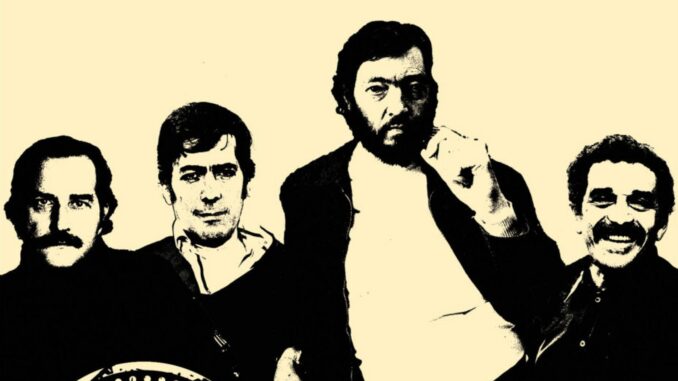
A year ago, in an interview in the North with various writers and writers, we started talking about literary relations between Latin America and Spain. For me, I always think about this nonsense from the beginning. First of all, there are ten new countries in the Americas that write Spanish, we are one on this side of the Atlantic, and after all, because we are born to our father, whether this country or a literary tradition, it is always a great and complete act of tradition.
And there he lives and lives, whether he wants to or not. Here I decide that it is necessary to think about the internal structures that make us think on the other side as a whole, historical or literary, we require strength and high doses of desire to connect to color.
Later, a Spanish author said that there, in her vast and heterogeneous extension called Latin America, she was interested in authors from there, and an Argentinian author said that she was not interested in her country. They were builds something irreconcilablewho knows why he was going through the experiences but it’s something I’ve been thinking about some days and traveling with these books to save miles upon miles of ocean and some abysmal fossils.
What are the terms of this comparison? What is the reason for interest or lack of interest? I wonder, from Madrid, is a Mexican more interested in a book by a Chilean than a book by a Spaniard? Can this country now be a counterweight to what is being created and restored in others where the same language is written? My provisional answer to this last request is: no. Or not enough, even if it means only decompensation.
I think of all the Latin American authors I’ve read in my lifetime without paying attention to their specific origins. First, aquellos del boom that blew my mind when I was a teenagerpages and verses learned by heart that we wrote about other distant and different worlds, and that in the same words they reveal new forms that correspond with freedom to castle norm and realism. I wrote the authors because the above authors came to me later. And now, when I get my hands on the works of contemporary people, that they are now writing the same, and that they are translating the totality of what is happening in their territories, in all of them, into new narrative and poetic forms.
Sharing language is a profound way of sharing the world. And that has a serious weight on any identity
Don’t worry about making yourself more uncomfortable in an interview that asks you for literary references. Because I’m not an immovable private canon and I don’t want to leave anything else. Writing continues over the years and they are not the same authors and authors who tracked down the details of the first book that will now accompany you. Querying the initial reading as it was originally written meant that I would never have to make any transitions and that the writing always required reading, not just the classics.
So that if I was targeting others, and in summary, so that I don’t look like an ignoramus who doesn’t know what to say, I tried to do some revision. Y they pull the roots out of my wordsone is transatlantic and the other is here, more to the north, in this other territory called Europe, of which here, in artificial form, I also feel another part, although the literary translation of Spanish works is very elusive, so that it seems almost reciprocal.
But I cannot deny that sharing a language is a profound way of sharing the world. And that has a serious weight on any identity. The person you write is the person you look at and see. Ojalá podamos break something more fronteras that we shall ever enter this island of Barataria and open a channel and further develop our ideas, our plots, and our forms.
Aroa Moreno (Madrid, 1981) is a journalist and writer. He debuted as a narrator with Hija communists (Caballo de Troya, 2017). On the latest book, e.g Mañana matarán and Daniel (Random House, 2025).
Leave a Reply