
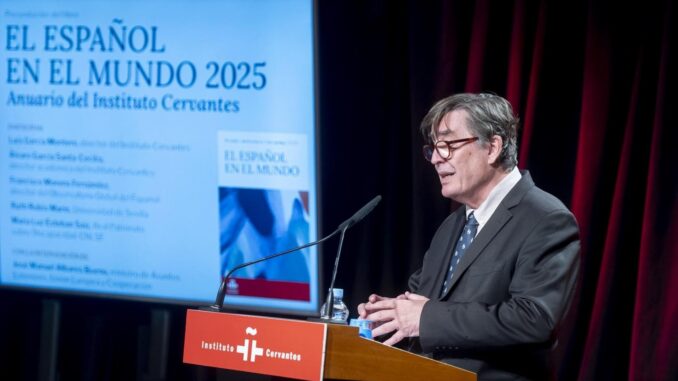
Spanish institutions founded for the defense and promotion of the language, the Real Academia and the Instituto Cervantes.
Title: El español ascena. Analysis of its international promotion and new proposals
authors: Javier Serrano Avilés, Jesús Fernández González, David Fernández Vítores and Rebeca Gutiérrez Rivilla
editors: Editorial office of the UJA
Release year: 2025
Available online Editorial office of the UJA
Available online Unebook (digital edition)
Although the virulence of the fight between Luis García Montero and Santiago Muñoz Machado surprised the inappropriateness of the moment, it shed light on a number of issues that the teachers Javier Serrano Avilés, Jesús Fernández González, David Fernández Vítores and Rebeca Gutiérrez Rivilla analyzed in El español ascena, a comprehensive study that analyzes the Spanish language as an international language and more specifically those who demonstrate public institutions as promoters and spreaders of our language in the context of their foreign language learning.
The best part is that the authors recall from the beginning the euphoria that usually accompanies the dissemination of data on the expansion of Spanish in the number of words, a lot of affirmations that emphasize that it is “the second mother tongue of the world!”, “maintains unidas a más de 600 million people”, “studying” or “the second language of international communication” 2 million people no such anecdotal circumstances are celebrated as “the unstoppable rise of reguetón places in the world, which are to be told in Spanish”.
On the contrary, Serrano Avilés, Fernández González, Fernández Vítores and Gutiérrez Rivilla they condemn data failure or insufficient data reliability taking into account other parameters, such as the number of people who study it as a second language, the number of primary schools, universities and non-registered schools, the education of their professors or the level of study in each case.
Yes to this addition”the possibility of a more operative structure in Spanish institutions – and also Hispanic Americans – whose mission is to promote and spread the language, as well as the absence of a pan-Hispanic policy in this sense, more than the legislation proposed by the Royal Spanish Academy and the Association of Academies of the Spanish Language, the panorama seems much less worrying. Also interested in this volume, which updates the available information and suggests effective alternatives and new plans to solve the problems of entendimiento inside the institutions.
Tras detenerse en las the actual number of students studying Spanish as a foreign language (ELE) and in the number and composition of professors, the authors divide the conjuncture of countries of the Spanish-speaking world into three large groups: countries with low, medium and high ELE institutions.
“The basic criterion for determining this distinction is the absence, partial and recent presence, or consolidated presence of Spanish in secondary public regulation. It is thus possible to draw up a relatively elaborate map presence and perspectives of Spanish as a foreign language. But it would be necessary to delve into data collection to make the photo clearer,” they point out.

The director of the Real Academia Española and the president of the Asociación de Academias de la Lengua Español (ASALE), Santiago Muñoz Machado (left) and the director of the Instituto Cervantes, Luis García Montero (right). Photo: Europa Press
The authors, who in this complete volume include the situation of Mexico, Argentina, Chile, Colombia, Cuba, Equatorial Guinea and Peru, i.e. countries where Spanish coexists with native languages of very significant vitality and position, emphasize the importance of the Aztec country for the relevant UNAM initiatives in the context of ELE and say that “I will not be more also stimulate these areas of cultural diplomacy in which Mexico is particularly strong, as well as in the book sector, such as the Guadalajara Book Fair, the most important in the Spanish world, and FCE, the emblematic editorial that has revolutionized Latin American thinking since the 1950s.
In addition, it is clear that Spain needs to reposition its external action in the context of Spain’s internationalization: “For this reason, it would be necessary to create a structure or protocol in the Spanish public administration that allows global country strategy managementwith the aim of not only coordinating but also organizing and rationalizing the industry”.
Furthermore, they consider it necessary that the government joins the task proposed a national strategy for ELE’s external action plan coherent actions based on good data analysis and check how each drug works. This plan will tend to include clear self-evaluation indicators and systems, self-evaluation indicators and mechanisms.
This first phase of the strategic proposal, focused only on how Spanish institutions promote ELE, should be more closely linked pan-Hispanic multilateral dimension which allows you to communicate and coordinate with all interested Spanish countries.
In this line, we also tend to engage in the Spanish strategy of international cooperation for development, p projects perform other administrations in the summer with universities that have ELE departments and with the Ministries of Education of the Spanish countries, with ELE associations and in cross-sectional form with the initiatives of other actors in the private sector.
Leave a Reply