
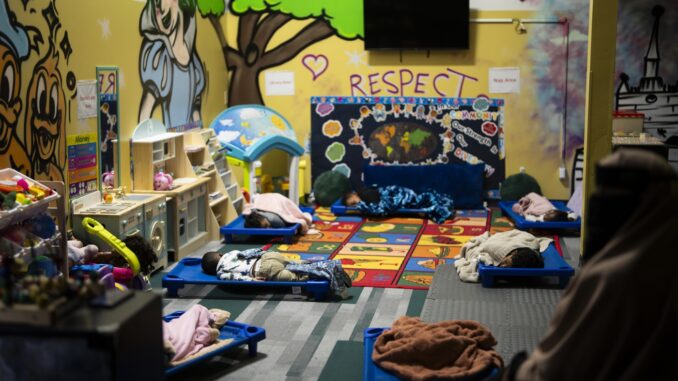
Children sleep during naptime at Minnesota Child Care in Minneapolis on Dec. 30.
Renee Jones Schneider/The Minnesota Star Tribune via Getty Images
hide label
switch subtitle
Renee Jones Schneider/The Minnesota Star Tribune via Getty Images
US Department of Health and Human Services announced Monday that he will roll back a number of Biden-era rules that govern one of the largest sources of federal funding for child care. The move comes less than a week after HHS confirmed it had frozen all federal funding through the same program.
The Child Care and Development Fund (CCDF) sends money to states, tribes, and territories to help make child care more affordable for low-income families.
The Biden administration’s rules encouraged states to base payments to child care providers on enrollment rather than verified attendance, pay providers up front and prioritize guaranteed slots with providers over vouchers.

HHS now says it plans to restore attendance-based billing, no longer require providers to be paid in advance and change the priority of vouchers.
“When controls aren’t in place, bad actors can bill for children who aren’t there,” said Alex Adams, assistant secretary for family support at HHS’s Administration for Children and Families. “Families and taxpayers deserve proof that services are being provided to children.”
But child welfare advocates told NPR that states already have many controls in place to prevent fraud.
“We know it’s true that there are longstanding program integrity requirements that are in place and are updated regularly, updated annually,” said Susan Gale Perry, CEO of Child Care Aware of America., which helps families access affordable childcare across the country.
Around 1.4 million children and 857,700 families received childcare assistance through the CCDF per month in 2019, according to the latest figures published on HHS website.
Melissa Boteach, director of policy at Zero to Three, a nonprofit that advocates for infants, toddlers and families, said the proposed policy changes create “chaos and confusion” by removing provisions that were intended to make the child care industry more stable and affordable.
This comes after a funding freeze announced over the holidays
Monday’s announcement comes days after HHS said it was freezing federal funding provided through the CCDF.
HHS spokesman Andrew Nixon told NPR on Wednesday that the agency would freeze CCDF funding effective immediately, and said the agency would release funding after states provide certain “administrative data.”
“Many of the states that have to administer these programs are still not clear on exactly what that means.” Boteach said. “And this ambiguity has real consequences for families and for early educators.”
She also said “it wasn’t clear whether funding was coming or not, what needed to be done to turn it back on, and what states were supposed to do in the meantime.”
HHS has not yet responded to NPR’s request for clarification on how Monday’s announcement relates to the funding freeze.
“What we do know is that childcare providers work [a] very thin … profit margins,” said Perry of Child Care Aware of America.
She said going “even a month” without funding could result in childcare centers closing – impacting both children who benefit from CCDF funding and those who don’t.
Focus on child care providers in Minnesota
The recent focus on federal child care funding comes in response to allegations of fraud by day care providers in Minnesota.

As NPR reported, the day after Christmas, right-wing social media influencer Nick Shirley released a video he claimed showed Somali-American day care workers defrauding the federal government out of millions of dollars. The video doesn’t offer clear proof, but it has gone viral.
On December 30, HHS Deputy Secretary Jim O’Neill published on about “serious allegations that the state of Minnesota has funneled millions of taxpayer dollars into fraudulent preschools across Minnesota over the past decade.” He announced moves “against the blatant fraud that appears to be rampant in Minnesota and across the country,” including requiring “substantiation and certification or photographic proof before we send money to any state.”
In an HHS announcement Monday, O’Neill said, “The reforms we’re putting in place will make it harder to commit fraud.”
According to HHS, the rule changes are subject to a 30-day public comment period.
Leave a Reply