
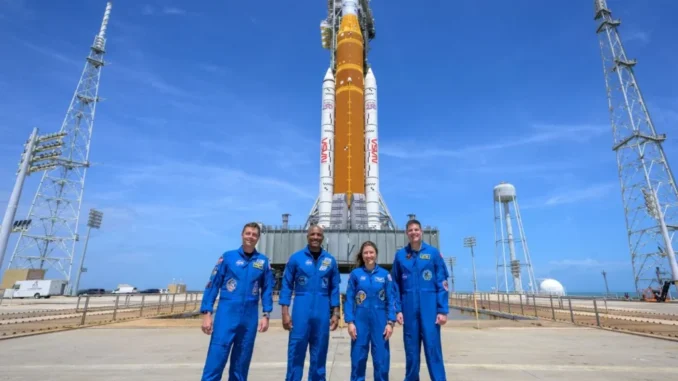
Four astronauts take off this Wednesday towards the Moon in the first manned mission to the natural satellite in more than 50 years, marking the beginning of a new era in space exploration.
The Americans Reid Wiseman, Victor Glover and Christina Koch, along with the Canadian Jeremy Hansen, will star in a 10-day trip that will make history in three ways: it will be the first time that a woman, an African-American astronaut and a non-US citizen participate in a lunar mission.
The Orion spacecraft will travel 384,000 kilometers—a thousand times farther than the International Space Station—to fly over the Moon without landing, replicating the trajectory of Apollo 8 in 1968. During the flyby to the far side of the satellite, communications with Earth will be interrupted and the four will become the human beings who have traveled the furthest from our planet.
“We are returning to the Moon because it is the next step in our journey to Mars,” explained Wiseman, mission commander.
The crew will tackle technology that the Apollo 8 astronauts would have considered unimaginable. While that mission flew with “the electronics of a modern toaster,” according to Harvard experts, Artemis II’s computing system represents an exponential leap.
But risks remain. “We don’t accept anything less than perfect,” warned Peggy Whitson, NASA’s former chief astronaut.
The Artemis program seeks to establish a permanent lunar base as a platform to Mars, but faces pressure from China not getting there first: Beijing plans to take humans to the Moon in 2030, while Washington aims for a lunar landing in 2028. The rocket.
Leave a Reply