
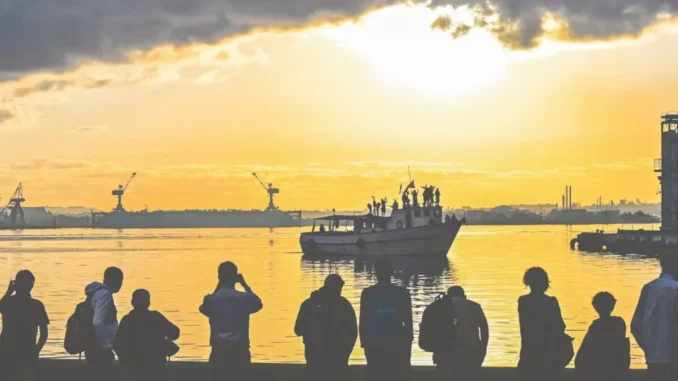
Around four in the morning on Tuesday, Mexico time, the Russian oil tanker Anatoly Kolodkin docked at the port of Matanzas with 730 thousand barrels of crude oil on board, the first energy shipment that Cuba has received since January.
You may also be interested in: Washington proposes the ‘Greater North America’ and redefines the Global South
But the image of the ship gliding over the dark bay reveals less about the
oil than about power. Days before, President Miguel Díaz-Canel had admitted
that the secret negotiations with Donald Trump’s administration are not led by him,
but the “historical leader of the revolution.” That honorary title belongs to Raúl Castro, 94, the man Díaz-Canel supposedly succeeded eight years ago.
JUST IN: Sanctioned Russian tanker ANATOLY KOLODKIN docks in Cuba — 730,000 barrels.
Trump blinked. Putin delivered.
But here’s the catch:
Cuba needs diesel, not crude. Roughly 20 days to refine. Barely a month of relief.Big optics. Small payoff.#Russia #Cuba… pic.twitter.com/xwpgla0XR8
— Flashpoint India (@FlashpointIndia) March 31, 2026
The family returns to the scene
With Cuba on the verge of economic collapse, other family members have left the
shadows, as documented by The New York Times. Alejandro Castro Espín, 60 years old, son
Raúl’s sole and brigadier general of the Cuban army, resumed his role as operator with
Washington. He already did so in 2014, when he secretly conducted talks with the
Obama administration that produced a brief diplomatic thaw.
His nephew Raúl Guillermo Rodríguez Castro, 41, known as Raulito and the former president’s personal assistant, appeared unexpectedly on state television alongside the regime’s highest-ranking officials when Díaz-Canel revealed the conversations.
Days before, according to the same American newspaper, he had met with the team of Secretary of State Marco Rubio in a meeting held in Saint Kitts and Nevis.
The newest face on the board is Óscar Pérez-Oliva Fraga, 54, grandnephew
of Raúl and Fidel Castro, deputy prime minister and head of Foreign Trade and Investment
Foreigner.
This month he announced one of the most significant policy changes since 1959, allowing
that Cuban exiles own companies and invest on the island. Speak the language of
international business and was recently appointed deputy of the National Assembly, an essential constitutional requirement to aspire to the presidency.
The New York Times noted that some analysts in Washington are already wondering if she could become the Cuban equivalent of Delcy Rodríguez, the technocrat that the US accepted as the new leader of Venezuela after the capture of Nicolás Maduro.
The awkward grandson
In this scenario, an atypical figure also emerges within the revolutionary lineage.
Sandro Castro, 33 years old, grandson of Fidel Castro and businessman linked to the night sector, declared in an interview with CNN that “the majority of Cubans want to be capitalists” and expressed his support for an eventual economic agreement with the Trump administration.
Although he claims his grandfather’s legacy, he questions the government’s economic performance and maintains that the model should be opened to private initiative.
A ship that is not enough
Russian oil is the backdrop to this reconfiguration. As reported by AFP with
based on statements by Jorge Piñón, an expert in Cuban energy from the University of
Texas, the shipment will take between 20 and 30 days to refine and distribute, and the 250 thousand
barrels of diesel that could be produced would cover just 12.5 days of national demand.
The government will have to choose between allocating the fuel to electric generators or to
trucks, tractors and buses that support the economy. Cuba has accumulated seven national blackouts since the end of 2024. For analysts, the ship does not solve the crisis; it buys time for the regime.
On the streets of Havana, that margin does not translate into relief. The AFP collected the
testimony of Giovanny Fardales, a translator who has not been able to buy gasoline for weeks
nor diesel for the generator at home. “Nobody wants more oil to arrive; everyone
world wants this system to collapse,” he declared.
Pensioner Orlando Ocaña, 76, admitted before the same agency that the
cargo “is a relief, but it is not the solution. Only Miriam Joseph, an employee of a
state company, received the news with hope. “Of course it’s going to help us greatly.”
A Castro without the last name Castro?
White House spokeswoman Karoline Leavitt was explicit in pointing out that the ship’s arrival “is not a change in policy” and that future shipments will be evaluated on a case-by-case basis.
In parallel, Secretary Rubio insisted this month that the island needs “new people in charge.” The paradox, as The New York Times pointed out, is that the Castros already have these people prepared, with the blood of the revolution but without the surname that Washington rejects.
White House Press Secretary Karoline Leavitt says the U.S. will review oil shipments to Cuba on a case-by-case basis after allowing a Russian tanker to deliver fuel.
The move signals a flexible approach amid shifting energy and geopolitical dynamics. #BreakingNews… pic.twitter.com/JFD3IQXOmT
— DR ADNAN ALI (@DrMalko) March 31, 2026
Finally, historian Andrés Pertierra, from the University of Wisconsin, warned in statements to the American newspaper. “This could generate an absurd case of decastrification, where the family creates an illusion of change when the true power in Cuba still resides in them”,
Leave a Reply