
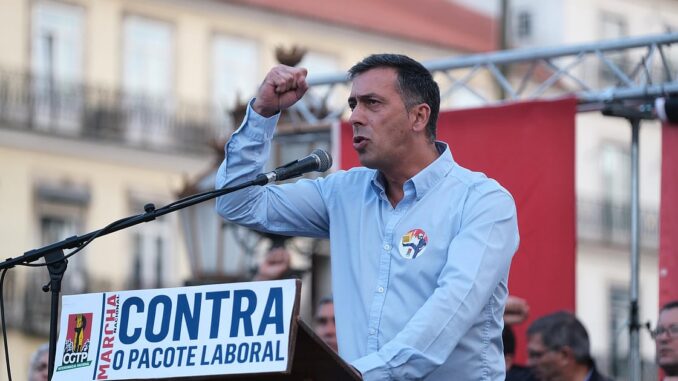
The general secretary of the CGTP reiterated this Monday (April 6) that the center “does not want to participate in parallel meetings”, arguing that the discussion of labor law should be in the Social Concertation, and accused the Government of debating “underhanded” against the workers.
“What this process has demonstrated is that the Government is trying to prepare its strategy on the sidelines of the Social Concertation meetings and here it is once again demonstrating the CGTP’s distancing from this entire process”, said the general secretary of the CGTP, Tiago Oliveira, at a press conference in front of the Ministry of Labor, hours before the Government received the UGT and the four business confederations for a meeting on changes to the labor law.
Tiago Oliveira accused the executive led by Luís Montenegro of wanting to move forward “undercover” with a labor package “that goes against workers”, insisting that it is “profoundly undemocratic” and “anti-constitutional”.
In recent months, the Government has met with the UGT and the four business confederations, leaving the CGTP – which also has a seat in the Social Concertation and even presented a counter-proposal at a bilateral meeting on September 3rd – out of the meetingswith the executive arguing that the union central placed itself on the sidelines of the negotiations from the beginning by asking for the proposal to be withdrawn.
The CGTP leader reiterated that he “does not want to participate in parallel meetings” and insists that the negotiation process must take place in plenary meetings of the Social Concertation.
“There is a space for this, which is the Social Concertation space, and what we demand is that this discussion be taken to the Social Concertation”, he said.
Asked about the fact that the Minister of Labor had said that if the CGTP made a formal request to join these meetings the Government would be available, Tiago Oliveira argued that the CGTP does not have to “please ask to meet and discuss the workers’ problems”.
“The same call or the same method that the minister used to call the other organizations that she used to call the CGTP”, he pointed out.
With a demonstration scheduled for April 17th and asked if they were considering moving forward with another general strike, the general secretary of the CGTP stressed that “all forms of struggle are on the table” and that the union center is not available to “discuss setbacks”.
“There will be a moment when workers make themselves heard and hold the parties in the Assembly of the Republic responsible for the position they will take in relation to the labor package”, he indicated.
The restrictions on ‘outsourcing’, the return of the individual time bank, the length of the contract term or the reinstatement of workers in the case of illegal dismissal, identified as ‘red lines’ for the UGT, are some of the changes that will still be at the center of the discussion to reach an eventual consensus and the document currently under discussion does not bring great approximations in these aspects.
According to the document to which Lusa had access, the Government insists on extending the term of fixed-term and uncertain-term contracts, on not reinstating workers in the event of unlawful dismissal, as well as on the return of the individual time bank and the revocation of the group time bank, even though it makes some adjustments to ‘outsourcing’ and in the sectors covered by minimum services in the event of a strike.. And, as in previous versions, it drops the simplification of dismissals for just cause.
This document was delivered almost two weeks ago to the UGT and the four business confederations: CIP, CCP, CTP and CAP.
Leave a Reply