
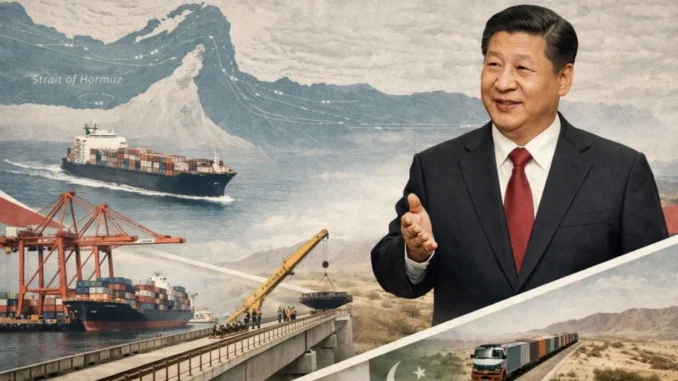
China presented this Tuesday, together with Pakistana five-point initiative to end the war in Iran which includes an immediate ceasefire and the reopening of the Strait of Hormuz. But while USA turns the maritime passage into a geopolitical threat, Beijing executes a parallel strategy that could make the strait completely dispensable.
The Sino-Pakistani plan, announced after the meeting between Pakistan’s foreign minister, Ishaq Darand its Chinese counterpart Wang Yiestablishes the immediate cessation of hostilities, the beginning of peace talks, the suspension of attacks on critical infrastructure—including peaceful nuclear facilities—and the reestablishment of safe passage through Hormuz. The fifth point proposes a framework agreement based on the UN Charter and international law.
You may also be interested in: Trump says that the US will cease its operations in Iran ‘very soon’, in two or three weeks
“It is clearly a balanced 5-point initiative that we both agreed on, and that everyone would be happy to support,” Dar told the American media. Axios. The president Donald Trumpconsulted about the proposal, did not criticize it and limited itself to stating that “negotiations with Iran are going well”, without confirming whether the United States supports the initiative behind the scenes.
China seeks to completely avoid the Strait of Hormuz
However, the real Chinese bet transcends any ceasefire. For five years, Beijing has been developing the most expensive project of its The New Silk Road (Belt and Road): a train connecting China with Pakistan and the construction of a port on Pakistani territory that completely avoids the Strait of Hormuz. The infrastructure would be directly connected to Iran and Chinese territory, guaranteeing Beijing permanent access to energy without depending on the maritime passage.
NEW
With potential to reshape not only trade but geopolitics — China proposes most expensive Belt and Road Initiative to date with a $58 billion railway system that would connect Pakistan to western China in a move to reduce Western trade dependence – report pic.twitter.com/6b7UPEwVT6
— Insider Paper (@TheInsiderPaper) April 28, 2023
“The idea is to build a port in Pakistan that does not depend on the Strait of Hormuz, because it would be directly connected to Iran and Chinese territory,” he explained. Agustín H. Bereainternationalist expert in the Middle East and academic at the Universidad Iberoamericana.
Emerging regional pivot
Pakistan thus emerges as a regional pivot. It is a nuclear power, the only country besides China that uses the Chinese GPS —not the American one— and signed a military cooperation and mutual defense treaty last year with Saudi Arabia. “This position allows it to serve as a neutral guarantor in negotiations where other actors lack credibility,” said the specialist.
“If negotiations are taking place in Pakistan, it is because they are being sponsored or guaranteed by China,” Berea noted. “Every ceasefire or peace agreement needs a guarantor, a military power; traditionally they used to be the Soviet Union or the United States.”
Cooperation without conditions
The Chinese model of cooperation contrasts with Western demands. While the United States and Europa condition their support on democratic standards or political alignments, China offers what Berea defines as “south-south cooperation”: business, technology transfer and financing without ideological impositions. This approach allowed Beijing to achieve a peace agreement between Saudi Arabia and Iran in 2023, reopening diplomatic relations closed for years.
Prime Minister Shehbaz Sharif, Foreign Minister Ishaq Dar, & Chief of Army Staff General Field Marshal Asim Munir held a meeting with Chinese President Xi Jinping in Beijing


• CPEC Phase-II
• Highly Likely that President Xi will visit Pakistan next year on Prime… pic.twitter.com/LD6L3CCwFv— Pakistan Strategic Forum (@ForumStrategic) September 2, 2025


Decisive intelligence
But behind commercial pragmatism there is a determining military factor. “In contemporary military doctrines, intelligence is the most important thing you can have,” Berea warned. “You can have a relatively cheap offensive capacity with considerable production, but not any country can have permanent, 24-hour, high-quality intelligence.”
Esa satellite intelligence —the American GPS, the GLONASS Russian or BeiDou chino— determines decisive advantages in modern conflicts. China shares this technology with Pakistan, consolidating an alliance that gives it military and economic projection beyond its traditional sphere of influence in Asia Oriental.
You may also be interested in: Controversial photos of Kristi Noem’s husband revealed, ‘it’s a shame’: Trump
— These systems provide Pakistan’s situational awareness, navigation and precision-guided… pic.twitter.com/k8vcdbwpy2
— Clash Report TR (@ClashReporttr) April 29, 2025
That China intervened as a mediator in a war started by the United States represents a notable geopolitical shift. Beijing is not only negotiating peace in Hormuz: it is simultaneously building the infrastructure that will make crossing it unnecessary.
Leave a Reply