
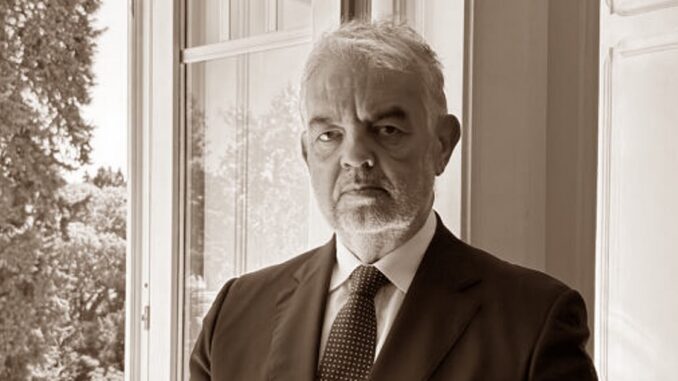
Diogo Sassetti Ramada Curto, a distinguished voice — and, at times, polemicist — of contemporary historiography, died this Saturday (April 11), at the age of 66. General Director of the National Library of Portugal (BNP) since April 2024 and full professor at the Faculty of Social and Human Sciences at Universidade Nova de Lisboa, his disappearance leaves a void in critical thinking about the empire and Portuguese society.
With a career between academia and the world, Ramada Curto was born in Lisbon on April 22, 1959 and was a direct disciple of Vitorino Magalhães Godinho, from whom he inherited the vision of history as an integrated social science. He graduated in History and received a PhD in Historical Sociology from Universidade Nova de Lisboa, the institution where he consolidated his teaching career.
His prestige took him to cross borders. For eight years, he held the prestigious Vasco da Gama Chair in History of European Expansion at the European University Institute of Florence. He also worked at world-renowned institutions such as the École des Hautes Études en Sciences Sociales in Paris, and the universities of Yale and São Paulo, where he was a visiting professor.
In addition to teaching, his contribution to Portuguese culture included the publishing sector. He was responsible for founding and directing the “Memory and Society” collection at Difel, and later for the “History and Society” collection at Editions 70. Through these projects, he introduced fundamental works by international authors to the national market, allowing generations of students and researchers access to new paradigms of social sciences.
Also a critical voice
Known for his restless spirit, the historian did not shy away from intervening in the public debate, frequently questioning the more traditional or “celebratory” views of the Portuguese Expansion.
His work, which includes titles such as Written Culture: 15th to 18th centuries or The Portuguese Maritime Expansionreflects a constant focus on power dynamics, the sociology of culture and the deconstruction of historical myths.
In recent months, he dedicated himself to managing the National Library of Portugal, a position to which he had been appointed with the intention of continuing the modernization and opening of that institution to the academic community and the general public.
The disappearance was lamented by the Minister of Culture, Margarida Balseiro Lopes, on social mediai:
Leave a Reply