
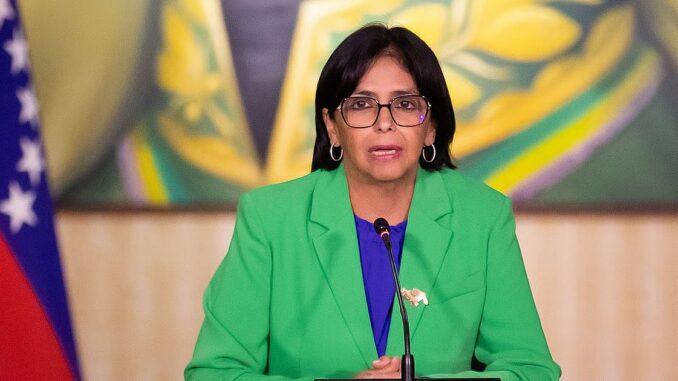
The interim President of Venezuela, Delcy Rodríguez, remained in office beyond its term, established at 90 days by the country’s Supreme Court following the arrest of Nicolás Maduro by the United States.
Venezuelan lawmakers did not hold a public vote to extend the former vice president’s term beyond last Friday’s deadline, so it is not clear how long she will remain head of the state, according to the AP agency.
In light of the Supreme Court ruling, Maduro officially remains the president of Venezuela and his “forced” absence, resulting from a “kidnapping”, makes it temporarily impossible for him to carry out his duties.
Under the terms of the Constitution of the South American country, according to the court, temporary absences must be filled by the vice president for a maximum period of 90 days.
These interim appointments may be extended by the National Assembly for a further 90 days.
The National Assembly, controlled by Rodríguez’s party, could call early elections if lawmakers declare the position permanently vacant.
The government press office did not provide clarification to the AP.
Ronal Rodríguez, a researcher at the Venezuela Observatory at the Universidad del Rosario (Colombia), told the AP that the government, especially after Maduro took office in 2013, has previously resorted to legal interpretations to stay in power, and that it should use a similar method again.
“It is very likely that they will try to invent some kind of explanation, such as the fact that it is Good Friday or the way the days were counted, but, in the end, everything will be validated by a decision of the Supreme Court of Justice,” he said.
Maduro and his wife, Cilia Flores, were arrested on January 3 in the capital, Caracas, and taken to New York to face drug trafficking charges, to which they pleaded not guilty.
Rodríguez and other ruling party leaders demanded that the couple be released, calling their detention a kidnapping.
The Trump administration surprised Venezuelans by choosing to work with Rodríguez after Maduro’s ouster, ignoring the country’s political opposition.
Since then, Rodríguez has collaborated in implementing the administration’s phased plan to end the country’s complex crisis, promoting the oil sector to international investors and opening its energy sector to private capital and international arbitration.
Rodríguez also replaced senior officials, including Maduro’s loyal defense minister and attorney general.
US President Donald Trump has frequently praised his work.
In a new step in the normalization of relations between the two countries, last week, the US government lifted the sanctions it had imposed on Delcy Rodriguez, removing her from its ‘black list’ from the government service responsible for economic sanctions (OFAC).
OFAC, which depends on the United States Treasury, is, in fact, gradually lifting the embargo imposed in 2019 on the country’s oil.
The Secretary of State of the United States, Marco Rubio, last week classified as “extraordinary” what has been achieved in the last three months in Venezuela, the beginning of a transition phase where, as he highlighted, “free” and “fair” elections should be held.
Also last week, the United States announced the resumption of activities at its embassy in Caracas, seven years after its closure.
The United States stopped recognizing Maduro as Venezuela’s legitimate leader in 2019, a year after he claimed victory in elections widely seen as rigged as opposition parties and candidates were barred from participating.
Leave a Reply