
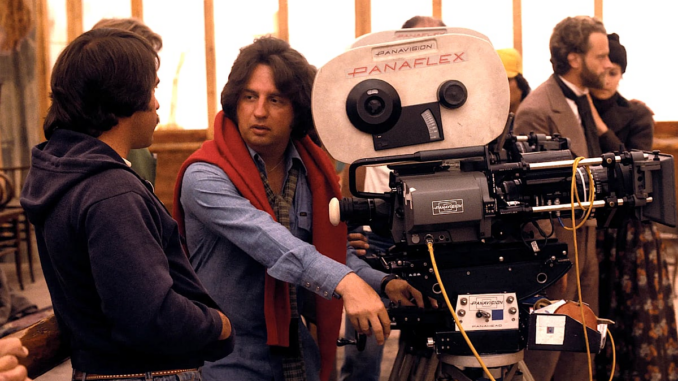
THE GATES OF HEAVEN (1980), at 4:45 pm — The critical review to which the dramatic universe of the western throughout the 1960s/70s (with films by John Huston, Sam Peckinpah, Arthur Penn, etc.) almost always had as its main focus the representations of conflicts between settlers and Indians — let us remember the model example of The Fugitive Valley (1969), by Abraham Polonsky. When writing the script and signing the direction of Heaven’s GateCimino does not stray far from this symbolic universe, although exploring an unusual thematic derivation. This is, in fact, the saga of a cultural, political, and ultimately warlike cleavage between whites: on the one hand, the arrival of European immigrants to Wyoming; on the other, the resistance of the land barons of that state — resistance, it must be understood, little by little expressed through firearms. Subject to several re-edits, with different durations, the film will be presented in the so-called director’s cut (that is, Cimino’s own version), lasting about three and a half hours. His narrative time is, in fact, vital for us to understand Cimino’s narrative boldness, creating a genuine epic whose historical importance the years have only reinforced. Not forgetting the energy of a remarkable cast, including, among others, Kris Kristofferson, Christopher Walken, Isabelle Huppert, John Hurt, Sam Waterston, Jeff Bridges, Brad Dourif and, in one of its final compositions, veteran Joseph Cotten.
Leave a Reply