
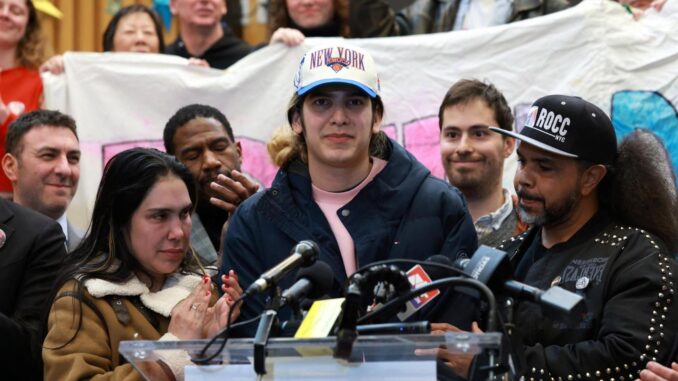
Dylan Lopez Contreras He is 21 years old and lives in the Bronx, New York. He is Venezuelan and arrived in the United States in 2024 with his family after leaving his country in the midst of the immigration crisis.
Since then he has been trying to rebuild a life from scratch. Study at Ellis Preparatory Academy—a public institute for students who, due to age, cannot attend school in the American system—and works as a delivery man to help financially at home.
Their immigration status is fragile, pending resolution within the asylum system. That implies a strict routine: regular appointments, mandatory appearances, check-ups. You have learned that compliance is not optional, but the only way forward.
Going to those appointments was part of the process to regularize your situation. Until it wasn’t.
On May 21, 2025, he attended one of those meetings in an immigration court in Manhattan. He didn’t come out of there. ICE agents detained him inside the building. He was 20 years old.
He came of age (21 years) in a detention center in Pennsylvania, more than 400 kilometers from his home. This week he hit the street again. Without a clear explanation. He never quite knew why he came in. Nor why has it come out now.
The point at which you lose protection
His asylum application was suddenly unappreciated. With no lawyer present, no real room to object, and without fully understanding the consequences, the process was abruptly closed. Outside the office there was already two ICE agents prepared to arrest himhandcuffs in hand.
The Government maintained that he had entered the country illegally. His defense, the opposite: until that moment he was within an open process that allowed him to remain in the United States. The difference was not technical. It was total. Be inside the system or be at its mercy.
That same day he was transferred out of New York. It ends at Moshannon Valley, a detention center in a rural area in the middle of nowhere.
The distance is not only geographical: it complicates access to legal defense, dilutes public attention and makes the case easier to manage away from the spotlight.
There, life is reduced. No classes, no work, no continuity with the above.
In a text written from within the center, he himself described day-to-day life as “uncomfortable, stressful and monotonous“. He acknowledged that he missed home-cooked food, his friends and, above all, the connection with the outside world. “The most difficult thing is being cut off.”
Away, his mother, Raiza Contrerasdoes not rest. Activate a support network, get legal assistance and manage to remove the case from the private sphere. His son’s story begins to circulate among organizations, lawyers and the media.
And take one more leap.
The senator from New York and Democratic leader in the Senate, Chuck Schumerintervenes publicly to request his release. The pressure reaches Washington. In February of this year, Raiza is invited as a companion to the State of the Union speech, one of the most visible political events in the country.
The case is no longer just that of a detained student. It’s a symbol.
And he wasn’t the only one. In the following months, similar arrests of migrant students were repeated after attending mandatory appointments.
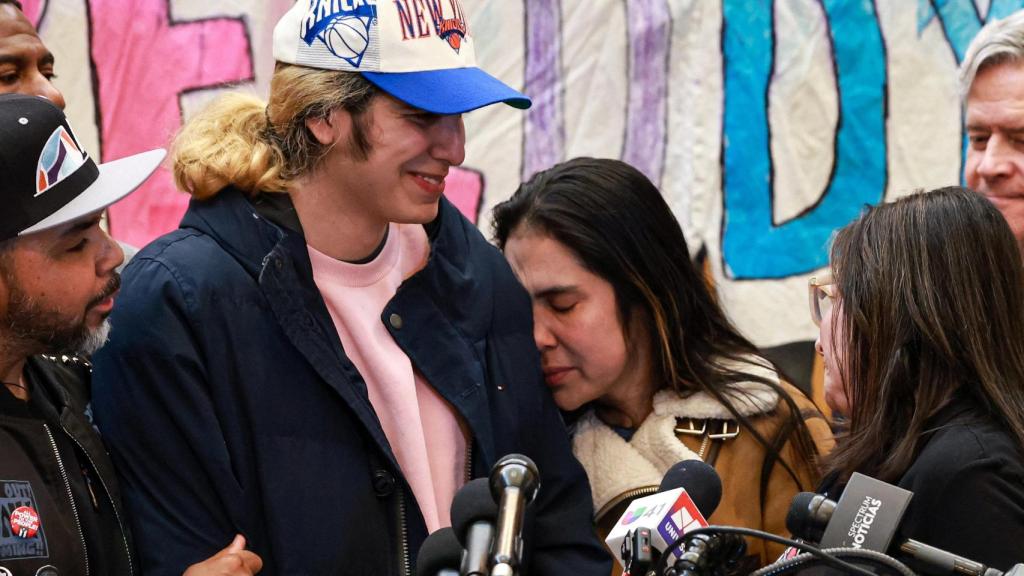
Raiza, Dylan’s mother, hugs her son outside the ICE center in Pennsylvania.
Your school stands in solidarity
A month after his arrest, the school where Dylan studied holds its graduation ceremony. graduation annual. Fifty students enter the auditorium with bands crossed over their chests, each with the flag of their country.
Seventeen different nationalities. Venezuela, Colombia, El Salvador, Mali, Senegal, Guinea… Parents with balloons. Mobile phones held high. Spanish and French mixing in the air.
Although Contreras did not have to graduate, he was the undisputed protagonist of the event. So was the fear that immigration agents would enter the assembly hall and more young people would suffer the same fate.
Before handing out the diplomas, the director, Norma Vegaremembers: “One of ours has been arrested,” he says from the stage. “And we have to make sure it is never forgotten.”
It is not a symbolic mention. Suffering the same fate is a possibility for the more than one hundred people who are present. At least until this week, when everything has changed. Dylan has come home.
The return that does not close the story
The doors of the detention center opened before dawn.
Dylan stepped out of the shadows with firm steps. Dressed with the same clothes that came in almost a year ago. As if time had stopped.
Outside is his mother and several activists who have driven through the night to pick him up. And 400 kilometers back home.
His departure does not respond to a clear turn in his case. His legal team admits not knowing the exact reasons for the release. Federal authorities have not provided any explanation. They just put something on his ankle.
A GPS tracking device. 24-hour surveillance and a reminder: If a judge determines that you cannot remain in the United States, you will be deported immediately. His legal situation remains unresolved.
Dylan has returned to the same place he came from. With one difference: now he knows that he can disappear at any moment.
Leave a Reply