
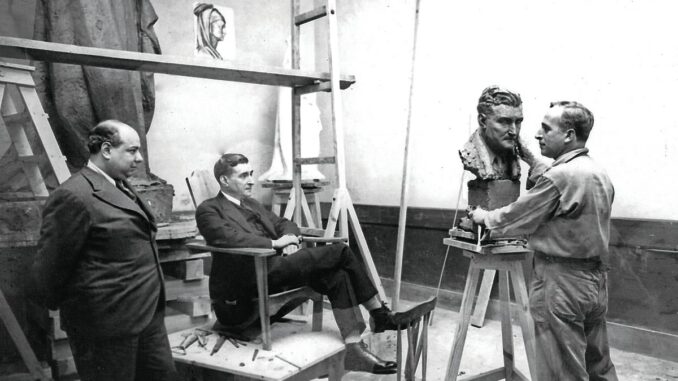
“Iron, despite being modernist, takes the neo-Garretista cultural movement and invents this agropastoral Salazarism, this mild Portuguese Salazarism”says Adelino Maltês. “Iron created, around Salazar, a whole field of activities that made up the regime. He created popular marches, the Barcelos rooster, Portuguese cinema. The whole story of ‘Ó Evaristo, you have this!”explains Orlando Raimundo. “He was a wonderful prose writer who managed to make all Portuguese mothers and the whole of Portugal fall in love with that handsome figure who was Salazar.”says Rita Ferro. “António Ferro, even because of his modernism, is much more fascinated by fascism from its cultural, futuristic, revolutionary side”analyzes Jaime Nogueira Pinto. “Salazar was a pragmatist and realized early on that António Ferro was an important person and in intellectual circles he had an extraordinary aura”highlights Guilherme d’Oliveira Martins.
Five visions of António Ferro, a name that is almost automatically associated with Salazar, after all was for almost two decades the great propagandist of the Estado Novo. But be it political scientists and historians, such as Maltez, Nogueira Pinto and Oliveira Martins, the journalist and biographer Orlando Raimundo (recently deceased, and to whom we pay tribute because this podcast owes him a lot) or, in a very special way, his novelist granddaughter Rita Ferro, everyone recognizes in him a man of great culture, of inexhaustible energy, who left his mark on Portugal in the 20th century, and continues to fascinate those who live in Portugal (and beyond) in the 21st century.
Antônio Ferro, Genius or Propagandist? Or Both? It’s the title of a podcast narrative from Diário de Notícias, the first episode of which is now available, with voiceover and sound design by Nuno Braga. There will be six episodes, one per week, telling the life of a man who was born in 1895 and died in 1956. From Alentejo and Algarve origins, son of a father who owned a hardware store in Lisbon and a housewife mother, until his death when he was a diplomat, we talk about the editor (by force!) of the magazine Orpheusthe novelist and cinephile, the reporter who interviewed Mussolini and Hitler, and Salazar himself, but also Hollywood stars, and distinguished himself in the service of the Estado Novo at the head of the National Propaganda Secretariat, the SNP, later the National Information Secretariat, the SNI.
This year marks the 70th anniversary of his death, at a time when he represented Portugal in Rome. He had two children from the poet Fernanda de Castro. Granddaughter Mafalda Ferro runs the António Quadros Foundation, named after Ferro’s eldest son, a philosopher, and this year she has already promoted the publication of a book about her grandfather, with the title Antônio Ferro: Spirit in Movement. And the countless master’s and doctoral theses whose starting point is Iron or one of its many facets is impressive. Don’t forget that he was a friend of Mário de Sá Carneiro and Fernando Pessoa, also of Almada Negreiros and Manoel de Oliveira, and, it should be noted, if he was not the creator of the Galo de Barcelos, he was certainly the one who reinvented it to the point of becoming a symbol of Portugal.
Leave a Reply