
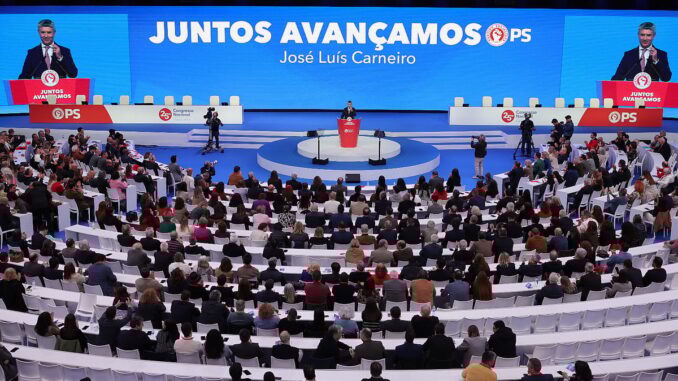
The 25th National Congress of the PS, which takes place this weekend (between March 27th and 29th) at the Pavilhão Multiuso de Viseu, in addition to bringing to debate the party’s global strategy motion, authored by the general secretary, José Luís Carneiro, debates some of the 50 sectoral motions that were submitted. To see the light of day, that is, to be presented, they must gather the favorable votes of at least 10% of the 671 delegates participating in the socialist main meeting. If that happens, they will be discussed this Sunday. The themes are varied, focused on what activists consider to be the causes of the PS, but also include unusual ideas, which are not even new.
Two years ago, at the party’s 24th Congress, activist Luís Pedro Gonçalves had already insisted on the idea that there is an exchange of babies in maternity wards, I argue that this is something that the PS must oppose. In this great socialist meeting, Luís Pedro Gonçalves returns to the charge and, in the title of the document, explains what he is about: “Against the exchange of babies in Portugal, by order of his excellency, the President of the Republic.”
The first argument presented by the socialist is the party’s founding guiding line, which involves an assumed “fight for the defense of human rights”.
“Over time, the Portuguese have always known what to expect from us, and today, as always, we reaffirm our values and our struggle”, says the activist in the motion, adding that, further on, “the Portuguese State, like all other nations, has its secret services, with a type of action that is not publicized, and if possible is even concealed”. According to the activist, this happens in several ways and even involves “false information”.
“Most likely this is why way of workingthat for years the majority of the population went without noticing a certain type of activity”, he insists, referring to “evidence brought to the public” that suggests that there are “identities exchanged between newborns in Portuguese maternity wards”, something that happens “intentionally deceiving the parents and definitively influencing the lives of the exchanged children”.
Therefore, Luís Pedro Gonçalves once again demands that the PS take a position, “clearly and unequivocally, against the exchange of babies in Portugal”.
Regionalization, own bodies and national development through this route
Titled Territorial Cohesion, Local Power, Regionalization and Local Financethe motion presented by the former president of the Board of Directors of the National Association of Portuguese Municipalities Luísa Salgueiro argues that “Portugal needs a new stage of State reform, focused on territorial and social cohesion”.
According to the socialist, the path that “deepened decentralization and took the first steps towards the democratic legitimization of continental regional levels through the reform of the” Regional Coordination and Development Commissions (CCDR) was “traced in the last PS governments”.
Thus, listing a series of measures, such as defending the idea that a “territorially balanced, socially inclusive and institutionally more efficient development model is the essential engine of territorial and social cohesion”, Luísa Salgueiro recalls that the PS rejects “the idea that the country’s success can continue to be measured only by national indicators, which ignore persistent inequalities between territories”.
This is why the document highlights that it is essential “to create regions with their own, directly elected bodies” as “a condition to scale up public policies, respond better to the concrete needs of populations, reinforce competitiveness and guarantee equal opportunities”.
“The PS has a special responsibility in this field and must be the main mobilizing force for regionalization and the affirmation of regions as effective political and institutional actors”, he argues.
New autonomy for Madeira
For the former leader of PS Madeira, Paulo Cafôfo, that autonomous region must reaffirm its autonomy. It is in this context that the motion advanced by the socialist entitled In 50 years of autonomy, a new autonomy.
Paulo Cafôfo justifies his motion with the idea that “half a century after” autonomy was achieved, Madeira’s autonomy “cannot be understood as a closed, static or merely administrative model. It has to assert itself as a living political project, oriented towards concrete results in people’s lives, capable of deepening regional democracy, reinforcing social cohesion and ensuring greater decision-making capacity in everything that concerns the reality of Madeira and Porto Santo”.
This is why the PS activist demands “a new political culture, a new autonomy that places at the center the effective autonomy of people and organizations that live, work and decide in the region”.
Europe, “against the limits of exclusively national approaches”
The former deputy minister and Parliamentary Affairs of the Government of António Costa Ana Catarina Mendes submitted the motion entitled Building the future with memory – the European horizonwhich, as the name suggests, intends “deepen the European project”, highlighting that “Portugal’s participation in the European Union is today the most capable way to guarantee a Union that is more agile, stronger and closer to its citizens”.
The document begins with a quote from Mário Soares, which justifies: “Rethinking Europe and its future is a permanent duty that must be assumed with humility given the historical importance of the objectives and that must be the work of all Europeans.”
The now socialist activist explains that “social challenges require common responses”, such as the housing crisis, which “across several European countries, demonstrates the limits of exclusively national approaches”.
“Also in this field, it was a socialist government that placed housing on the European agenda and demanded a common response against the will of the PSD-CDS-PP coalition, ensuring a European commissioner responsible for housing”, recalls Ana Catarina Mendes, reinforcing the idea with the statement that “the PS has always defended that full use of EU powers is necessary to mobilize European instruments, with common financing, adequate rules and coordination of policies to guarantee access to housing, especially for young people”.
Leave a Reply