
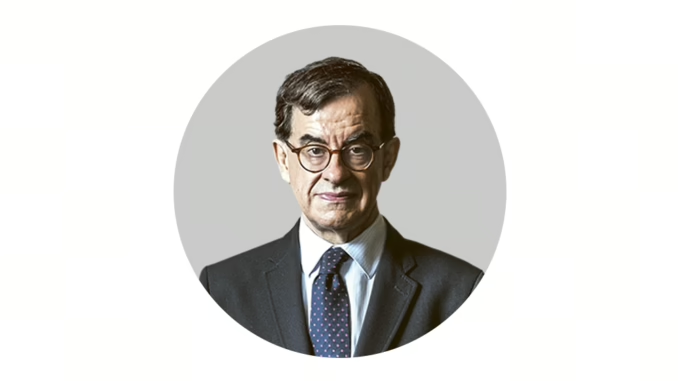
The holding of the International Colloquium on Fernando Gil at the Calouste Gulbenkian Foundation was an opportunity for a fair tribute to a fundamental reference in Portuguese and European philosophical thought. Thanks to the initiative of Filomena Molder, António Marques and Diogo Pires Aurélio, there was the opportunity to remember the rich legacy of a professor whose work should be remembered and deepened.
I had the great pleasure and honor of having deprived and collaborated with the philosopher, not only during the Balance of the Centurya remarkable cycle driven by Mário Soares, but also in long reflections on contemporary thought, especially in the essential debate on the Science as Culturedeveloped with José Mariano Gago.
I also remember your idea about the need for an Institute for Advanced Studies, similar to Princeton, which the Gulbenkian Foundation is currently developing under the wise guidance of Miguel Tamen.
I remember our meetings, sometimes in Belém and sometimes in Paris, at frugally unforgettable lunches at Brasserie LIPP, in Saint Germain-des-Prés… Fernando Gil was encyclopedic, and was one of the animators behind the publication of Einaudi in Portugal, by the hand of Vasco Graça Moura. Thus, I was mainly concerned with the study of the evidence that surrounds us, between proofs, beliefs and convictions. Mimesis and Denial It is a masterpiece that demands re-reading. And it all culminates in great literature, from Bernardim to Camões, through the collaboration with Helder Macedo in Viagens do Olhar.
Jean Petitot’s words at the Conference, transmitted on video, allowed a general assessment of Fernando Gil’s remarkable intellectual trajectory and the very rich heritage he leaves us. Faced with the tension between foundation and foundation or between belief and conviction, the obligation of good evidence is imposed, as exposure to the unknown and as a difference that is very present in the uncertainty of the journey, according to the modality of the possible and the contingent, rather than necessity.
As you will say in Journeys of the Look: the story is fulfilled and the journey opens up to discovery. “It is better to try it than to judge it”, according to Camões’ formula through the mouth of Venus. With great coherence, we heard as early as 1961, in Anthropological Approachesthis statement: “As a rational subject I demand to know, as a sensitive subject I demand to communicate, as an ethical subject I demand values. Knowing, communicating, valuing imply movements of consciousness outside of itself, reference to objects external to the subject, specific movements that aim at plenitude and not blind impulses.”
But it is in the relationship with art that the evidence manifests itself in all its splendor. In “beautiful as an excess of existing” there is a natural encounter with Leibniz, in the same way that the origins of the Portuguese Renaissance are expressed in the convergence with Helder Macedo. And the perplexity regarding the tragic events of September 11th (in the alert made with Paulo Tunhas) corresponds to the awareness of a disturbing evolution that is affecting current events in the world. Belief is tending to be ideological and conviction concerns the truth.”
“The happiness of knowing prolongs the energy of life, conviction is that same happiness.” When we listen to the philosopher we realize his passion. Conviction presupposes an activity of the spirit, an action of the Self. We are at the heart of the philosopher’s attitude.
Leave a Reply