
TEHRAN (AP).— A ceasefire agreement to pause fighting with Iran hung by a thread yesterday after the Islamic Republic closed the Strait of Hormuz again in response to the Israeli attacks in Lebanon. The White House, For his part, he demanded the reopening of the waterway while seeking to keep the peace talks.
United States and Iran claimed victory after reaching the agreement, while governments around the world expressed their relief, even as more drone and missile attacks were recorded in Iran and countries of the Persian Gulf.
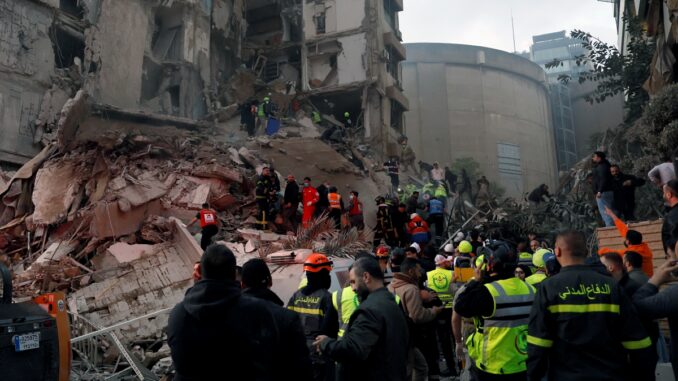
At the same time, Israel intensified its attacks against the political-military group Hezbollah in Lebanon, raiding several commercial and residential areas of Beirut. At least 182 people were killed and hundreds wounded in one of the deadliest days of Israel’s offensive against Lebanon.
The new wave of violence threatened to derail what the vice president of the United States, James Vancerated as a “fragile” agreement.
He Iranian Foreign Minister Abbas Araghchiinsisted that the end of the war in Lebanon was part of the ceasefire agreement with the United States. However, the Israeli Prime Minister Benjamin Netanyahuand US President Donald Trump assured that the truce did not cover Lebanon.
“The world sees the massacres in Lebanon,” Araghchi said on
White House press secretary Karoline Leavitt said the closure of the Strait of Hormuz was “completely unacceptable.” He reiterated Trump’s “expectations and demands” that the channel be reopened.
US Defense Secretary Pete Hegseth said US and Israeli forces had achieved a “military victory with a capital V” and that the Iranian military no longer posed a significant threat. The Iranian military said the country forced Israel and the United States to accept its “proposed conditions and surrender.”
Uncertain terms
Even before the new attacks, many details of the pact were unknown.
Iran said the deal would allow it to formalize its new practice of charging ships passing through the strait, a crucial route for oil trade. But details were unclear, including whether vessels would feel safe using the route or whether shipping traffic had resumed. It was also unclear whether any other countries accepted this condition.
Only 11 boats crossed the strait yesterday, about the same number as in previous days, according to Windward, a maritime intelligence company.
Iran demands tolls from transporters of up to $1 per barrel for the release of oil, he said. The largest oil tankers carry up to 3 million barrels of crude oil.
Plan allows Iran and Oman to charge ships a fee to transit through the strait, according to a regional official who spoke on condition of anonymity to discuss negotiations in which he was directly involved. The official indicated that Tehran would use the money for reconstruction.
The future of Iran’s nuclear and missile programs—the elimination of which was a major war goal for Washington and Israel—also remained unclear. Trump said the United States would work with Iran to remove buried enriched uranium, a statement that has not been confirmed by Iran.
Trump initially said Iran had proposed a “workable” 10-point plan that could help end the war that the United States and Israel started on February 28.
But when a Farsi version appeared indicating that Tehran would be allowed to continue enriching uranium — a key element for building a nuclear weapon — Trump called the initiative fraudulent without explanation.
Vance later said the deal was being misrepresented in Iran, although he did not offer details.
Leavitt stated that the Iran’s original 10-point plan was “fundamentally unserious, unacceptable and completely discarded.” But on Tuesday he presented a new 15-point plan that could “align with ours” to achieve peace, he said.
The White House He also said Vance would lead the team of American negotiators in their talks to find a permanent end to the war.
Pakistan, which would host the negotiations, indicated that the dialogue could begin in Islamabad as early as Friday.
Tehran’s demands to end the war include the withdrawal of US forces from the region, the lifting of sanctions and the release of its frozen assets.
Leave a Reply