
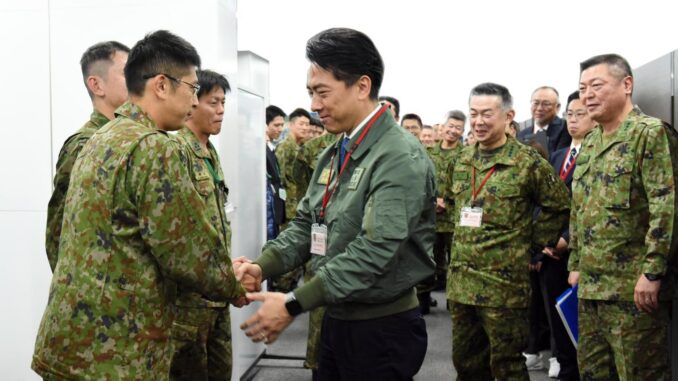
At the westernmost point of Japan, where the coast of Taiwan can be seen on clear days, the small island of Yonaguni begins to transform into a military outpost in the face of growing tension with China.
With barely 1,700 inhabitantsthis remote enclave of the Ryūkyū archipelago was for decades known for its dwarf horses, its transparent seabed and relaxing tourism.
Today, however, the landscape is beginning to change: antennas, radars and projects for new missile batteries announce that this territory located just over a hundred kilometers from Taiwan It has become a strategic piece in the security chessboard of East Asia.
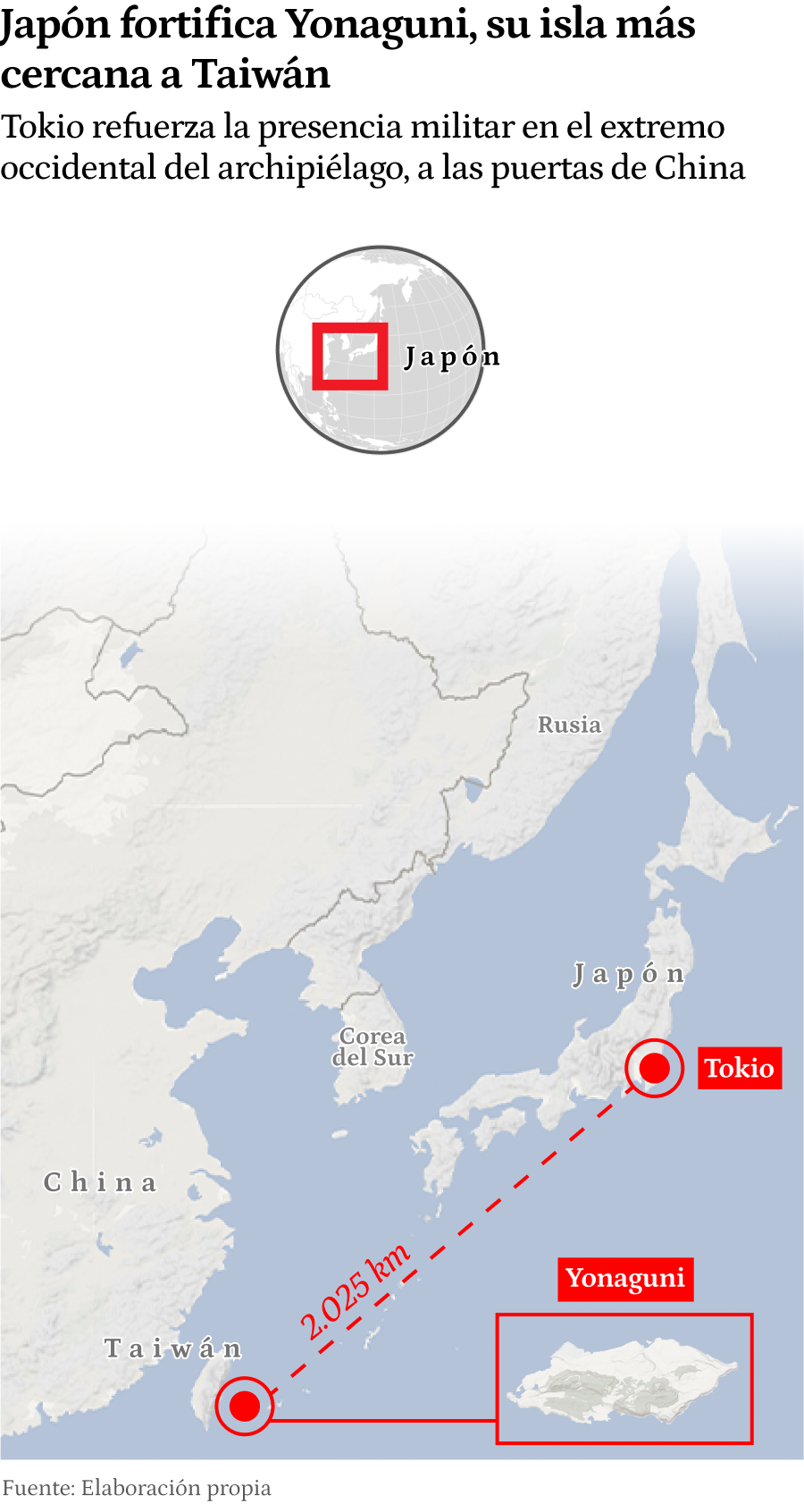
Vital trade routes pass through these waters as well as naval and air patrols increasingly frequent from China, in a context of growing military pressure around the Taiwan Strait.
For Japan and its ally, the United States, this narrow arc of islands that extends from Okinawa to the vicinity of Taiwan has become a key element in monitoring military movements and guaranteeing strategic balance in the region.
The hardening of discourse also reflects a broader political shift in Tokyo.
The Government of Sanae Takaichi has adopted a much firmer tone on regional security, resuming a line defended for years by the former prime minister Shinzo Abe and conservative sectors of the ruling Liberal Democratic Party (PLD).
Faced with the pragmatism that for decades sought to balance the alliance with the United States and the economic relationship with China, the current Executive is committed to a more explicit deterrence strategy around Taiwan.
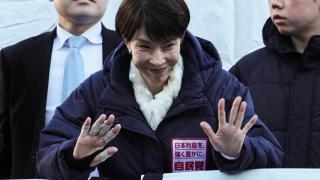
This shift also has significant support at the polls: after its recent electoral victory, the Government maintains high approval levels and growing support for strengthening defense in an increasingly tense regional context.
This same Tuesday, the Minister of Defense, Shinjiro Koizumihas reported that the country has begun deploying its long-range anti-ship missile system for the first time to test its counterattack capabilities if necessary.
“It is an initiative of utmost importance to strengthen the deterrence and response capabilities of Japan, whose security environment is the most serious and complex since the end of World War II,” he stated.
Mission: protect the routes
This strategic shift can already be seen on the ground in Yonaguni.
In 2016, the Japanese Government deployed a Self-Defense Forces coastal surveillance unit on the island equipped with radars capable of monitoring maritime and air traffic in the strait that separates Japan and Taiwan.
The base marked the beginning of a permanent military presence in a territory that for decades had remained practically apart from the defensive strategy of the country.
Since then, Tokyo has been progressively strengthening its military presence at the western end of the Ryūkyū Islands archipelago.
The goal is to create a chain of surveillance and defense to closely monitor China’s naval and air activity in the East China Sea and protect the sea routes connecting Japan with Southeast Asia.
This reinforcement is now beginning to be translated into concrete calendars. The Defense Minister recently announced that Japan plans to deploy a surface-to-air missile system in Yonaguni before March 2031.
The medium-range system with 360-degree surveillance capability would allow intercepting enemy aircraft and projectiles and strengthening the defense of the maritime corridor that separates the island from Taiwan.
End of isolation
But this strategic transformation is also perceived in the daily life of Yonaguni.
The island has traditionally lived off of fishing, livestock and modest tourism attracted by its seabed and the small native horses that graze on its meadows.
For decades, this remote territory was Known above all for its tranquility and isolation with respect to the large cities in the center and east of the country.
The arrival of military installations has also brought economic changes.
The construction of infrastructure, the presence of Self-Defense Forces personnel and investments from the central government have generated new jobs and activity on an island that for years had suffered the demographic decline common to many rural Japanese areas.
But the military reinforcement also raises concern among part of the population.
Some residents fear that Yonaguni’s growing strategic importance will make it a potential target in the event of conflict over Taiwan.
For many inhabitants, accustomed for decades to living outside of regional tensions, the idea that their home could become a geopolitical front line is as new as it is disturbing.
The growing regional tension is also perceived among the fishermen of Yonaguni. Shigenori Takenishihead of the local fishing cooperative, assures EL ESPAÑOL that in recent years the presence of Chinese military ships and aircraft has visibly increased in the waters near the island and in the fishing areas near the Senkaku Islands, rich in bluefin tuna.
“We try to be pragmatic and avoid going out when we detect their presence, especially if they are large ships,” explains Takenishi from the port. “Of course it is threatening, there is no doubt. In recent times we have seen many ships, even some aircraft carriers.”
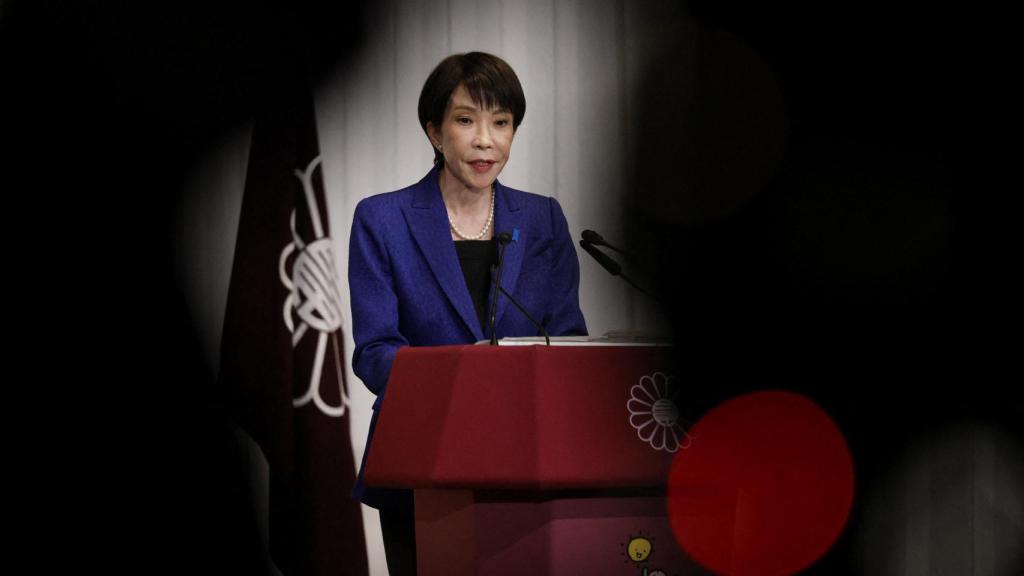
Japanese Prime Minister Sanae Takaichi, leader of the ruling Liberal Democratic Party (LDP), speaks during a press conference at the LDP headquarters in Tokyo, Japan, on February 9, 2026.
Reuters
The mayor of the island, Kenichi Itokazushares that perception of growing military pressure.
In his office, decorated with Japanese and Taiwanese flags that reflect the close historical ties between both communities, he is satisfied that Yonaguni today has a permanent Self-Defense Forces garrison of about two hundred people.
As he explains to EL ESPAÑOL, the gradual increase in Chinese military ships and planes in the surrounding area had generated concern among the inhabitants.
The relationship with Taiwan, on the other hand, is very different. “Before the Taiwanese Army carries out naval maneuvers in the area, we are always notified in advance so that fishermen avoid those waters,” explains the mayor.
Even so, local authorities have a contingency plan in case of crisis: the air evacuation of the population to the city of Fukuoka in a few hours. “We know that not everyone will want to leave,” Itokazu admits, “but whoever wants to leave can do so.”
The progressive militarization of the southwestern islands also reflects an increasingly intense debate within Japan over the scope of its defense policy.
For decades, the country has maintained a markedly pacifist doctrinebased on the post-war Constitution and the principle that its Self-Defense Forces should be strictly limited to the protection of the national territory.
However, the increase in China’s military pressure in the East China Sea and the growing uncertainty around Taiwan have reopened the debate between those who defend preserving this constitutional pacifism and those who are committed to strengthening the country’s deterrence capacity.
Prime Minister Takaichi has clearly placed herself in this second camp.
After obtaining support at the polls, its Executive has promoted a strategy that seeks strengthen defensive capabilities of Japan and prepare the archipelago for a possible crisis scenario in the Taiwan Strait.
In that context, the Ryūkyū island chain —and in particular Yonaguni— has come to occupy a central place within the new Japanese security architecture.
In this remote corner of the Japanese archipelago, where on clear days the silhouette of Taiwan is drawn on the horizontiny Yonaguni has become much more than a frontier island.
Its increasing militarization symbolizes Japan’s strategic change in a regional environment increasingly uncertain, marked by the rivalry between China and the United States and by the fragility of the balance around Taiwan.
In that advanced line of the western Pacific, the future of Asian security is also beginning to be played out in places where until recently only the fishing boats, the wind and the sea could be heard.
Leave a Reply