
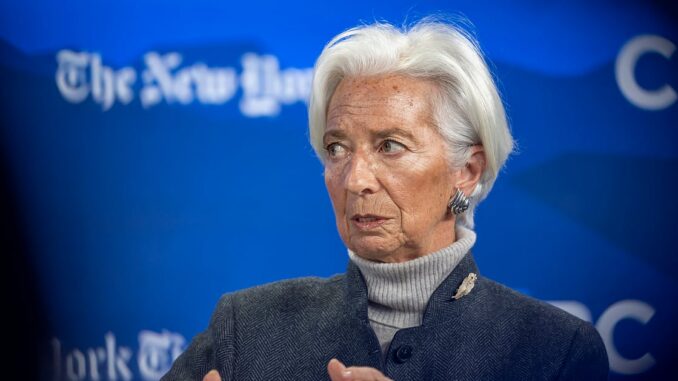
The European Central Bank has different options to react to the energy shock related to the war in Iran, measures that will be adapted depending on its magnitude and duration, the institution’s president assured today.
The ECB will not be “paralyzed by hesitation” and has a “graduated range of response options” in terms of monetary policy, said Christine Lagarde, without specifying, however, which ones.
The institution will not act “before having sufficient information about the magnitude and persistence of the shock, as well as its propagation”, he added.
According to Lagarde, everything will be done to maintain inflation at 2%, a commitment that remains “unconditional”, while a lasting increase in hydrocarbon prices could cause an acceleration in price rises.
Last week, the ECB maintained key rates, as it has since July, and published a series of economic scenarios showing that the risks weighing on inflation are not linear: the longer the shock lasts and intensifies, the more prices and wages accelerate, with a growing deviation from the 2% target if the ECB does not react.
Thus, small magnitude, one-off and short-lived supply shocks can be ignored, but “as expected deviations from our inflation objective become more significant and persistent, the need to act becomes stronger”, he insisted.
Monetary policy “cannot make energy prices fall”, but the ECB will monitor the risk of seeing the current rise in oil and gas prices trigger “generalized inflation”.
In this regard, the inflationary shock caused in 2022 by Russia’s invasion of Ukraine “left its mark”, according to Lagarde.
The current situation is, however, different, explained Lagarde: at the beginning of 2022, inflation was already at 5% in a context of strong demand and post-Covid shortages, while today the recovery is moderate, inflation is close to 2%, budgetary policies are less accommodative and ECB rates, at 2%, maintain a restrictive nature for the economy.
Leave a Reply