
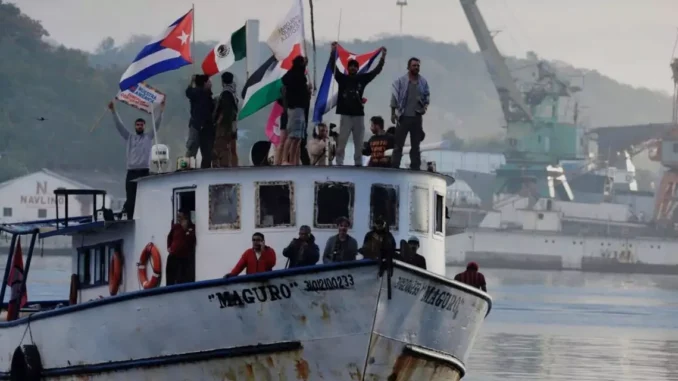
Two boats that left Isla Mujeres bound for Havana remain missing, triggering an international search operation in the Caribbean.
The sailboats set sail on March 20 with humanitarian aid on board and were due to arrive between the 24th and 25th of the same month. However, so far no communication has been established or their arrival confirmed.
In total, nine crew members of different nationalities were traveling, which has expanded the concern beyond a single region.
SEARCH AGAINST THE TIME
Given the lack of contact, a maritime and air operation was activated to try to locate the vessels on the estimated route between Mexico and Cuba.
The tasks include deployments in the Caribbean and the Gulf of Mexico, as well as the participation of rescue and maritime surveillance stations. Alerts were also issued to vessels in transit to report any signs.
The operation includes variables such as sea currents and weather conditions, factors that could divert the sailboats’ original course.
INTERNATIONAL COORDINATION
The search is not limited to Mexican waters. Contact was established with maritime rescue centers and authorities from countries such as Poland, France, Cuba and the United States.
In addition, communication is maintained with port and diplomatic entities to expand the scope of location in an area where maritime traffic is constant but also complex.
CONCERN FROM CUBA
The case has generated concern in the Cuban government. President Miguel Díaz-Canel publicly expressed his concern about the disappearance of the vessels.
Through social networks he noted: “From our country we do everything possible in the search and rescue of these brothers in struggle,” in reference to the humanitarian mission they carried out.
RISK ROUTE AND GAPS IN MARITIME CONTROL
The disappearance of both vessels shows the persistent risks on Caribbean maritime routes, even on known routes.
Although there is international coordination, response times and the vast maritime extension complicate location, especially when there are no prior emergency signals.
The case also raises questions about the monitoring protocols on trips with humanitarian cargo and the capacity for real-time monitoring, in a region where natural conditions and lack of control can turn an ordinary journey into an emergency.
Leave a Reply