
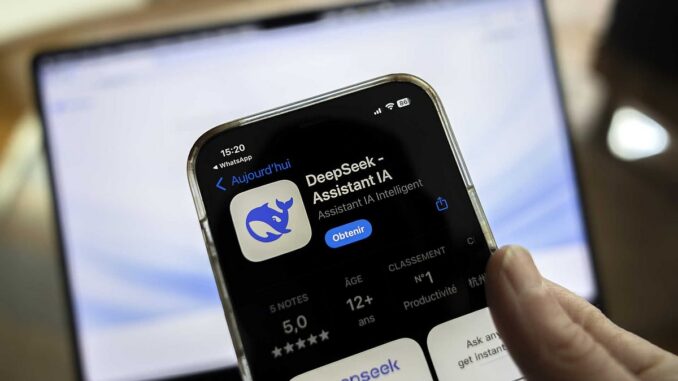
The global technology industry awaits the launch of the new artificial intelligence model from Chinese company DeepSeek, whose choice of ‘chips’ could indicate China’s degree of autonomy in the face of United States restrictions.
In early 2025, the Hangzhou (eastern China) startup shook up the industry with the launch of a low-cost AI system capable of rivaling Gemini, ChatGPT or Claude.
Since then, and despite a series of rumors about an imminent launch, DeepSeek’s new generation “V4” model continues to emerge.
The choice of chips used to train and operate the new system is at the center of speculation: whether it is world-leading North American technology or “made in China” alternatives that the country is trying to develop quickly.
“It’s important to know, because this reveals, in a way, China’s trajectory towards self-sufficiency in AI”, explained Wei Sun, an analyst at Counterpoint Research, cited by the agency France Presse.
According to the specialized portal The Information, the “V4” model will be able to work with the latest ‘chips’ produced by the Chinese giant Huawei.
Such an evolution would represent a decisive step for China, which remains without access to Nvidia’s top-of-the-line H200 chip, despite an easing of export restrictions imposed by the United States.
In anticipation of the launch of the new DeepSeek model, technological giants such as Alibaba, ByteDance and Tencent will have placed large orders for Huawei ‘chips’, according to the same source, which cites people with direct knowledge of these operations.
Created in 2023, DeepSeek was initially a side project of a speculative fund, which had the vision of accumulating Nvidia processors.
In January 2025, its R1 conversational agent, with advanced reasoning capabilities, shook the markets, causing a drop in North American technology stocks.
The American President himself, Donald Trump, classified it as a “warning sign” for Silicon Valley.
The R1 was based on the previous V3 model, launched in December 2024. The company’s accessible and customizable AI tools have been widely adopted in China and have gained popularity in emerging markets such as Southeast Asia and the Middle East.
Presented as multimodal – capable of generating text, images and video, the V4 could once again shake up the North American technology markets, indicated Stephen Wu, founder of the Carthage Capital fund, cited by AFP.
“I expect DeepSeek V4 to be not just a software update, but a very powerful open source model with significantly lower costs,” he said.
However, more than performance, the company’s credibility is also at stake.
Until now, advances have been based on Nvidia technology. The transition to Chinese chips involves “deep re-engineering”, warned Wei Sun.
The United States justifies the export ban on Nvidia’s most advanced AI processors to China on national security grounds.
“The prolonged wait for DeepSeek V4 highlights the difficulties in developing advanced models without unrestricted access to Nvidia’s cutting-edge equipment,” said Stephen Wu.
Still, some reports indicate that DeepSeek may have circumvented the restrictions by training the V4 with thousands of Nvidia’s next-generation Blackwell chips, dismantled in third countries and smuggled into China.
Another Chinese AI startup, Zhipu, presented an image generator in January that, according to the company, was fully trained with Huawei chips.
Leaks of information suggest, however, that DeepSeek’s attempt to train its models with national Huawei Ascend chips failed, leading the company to discreetly return to restricted Nvidia chips, Wu added.
Still, “if they have managed to train the V4 entirely with Huawei ‘chips’, this will represent a significant change in the geopolitical technology landscape,” he concluded.
Leave a Reply