
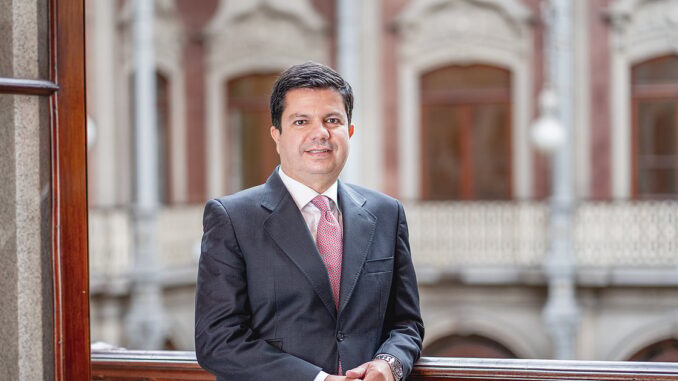
Nuno Botelho, president of the Porto Commercial Association, defends a new relationship between Porto City Council and civil society, with less municipal protagonism and more support for the institutions that already make the city function. Throughout the interview, at Palácio da Bolsa, he criticizes Lisbon’s centralism, warns about the lack of political and media visibility in the North and maintains that the region, despite its weight in exports, continues to fail to create the wealth and salaries it needs. It also defends tourism with greater added value, greater capacity for cooperation between companies, the review of the tax burden and a strategic focus on the railway, connecting Porto to Lisbon and Vigo
With the change of leadership at the Porto City Council, what type of relationship do you hope to establish between the city hall and the Porto Commercial Association?
There will be changes, there are already changes. From the outset, a big change – Pedro Duarte and I are the same age, we were classmates at school and university, we always had a good relationship, and it can be felt. There is a more intense, very positive interaction with Porto city hall and there is reciprocal consultation on a series of issues. And there is a lot of expectation that things will be more fruitful for the city.
Has the cooperation between the city hall and the business community been sufficient? What could concretely improve?
It could be better. A council like Porto’s is lucky to have a civil society and a set of institutions around it that make the city work. It makes it much easier for a mayor to have a civil society and a set of institutions that actually make people’s lives easier. I’m talking about the Porto Commercial Association, the Business Association, Santa Casa da Misericórdia in the social area, the Church’s own social network as well, with a very fine mesh that reaches and addresses many situations. If we go to the cultural field, we have Casa da Música. Serralves. In other words, there is a strong, vibrant civil society that wants to do things, that wants to work. A set of entities that can easily respond. It is up to Porto City Council to create the conditions so as not to get in the way too much. Getting out of the way means helping. I have said this many times, including to the current mayor. Their role is to help these entities. And can this improve? He can.
Rui Moreira, who also presided over the Porto Commercial Association (Porto Chamber of Commerce and Industry), “municipalized” too much?
Without wanting to comment on the former president’s work, I can, however, say that the Porto Chamber ended up wanting to do everything, whether on the social network or, above all, with companies. So, yes, there was an attempt to municipalize everything, targeting a series of issues that were not necessary. Now, it is necessary to return to civil society what belongs to civil society. The Chamber must take care of the tasks that are in fact its responsibility – urban cleaning, security, mobility, green spaces. In other words, the quality of life of Porto Alegre residents.
The city has experienced a strong economic and tourist transformation. Has the Chamber been able to balance economic growth and quality of life for those who live and work in Porto Alegre?
Prior point – I am absolutely in favor of tourism. The argument that gentrification is a consequence of tourism is erroneous. No people have lived in the center of Porto for many years. It started in the 80s and 90s and became more pronounced. The people of Porto Alegre naturally left the city center because, it is good for people to realize, in evolved cities, the city centers are normally the most expensive areas. Afterwards, the building, the result of the old rent law, was very dilapidated. Nobody liked living here. Tourism has opened the door to a very large urban requalification. In fact, Porto, in this aspect, was a pioneer with the Urban Rehabilitation Society, which in a few years returned many rehabilitated buildings to the city, preserving the heritage. Today Porto is a very good city to visit and remains intact, with a very clear historical root. Tourism came to bring the financial cushion to allow these investments, it was thanks to tourism that people invested and believed in the business.
That said, we are now at a time where we should think about the type of tourism we want to have. And then I am a little critical of the policy that is being followed. More than breaking records in the number of visitors, we have to have better visitors, with more purchasing power. Visitors who leave more money, use our restaurants, consume in our bars, rent cars.
Leave a Reply