
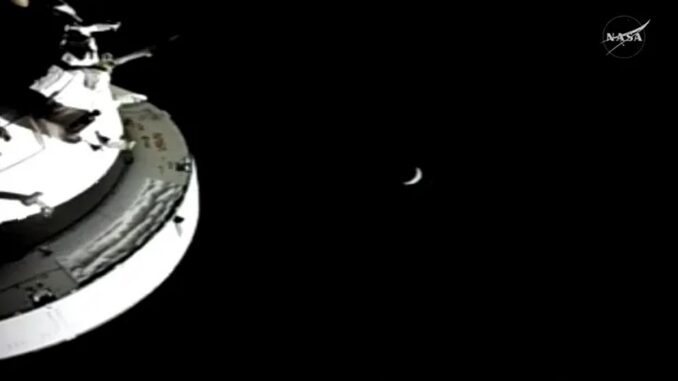
The Orion capsule has already “doubled” around the Moon and is, technically, on its way home. After reaching the point of furthest distance from Earth and plunging into absolute silence for 40 minutes while flying over the far side of the satellite, the crew of the Artemis II mission reestablished contact with the Control Center in Houston with an emotionally charged message.
“It’s so good to hear Earth again,” said astronaut Christina Koch once the radio signal was restored. In a reflection directed at the inhabitants of the planet that is now growing again in the ship’s windows, Koch highlighted the connection between the explorers and their origin: “To Asia, Africa and Oceania, we are looking at you. We hear you. You can look at the Moon right now. We see you too”, he said over the radio.
The spectacle of “Earthrise” – the “Earthrise” – and the mysteries of the hidden side
Although communications were interrupted at 11:44 pm this Monday (Lisbon time), scientific work within Orion did not stop.
During the “blackout” period, the four astronauts witnessed one of the most iconic events in space exploration: the Earthrise — “Earthrise” seen from the Light Like the Apollo 8 crew in 1968, Wiseman, Glover, Koch and Hansen saw the Blue Planet rise majestically above the lunar horizon — a moment that marks the beginning of the transition from the exploration phase to the return phase.
But there was time for more than contemplation. The crew took advantage of the passage through the hidden side to carry out scientific observations of opportunity. Astronauts looked for distinct flashes of light on the lunar surface, caused by the impact of space rocks (meteoroids) on the ground, and documented a phenomenon that continues to intrigue scientists: dust floating above the edge of the Moon. This suspended lunar dust, observed during Earthrise, is a mystery that NASA now hopes to help solve with the data and images collected this morning.
“We will always choose Earth”
Christina Koch’s message also served as a manifesto for the future of the Artemis program. “We will explore. We will build ships. We will visit again. We will build scientific outposts, drive rovers, do radio astronomy and found companies. We will strengthen industry and inspire. But ultimately, we will always choose Earth. We will always choose each other,” said the astronaut.
With the propulsion maneuver successfully carried out to place the ship on the return trajectory, Orion now begins to be “pulled” back by Earth’s gravity. The record distance of 406,707 kilometers now belongs to history, but the science and images collected during the minutes of solitude on the far side promise to fuel human knowledge for decades.
Orion now has a few days of travel ahead of it before its final dive into the Earth’s atmosphere and recovery in the Pacific Ocean. For now, the crew can finally rest with the image of Earth becoming, minute by minute, bigger and bigger.
Leave a Reply