
In the next 15 days it will be resolved the future of the war in Iranas long as both the United States and Iran respect the ceasefire agreed upon last Wednesday morning, which includes the suspension of bombing and the opening of the Strait of Hormuz.
It will be during these two weeks when both countries will negotiate a definitive peace agreement. They will also do so in Islamabad, capital of Pakistan, central intermediary of conversations that, so far, have not been particularly fruitful.
The negotiations will be based the ten point plan proposed by Iran —and not the American 15 points—, which improves the country’s situation compared to before the conflict.
Hormuz, Tehran, Lebanon… These are the keys to the ceasefire agreed between the United States and Iran
In fact, the Iranian regime calls for the lifting of all sanctions that weigh on the Persian country, as well as the right to continue enriching uranium and the promise of do not make nuclear weaponsamong other measures reported by state media.
Now, whether or not an agreement is reached is in the hands of a few chosen to participate in the negotiations in Islamabad that seem, to say the least, complex due to the enormous mistrust that exists. between two actors historically opposed.
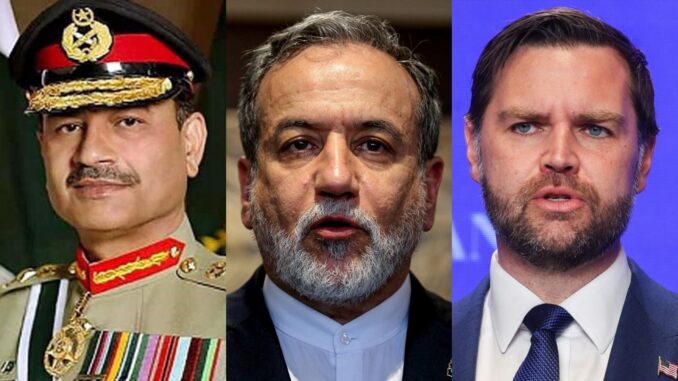
Among the negotiators is US Vice President JD Vance, whose participation was confirmed this Wednesday, after weeks of speculation. And DonaldTrump had previously assured that he would not attend “for security reasons”. Several senior Pakistani officials close to the US president will also participate, as well as representatives of the Iranian regime.
Pakistani Facilitators
To date, Pakistan has led diplomatic efforts. Among other things, because its very high dependence on Gulf oil, its good relationship with the Trump Administration and its 900 kilometers of border with Iran, have made regional peace and stability in a need.
His role, in fact, more than that of a classic mediator has been that of technical facilitator. A kind of communication channel, in which the Pakistani representatives were in charge of passing messages from one side to the other.
One of the key interlocutors so far (and, probably, in the negotiations to come) is General Syed Asim Munirchief of the Pakistan Army.
“I want to thank the Iranian leadership and the American leadership, who accepted my request and appreciated the seriousness and sincerity of Pakistan for the sake of peace. This was not an unusual thing.
A special thanks to the President of Iran, Mr. Masoud Al-Badeshkian, who accepted my request… pic.twitter.com/NMPe0d7czD
— Government of Pakistan (@GovtofPakistan) April 8, 2026
Known for being the most powerful man in the country (who even has lifelong legal immunity thanks to a constitutional reform), Munir has a good relationship with Trump, with whom he met twice in 2025 in the Oval Office and who showered him with praise, even considering him “his favorite field marshal.”
Furthermore, it is believed that this ex-spy has ties to Iran’s Revolutionary Guard Corpsa country with which Pakistan has an enormous historical, cultural and religious bond. Munir, however, has adopted a relatively discreet stance in an already discreet diplomacy.
He has been the Pakistani Prime Minister, Shehbaz Sharifwho has emerged as the architect of the ceasefire. On Wednesday, before Trump’s ultimatum to Iran to allow oil tankers to safely pass through Hormuz expired, Sharif said diplomatic efforts were “moving forward steadily, firmly and forcefully.”
Therefore, through a message published on X, he asked Trump to extend the deadline by two weeks. In return, he asked his “Iranian brothers” to open the Strait of Hormuz during that same period as “a gesture of goodwill.” It was after his words that both Iran and the United States relented.
Iranians ‘pardoned’
The Iranian Foreign Minister, Abbas Araqchiwas one of the first to respond to the request of “his brother Pakistan” and announce “safe passage” through the Strait of Hormuz for two weeks if the attacks against his country stopped.
In recent weeks, Araqchi has participated in what he described as “contacts” with the US special envoy, Steve Witkoff, although at all times he has clarified that it was not a negotiation, but rather an exchange of messages through friendly intermediaries, he said on the television network. Al Jazeera.
The Iranian official was one of the “pardoned” by the United States. A few weeks ago, the White House asked Israel — with which it launched the joint operation against Tehran — to remove it from its list of objectives because it considered it a possible interlocutor for a ceasefire and a negotiated solution to the conflict. Another of those pardoned was the president of the Iranian Parliament, Mohammad Baqer Qalibaf, who is expected to lead the negotiating team.
Iranian Foreign Minister Abbas Aragchi and Speaker of the Iranian Parliament Mohamed Baqer Qalibaf
Qalibaf, a soldier who became commander of the Revolutionary Guard and chief of the Police, was a protégé of the late Ayatollah Ali Khamenei. Considered from the hardest wing of an already radicalized regime, he is attributed a strong influence in the country.
Some reports suggest that it could be the “outstanding figure” with whom Trump says Washington is trying to negotiate, an Iranian leader who is not the supreme leader.
“We are dealing with the man who, in my opinion, is the most respected and the leader. It is a little complicated: we have eliminated everyone,” said the American president. However, Qalibaf has so far denied having participated in any talks.
Trump’s trusted men
The American president, although he has never stopped escalating his rhetoric against Iran – he even warned that “an entire civilization would die” if an agreement was not reached – has commissioned his most trusted men to participate in the negotiations.
Among them are Steve Witkoffspecial envoy for the Middle East, and Jared Kushner, the president’s son-in-law, who delivered to the facilitators the peace plan that was later rejected by Tehran.
Also the vice president JD Vanceopposed to the war in Iran and one of the main defenders of the doctrine America First, has participated in those efforts. On Tuesday, from Hungary, where he was supporting the ultranationalist Prime Minister Viktor Orbán in the final stretch of the electoral campaign, he contributed to ironing out the last issues in the hours before the ultimatum expired.
Leave a Reply