
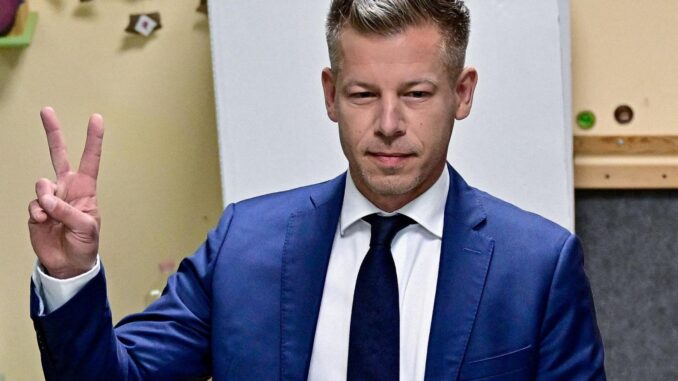
Magyar, a 43-year-old lawyer, was the most serious rival that Orbán had ever had. In fact, all independent polls prior to the elections gave him a wide lead. A clear sign that there was managed to weather the Hungarian Prime Minister’s continued attempts to discredit him.
Through the government-controlled media, he was branded an abuser, traitor, scammer, and sexual harasser. A video of his sexual content was even spread on the Internet. “Yes, I am a 45-year-old man, I have a sexual life,” he defended himself then.
Orbán himself, aware of his weaknesswent so far as to call Magyar a “puppet” of European bureaucrats, at the same time as escalated his rhetoric against Ukraine and the European Union.
Magyar, on the other hand, did not want to enter that game. He presented himself as a innovative politician, the “anti-Orbán”, who promised to fight corruption and unlock the billions of euros in funds that the European Union kept frozen due to the degradation of the rule of law in Hungary.
However, Magyar is not a classic liberal, but a center-right leader who has managed to wrest Fidesz’s monopoly on the conservative vote. from within the same political space and with a similar language: that of patriotism and the people.
Magyar has built its profile by projecting a modern and athletic imageto the point that many see him as a kind of “political messiah.” It has even become popularly known as Slim Fit Jesusa nickname that alludes to his fitted suits and that stylized appearance with which he attempts to distance himself from the old guard and present himself as someone who comes to “clean up” the system.
This is when the country will vote in a week. We are ready. You too?
What you can do in the 7 days ahead for the system change:
– talk to as many people as possible about the fateful choice;
– you help distribute leaflets, carry out Pure Voice, counter, knock, mobilize;
-… pic.twitter.com/C5x4lo2vaS— Péter Magyar (Don’t be afraid) (@magyarpeterMP) April 5, 2026
But Magyar is not a outsiderbut a former ally of Orbán. He was part of the Fidesz family for more than a decade, until he left it in 2024, fed up, as he explained, with the corruption and authoritarianism of the system built by Orbán, a framework that he came to describe as a “mafia regime.”
“Péter Magyar burst into Hungarian politics at a unique moment: a very serious economic crisis was accompanied by a serious moral crisis. This was the moment when social discontent became very palpable,” he explains. Gábor Polyákprofessor at Eötvös Loránd University.
It refers to the scandal over the government’s cover-up of sexual abuse of minors that opened deep cracks in the Government’s moral narrative. Among other things because it has self-erected as the defender of traditional family values and has even gone so far as to prohibit by law the talk of homosexuality in schools because it links it to pedophilia.
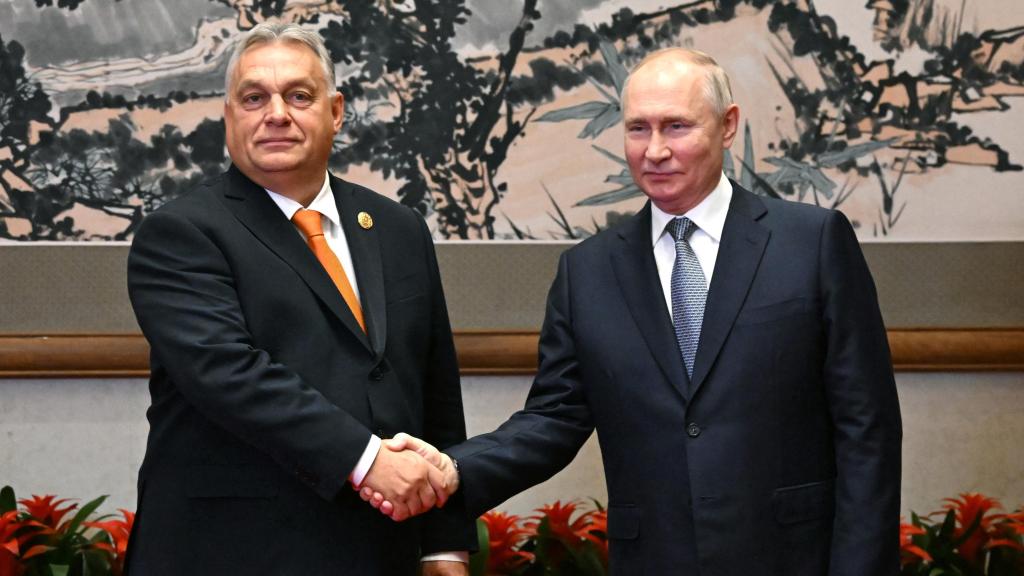
Hungarian Prime Minister Viktor Orbán with his Russian counterpart Vladimir Putin.
Reuters
“As soon as he identified the historical moment, he immediately devoted an enormous amount of political work to the construction of his conservative project,” adds Polyák.
However, Magyar’s popularity skyrocketed after publishing a recording with his then-wife and Minister of Justice in the Orbán Government, Judit Varga, in which she recounted alleged interference by the Executive in a high-profile corruption case. In parallel, Varga was forced to resign after the pardon granted to a man convicted of covering up sexual abuse of minors came to light, which also ended up costing President Katalin Novák her position.
Just four months after bursting onto the public scene with a viral appearance in a YouTube interview, the Tisza party won the June 2024 European elections about 30% of the votesplaced second behind Fidesz and left the traditional opposition reduced to irrelevance.
But what does Magyar have that Orbán’s other rivals haven’t?
For Zoltán Balázs, president of the Doctoral Council of the Corvinus University of Budapest and head of its Department of Political Science, Magyar possesses essential qualities that the previous ones did not have: “charisma, rhetorical ability, a phenomenal sense of political rhythm, tenacity.”
For the expert, one of the keys to its success is that it has managed to attract support that until now seemed reserved for the ruling party. Many voters perceive him for what he really is: a former Fidesz supporter, but young and incorruptible. They see in him someone conservative, patriotic, right-wing and capable of speaking in the towns, but without the wear and tear of the regime.
“He has an intimate knowledge of those who currently hold power, which has made him more fearsome in their eyes and, in turn, has benefited him in the eyes of public opinion. His followers understand that the Government fears Magyar, and that pleases them,” says Balázs.
The self-confidence it denotes has translated into a remarkable capacity for mobilization, with events that have brought together hundreds of thousands of people in Budapest under the motto Now or never. “He has toured the country and held rallies tirelessly, something that no Hungarian politician has been able to do until now,” the expert emphasizes.
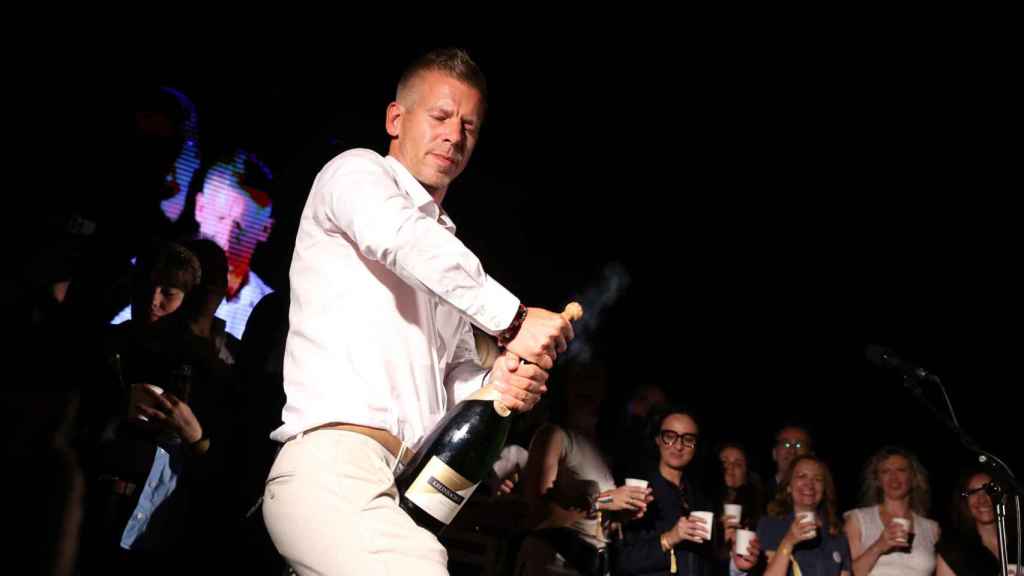
Péter Magyar, former member of the government and leader of the Tisza party, uncorks a bottle of champagne in Budapest.
In recent weeks, Magyar had multiplied campaign events in small cities and rural areas, traditionally strongholds of Fidesz, aware that mobilization in those territories was going to be decisive.
Return to the EU
In the final stretch of the campaign, Magyar condensed his message into three promises: put an end to the “mafia state” and corruption, restore democratic institutions and rebuild the relationship with Brussels to unlock frozen European funds. Neither more nor less than 17,000 million from different items. In reality, beyond being a Euroenthusiast, the Tisza party defends the interests of Hungary but, unlike Fidesz, without directly opposing the EU.
Along these lines, Magyar is also not outright opposed to Ukraine’s accession to the EU. But he does reject accelerating the process and proposes making Hungary’s final position subordinate. to a binding referendum. And, although it is part of the European People’s Party, its MEPs have abstained in some key votes on Ukraine and oppose sending Hungarian weapons or soldiers to the front.
In any case, Magyar has openly pointed out Russia as the aggressor, in contrast to the accommodating rhetoric towards the Kremlin that has characterized Orbán. His party defends a Hungary anchored in the EU and NATO, which recovers the traditional Western alignment without giving up a discourse of defense of national interests.
As explained by analyst Zsuzsanna Végh in a publication of the European Council on Foreign Relationsthe foreign policy vision that Tisza proposes is disruptive when compared to the the state in which of recent years in Budapest. “But its principles – loyalty to the EU and NATO, good neighborly relations and responsibility towards Hungarian minorities abroad – are not revolutionary,” he stresses. They are, in reality, simple European orthodoxy. And what makes them almost revolutionary is the extent to which Hungary, under Orbán, has moved away from them.
Leave a Reply