
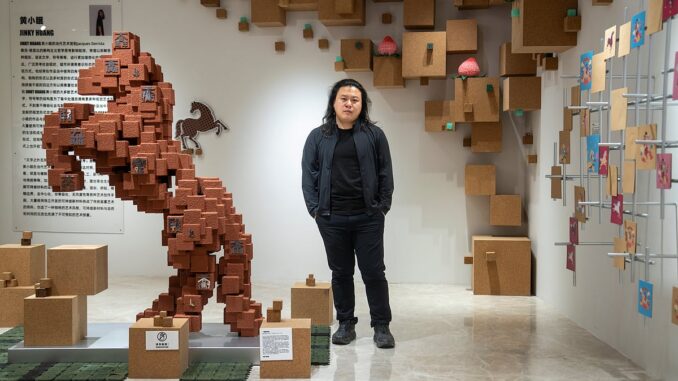
Portuguese cork has gained new life in the sculptures and installations of contemporary Chinese artist Jinky Huang, who has been using the material imported from Portugal for two decades to promote a vision of sustainable art. Huang told Lusa that he discovered cork around 20 years ago, when he lived in Italy, where he spent part of his childhood and youth. “I saw some materials made from cork that were for sale and I thought it was a very special material”he recalled.
The range of applications was then limited, but the creative potential sparked his immediate interest. “I like working with new and special materials. I was already making installations, sculptures and even clothes with different materials. When I discovered cork I realized that it could have many more shapes and possibilities”these.
The artist claims to have developed hundreds of techniques and applications for the material, which he now uses in sculptures, furniture and design objects, including chairs, sculptures and accessories. “From the point of view of sustainability, recycling and respect for the environment, cork is one of the best materials in the world”, told.
The raw material used in his works is imported from Portugal, a country that the artist has already visited to contact producers. “Portugal has the best cork”, said Huang, adding that the thickness and resistance of Portuguese cork are greater than that produced in China.
In 2025, Portuguese cork exports reached around 148 thousand tons, worth 1.1 billion euros, according to data from the National Statistics Institute (INE), an increase of 1.7% compared to 2024.
Despite working with cork for around 20 years, Huang acknowledged that this material remains relatively little known in the Asian country. “Most people in China only come into contact with cork through wine corks,” he said.
According to Huang, his career helped to promote cork in the country: “Today, when many people in China talk about cork art, they think of me”. In 2024, Portugal exported 19 million euros worth of cork and cork products to Chinaaccording to international trade data based on UN Comtrade. Although China is a relevant market in Asia, the United States and European countries continue to absorb a large part of Portuguese cork.
Over time, the use of cork led Huang to delve deeper into the concept of sustainability in artistic creation. “At first I didn’t think so much about sustainability, I just wanted to do something different. It was cork that made me really understand what sustainability, recycling and respect for the environment mean.”, he stated.
The focus on this material was recently at the center of the exhibition Deconstruct the Past Codes Hero: the Sustainable Roadspresented in Shanghai, the economic “capital” of China, where Huang resides and maintains his studio.
The exhibition, which received tens of thousands of visitors, reinterpreted two iconic figures from Asian popular culture – the Monkey King, from the Chinese mythological novel Journey to the West, and Astro Boy, a character created by Japanese Osamu Tezuka – through sculptures and installations inspired by sustainability. Among the highlights was a sculpture of the Monkey King made from cork.
In recent years, the artist has presented exhibitions in several Chinese cities and says that interest in his work has increased. “More and more people are getting to know my work and visiting the exhibitions,” he said. In 2025, he held four exhibitions in China and is now preparing new international exhibitions.
According to Huang, exhibitions are confirmed in Singapore, Thailand and New York, while negotiations are underway for new projects in Europe. In addition to artistic activity, Huang teaches and lectures at Chinese universities, such as the Central Academy of Fine Arts in Beijing, the Academy of Fine Arts of China and Tongji University in Shanghai. “My goal is for more artists to join this idea. I want new generations to participate in this movement”he stated.
Leave a Reply