
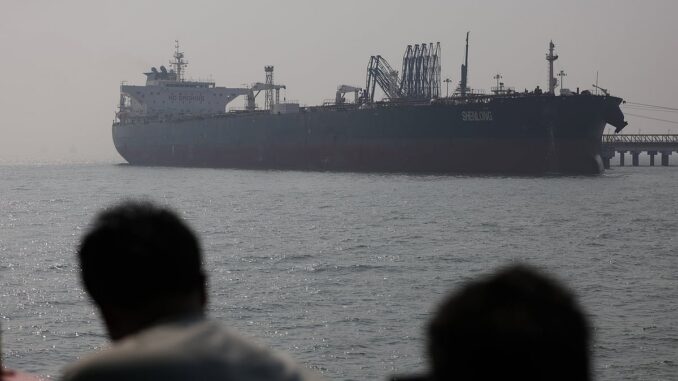
This Monday, March 16, the Minister of Foreign Affairs ruled out any military involvement by Portugal in the Middle East, including in the Strait of Hormuz, and highlighted that this position is shared by the majority of European Union member states.
“Portugal is not, nor will it be, involved in this conflict”, stated Paulo Rangelspeaking to journalists on the sidelines of a meeting of EU diplomatic chiefs in Brussels.
The minister stated that “everything that can be done to unblock the Strait of Hormuz and allow freedom of navigation is positive”.
“There are a lot of things that can be done on a political and diplomatic level. It is on this level that Portugal is and that, I believe, the European Union will also be on this level”, he said.
The Minister of Foreign Affairs said that, Among their EU counterparts, there is a “broad consensus” on the idea that efforts should be made to “overcome this blockage or manipulation of freedom of navigation” in the Strait of Hormuz, but without resorting to any military option.
“Everyone is willing, especially those who have more means – and when I say means, I also mean diplomatic means – to cooperate in this sense. Now, obviously, this does not imply a movement of military means to the region and, especially, to the Strait of Hormuz”, he said.
Asked whether Portugal supports a possible mobilization of the EU Aspides mission, which currently escorts commercial and merchant ships in the Red Sea, to the Strait of Hormuz, Rangel said that both this mission and Atalanta, which operates in the Indian Ocean, “could have some reinforcement”.
“But they are missions of a different type and, therefore, it is within their framework that it has to be seen. It is certainly not within the framework of this conflict, for which these missions were not designed”, he stated.
When asked whether Portugal would not respond to the challenge of North American President Donald Trump, who warned that NATO would have a “very bad future” if the allies did not help open the Strait of Hormuz, Rangel replied: “Yes”.
“What I can say is that we will not participate in this conflict, that has been very clear from the beginning,” he said.
The US president warned on Sunday that NATO faces “a very bad future” if allied countries do not help restore the passage of ships through the Strait of Hormuz, closed by Iran in response to US attacks.
“It’s appropriate that those who benefit from the strait help ensure that nothing bad happens there,” Donald Trump said in an interview with the Financial Times, noting that Europe and China depend on Gulf oil.
“If there is no response, or if the response is negative, I think it will be very bad for the future of NATO,” he added.
Leave a Reply