
Donald Trump no longer talks about “mass deportations”. He even acknowledges that “they went too far.” And that, in their world, is not a detail. It’s a sign. For months it was his motto. Straight. Without nuances. Almost a permanent campaign slogan.
Today has disappeared from the foreground. Not because the policy has changed, but because the calculation has changed.
Minneapolis broke the story. The surveys set off alarm bells. And November—when the midterm elections are held—conditions everything.
Trump is not backing down. It’s adjusting. And, as almost always in his way of governing, the adjustment begins with the words.
When a promise stops working
In politics, slogans last as long as votes.
“Mass deportations” worked well in the campaign because simplified the message and mobilized the bases. But governing is something else. And now, that same expression begins to bother where before it added.
The change is not improvised. It is directed. Within the Republican Party a clear slogan has been conveyed: stop repeating that term and focus the discourse on the expulsion of “violent criminals”. It is not a semantic question. It’s a damage control operation.
The contrast is evident. Trump promised the largest deportation operation in history and even talked about expel between 15 and 20 million peoplemuch more than the estimated irregular immigrants there are in the US.
It was a promise without nuances. Anyone who was in an irregular situation was a target.
Today Trump himself introduces a filter. He wants to deport everyone, yes. But he insists that the “worst” go first. That nuance changes everything.
The problem is that this new story arrives late. During the last 12 months it did not make as many distinctions as it now sells.
More than half of those deported had no criminal record. That is to say, the policy was quite similar to what the slogan that it now tries to hide said.
Reality overflows the story
There are policies that can be defended while they are abstract. Minneapolis stopped making it possible.
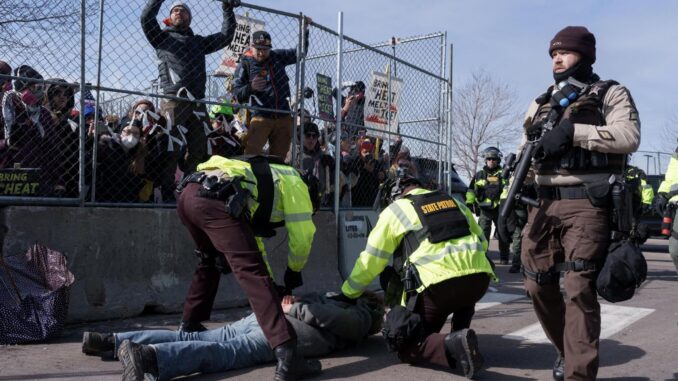
Two American citizens dead. protests. Official versions that are corrected again and again. A federal investigation. From there, immigration stops being just a plan and becomes an image. And pictures are worth a thousand words.
The surveys reflect this clearly. He support for immigration control remains. But the feeling is growing that the administration has gone too far.
Less talk, more pressure
If one is left alone with the language, one might think that immigration policy is being moderated. You just have to look at the border to see that this is not the case.
The Government has taken a step further: has militarized parts of the territory. More than 320 km in Texas and New Mexico have been transferred to the Army and converted into “national defense areas“.
This is not a symbolic gesture. It allows adding new crimes to those who cross: not only irregular entry, but also raid on military property. Since autumn, thousands of migrants have been charged under that figure.
The result is striking. Most of those cases does not end in conviction. Many fail in court because it cannot be proven that the accused knew they were entering a military zone.
Federal judges have openly questioned the legal basis for these charges. And yet, prosecutors continue to present them. The logic is not legal. It’s politics. Add pressure. Raise the cost. Send a message.
The same thing happens on other less visible fronts. The administration has restricted immigrants’ access to commercial driver’s licenses, a measure that could affect hundreds of thousands of transportation workers and raise the cost of products, even in Europe.
It is not a deportation policy. It’s another way to harden the environment.
Noem cae, Hegseth observa
In this ecosystem, the fall of Kristi Noem It is not understood as another relief. It is understood as a warning. Trump pushes her aside at the moment when immigration policy begins to generate wear.
Noem had been the face of the most visible phase: raids, constant exposure, a strategy designed to show strength. But when that same strategy begins to shake up the polls and complicate the narrative after Minneapolis, it stops being useful.
Its replacement by Markwayne Mullin It does not announce a turn. Announce another phase. Less noise. More control. Politics continues, but who embodies it and how it is presented changes.
The movement can only be understood by looking at November 3. The midterm elections In the United States they do not decide the presidency, but they do decide the real power of the president. The entire House of Representatives and part of the Senate are renewed.
If Trump loses any of those cameras, he will not leave the White House, but absolutely loses the ability to govern. Congress can block laws, stop budgets, paralyze appointments and open constant investigations. That is, it can turn a strong president into a puppet.
It is not a technical detail. It’s a change of scenery. Trump already experienced it in his first term. And what he is trying now is to avoid repeating it.
That’s why language matters. That is why “mass deportations” disappear. That’s why Naomi falls. It is not a question of convictions. It’s a matter of survival.
In that context we begin to look at other figures. Pete Hegseth is one of them. Not because his departure is imminent, but because he fits into the same risk pattern.
He is in charge of a delicate aspect—foreign policy and military involvement—with a increasing exposure and with a potential cost if the conflict is prolonged or complicated.
In Washington, leading analysts are beginning to read the Noem case as a precedent. First you try to sustain the policy. If the cost increases, the discourse is adjusted. And if it’s still not enough, the visible person in charge is changed.
It is not an exception. It’s the method.
And therein lies the key to the entire movement. Trump has not stopped believing in a strong hand. He has stopped talking about her like before. Because in November it is not just the parliamentary majority that is at stake. It is played continue ruling with power or start ruling with limits.
Leave a Reply