
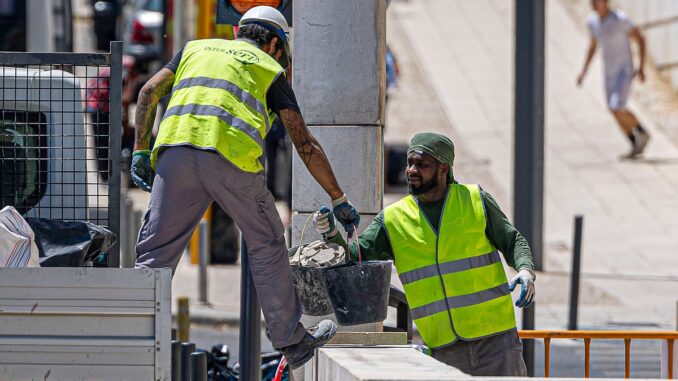
“The majority of workers who build infrastructure in Western countries today come from former colonial empires and are the product of a production structure set up in the 19th century.” In Portugal, the scenario is no different. A study by the Lisbon University Institute (ISCTE) indicates that the “common workers in the construction sector are African or Afro-descendant, unskilled and precarious”.
It is from this reality that the international conference is taking place this week in Lisbon “Colonial and Post-Colonial Landscapes: Architecture, Cities, Labour” (Colonial and Postcolonial Landscapes: Architecture, Cities and Workin free translation). The initiative is associated with a research project led by Ana Vaz Milheiro, professor and researcher at ISCTE, who received a grant of 2.5 million euros from the European Research Council to study the topic.
According to the researcher, cited in a statement, today it is the children and grandchildren of those who built the European empire who work in the construction sector. “The production machine set up by colonial empires in the 19th century continues to feed the labor needs of the current economy: just as their ancestors built European empires, their children and grandchildren today build the buildings, highways and factories in the countries to which they emigrated, keep them running, clean them, take care of their maintenance; in short, they are the current working class“, says Ana Vaz Milheiro. According to the researcher, “African workers only appear in construction in Portugal after independence, but this tradition was built before”.
Another of the speakers at the conference, which takes place at the Calouste Gulbenkian Foundation, is historian Alexander Keese, from the University of Geneva. Specialist in the history of colonial forced labor, Alexander Keese will present his research into the spaces and movements of this type of work. “The lack of debate and media interest that has occurred in Portugal regarding the 50th anniversary of the decolonization of the PALOP is very curious”he states. “There should be more archives and more publications on this topic in Portugal”, he criticizes.
Architect and researcher Cecilia L. Chu, from the University of Hong Kong, will also address the relationship between this historical past and the current housing crisis. “Without thinking and analyzing the past, it is not possible to find alternatives for the future. Only the understanding of historical dynamics makes it viable to question and reject the economic and social models that led to the normalization of real estate speculation and dependence on the market”, he says. At the same time, he emphasizes that “social housing continues to be viewed with some suspicion, despite the housing crisis”. The full conference program can be seen here. Activities continue until the evening of Friday, February 13th.
amanda.lima@dn.pt
Leave a Reply