
The storms that hit Portugal from the end of January and lasted three weeks in February had a very negative impact on tax collection: in January, tax collection grew by more than 6% compared to the same period last year; last February, the pace dropped to just 1%, reveals the Ministry of Finance, in the bulletin on budget execution, released this Tuesday.
A year ago, in February 2025, the value of tax revenue collected in the first two months of the year grew at a very significant rate, more than 15%, according to the same source.
With the storms, thousands of companies, mainly in the Central region and riverside areas, were destroyed or forced to interrupt their activities due to lack of energy, productive resources, lack of transport and communication, for security reasons.
Many will not have paid taxes, many did not even make any income during these times of devastation. It was like that for weeks. Several companies also never recovered from the impact of the train of depressions, several closed down.
Currently, even with this very adverse legacy, public accounts continue to record a surplus, but, for the first time in more than a year, the positive balance (it was almost two billion euros at the end of the first two months of this year) fell compared to the same period last year, a drop of 6%, around 127 million euros less in just one year, shows the bulletin that monitors the State Budget monthly (OE 2026).
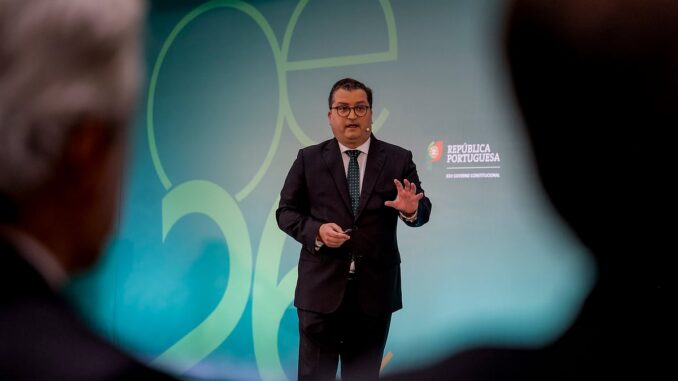
According to the document supervised by minister Joaquim Miranda Sarmento, “in February 2026, Public Administrations (PA) recorded an overall balance of 1992.4 million euros, which reflects a reduction of 127 million euros, compared to the same period of the previous year, as a result of revenue growth (5%) being lower than expenditure (6.3%)”.
“The 5% growth in UC revenue resulted, fundamentally, from the evolution of non-tax and non-contributory revenue (13.3%) and contributory revenue (7.9%), complemented by tax revenue (1%), which was affected by the effect of the storms at the end of January and beginning of February”, explains the Budgetary Body, the department responsible for calculating accounts in public accounting.
VAT, the biggest tax, loses its shine
According to the same source, “the growth in tax revenue (1%) mainly reflects the implementation of IMI (189.6%), in addition to VAT (0.9%), IRS (1%) and ISP (3.4%), mitigated by the declines in IRC (-40.3%) and tobacco tax (-14.2%). For the variation in revenue from contributions to social protection systems (7.9%), the most significant contribution was that of Social Security (8.3%)”.
Expenditure on State transfers to other domains and systems rose 7.7% year-on-year. Here, Finance highlights “the increases associated with the payment of the financial contribution to the European Union Budget, as well as pension charges, both in the general Social Security regime and in the convergent social protection regime of Caixa Geral de Aposentações, reflecting the annual updating of pensions and the increase in the number of pensioners”.
Expenditure on salaries of public employees (staff) increased by 5.8%, a dynamic to which “contributed the salary updates of workers in public functions, as well as the increase in the guaranteed minimum monthly remuneration. It is also worth highlighting the impact of the valorization measures in terms of specific careers, namely in the areas of education, health, security forces, and branches of the armed forces”.
The value of purchases of goods and services rose 8% and here the MF highlights “the greater volume of payments on products sold in pharmacies, medicines, clinical consumables and other health services, in entities of the National Health Service (SNS), as well as the evolution seen in the reimbursements of the agreed regime for beneficiaries of the health subsystem of the Institute for Protection and Assistance in Disease (ADSE)”.
At the end of last week, Miranda Sarmento admitted, for the first time, that “we cannot today exclude the possibility that in 2026 there could be a small deficit, but this does not put the balance of public accounts at risk, it does not put the reduction of public debt at risk”.
After the train of storms, the final cost of which has not yet been finalized (it could reach five or six billion euros), Portugal and the rest of the world are today faced with a new storm: the new war in the Middle East, which will also have negative effects on growth, public accounts and family purchasing power.
Leave a Reply