
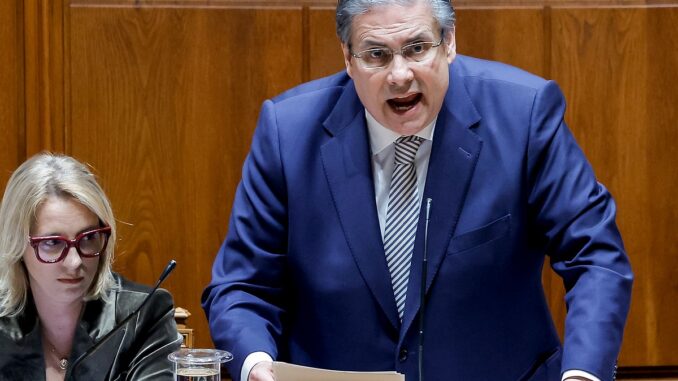
The Government’s proposed law that maintains a temporary and extraordinary discount on the tax on petroleum products (ISP) in force until June 30, justified by the impact on fuel prices of the “high uncertainty” generated by the geopolitical crisis in Iran, it was unanimously approved this Wednesday, April 8.
The outcome of the vote, in which only the blocist deputy Fabian Figueiredo announced that he would make a declaration of vote, ended up being a surprise, taking into account the criticism from several opposition benches of the Government’s initiative. Approval was guaranteed since socialist deputy António Mendonça Mendes, former Secretary of State for Fiscal Affairs, announced his vote in favoreven asking Luís Montenegro’s Executive “what are you waiting for to lower ten percentage points in VAT” on fuels.
For your part, Chega, through deputy Eduardo Teixeira, defended that the increase in fuel prices “is a serious matter and does not come with separate measures”, insisting on the party’s proposal to temporarily apply the intermediate rate of 13% VAT to fuelswhich was one of those that were refused debate and voting by the President of the Assembly of the Republic, José Pedro Aguiar-Branco, as they contradicted the brake norm of the Constitution of the Portuguese Republic.
The proposal had been defended by the Secretary of State for Fiscal Affairs, Cláudia Reis Duarte, as “a proportionate response to an extraordinary situation”, without contradicting European Union rules. The government official called for a “sense of responsibility from all parties” for the approval of a mechanism that “has the very clear objective of protecting family income and the competitiveness of companies, without putting the balance of public accounts at risk.”
The temporary discount is applied whenever the increase in fuel prices exceeds a value of ten cents, in unleaded gasoline and road diesel, in relation to those applied in the week of March 2nd to 6th.
The solution was criticized by Rui Afonso, also Chega’s deputy, who challenged the Government to reduce the direct tax burden on fuels and described the mechanism for offsetting the higher VAT collection with the ISP discount as “a fiscal labyrinth” and “engineering to protect budget surpluses”.
There was also no shortage of comparisons with other European governments, such as that of Spain, which was also mentioned by Chega, which led to ironic references from the left to their “new passion for the socialist government of Pedro Sánchez”. For Livre, Patrícia Gonçalves left the certainty that her party would “do differently”, namely through the creation of a national mobility pass that would allow “accelerating collective mobility”.
Leave a Reply