
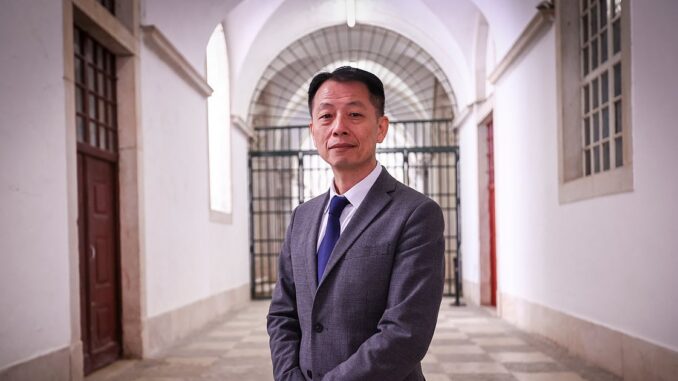
“We are extremely concerned in Taiwan about the situation. We have 15 submarine cables and if there is any damage to one of them, it will certainly create a huge strain on the entire communication system. The internet is essential today as all types of commerce, business, education and research depend on it. If something happens to the internet, not just one specific sector, but many sectors will suffer the consequences”, said Kenny Huang, in conversation with DN on the sidelines of Mafra Dialogues, organized by IPDAL. Huang is chairman of the Taiwan Network Information Center and on the panel titled From the bottom of the sea to the sky: Protecting critical infrastructure, from submarine cables to aerospace systems debated with Anum Khan, from the National Maritime Foundation of India, and João Fonseca Ribeiro, from UFORCE Portugal, with the moderator being Filipe Pathé Duarte, from Universidade Nova.
The potential threat to submarine cables in conflict situations is a widespread concern, but in the case of Taiwan it is felt very particularly, as in addition to being an island, and highly digitalized, there is also permanent tension with the People’s Republic of China. Beijing recalls that Kuomintang nationalists took refuge on the island in 1949 after being defeated in the Chinese civil war. And reunification with the Republic of China, Taiwan’s official name, remains a priority, through the use of force if necessary.
“During a disaster situation, the government is also concerned that the enemy may try to use the undersea cable to disrupt Taiwan’s communication system, leaving the country isolated in the digital world. Therefore, we need to find a way to mitigate the potential threat and improve this kind of resilienceespecially with regard to submarine cables. This is why we have identified several control mechanisms. For example, as I mentioned, we are concerned about any occurrence in territorial waters, so we have local regulations to strengthen this type of control mechanism within territorial waters. And do we have any control mechanism for the Exclusive Economic Zone? Not so far, but we are looking to identify government agencies that may have more capacity and resources to help in this regard. For example, the Navy, or even the Coast Guard, probably has more capacity, more technology, and more power to help mitigate this potential threat in the EEZ. And finally, what would happen if something happened in relation to international waters? We need to work together with partners,” Huang added.
With just 23 million inhabitants, and an area equivalent to a third of Portugal, Taiwan is, however, the 21st economy in the world, and this is largely thanks to technology companies, namely chip production. With an export-oriented economy, but with energy and raw materials import needs, the island is also affected by distant crises, such as the current conflict in the Middle East, which began with the Israeli-American attack on Iran. “Yes, of course, the conflict in the Middle East affects Taiwan. Obviously the price of oil has increased significantly, and the price of Taiwanese imports will also increase. In fact, our electric power company is already suffering from the rising price of oil. It has a big impact. For example, if something affects the price of a raw material, if that raw material is a basic component for making chips, it will impact the chip manufacturer and also the price charged. So far, our government is trying to monitor everything closely to ensure that if tensions in the Middle East continue, it will not affect the price for the consumer, but also the critical elements of our economy, such as chip manufacturing. We want to ensure that this type of export is successful”, highlighted the Taiwanese academic. He also drew attention to the fact that “another uncertainty, unrelated to the conflict in the Middle East, lies in the fact that the US has also imposed different taxes on chip manufacturers. Therefore, we need to monitor the international situation, not only in relation to the global scenario, but also due to trade relations, especially with the US government.”
In the last decade, with the successive election of two presidents from the Democratic Progressive Party, Tsai Ing-wen and, since 2024, Lai Ching-te, the relationship between China and Taiwan has deteriorated. Beijing accuses Taipei’s leadership of wanting independence and has used diplomatic, economic and military pressure to apply pressure. Regarding the reaction to the military exercises that China carries out around the island, Huang explains that the situation is analyzed based on two types of phases: “One phase is the period of peace. During the period of peace, we actually feel very comfortable and confident in dealing with any kind of disturbance. For example, just as we try to maximize the redundancy of the submarine cable, we also seek to provide more redundancy between the submarine cable and satellite communication. This is for times of peace. But even in times of peace, we need to deal with misinformation. For example, during the elections, a lot of disinformation was probably spread by our enemy. And yes, in times of peace, the government and people have full confidence in dealing with any kind of disturbance. The second phase would be a disaster situation that we can call wartime. And this is something we need to worry about, because wartime doesn’t just trigger an isolated attack. It can be any type of physical attack. And if there is some kind of physical attack or if they simply disconnect the entire submarine cable, what can we do? The government is working in this area right now, and to see if even the oldest submarine cable is cut, do we have any mitigation plans? And do we have any specific emergency communication systems to deal with this type of disaster situation? Yes, they are working on it.”
The conversation with a Taiwanese expert coincided with a visit to China by Cheng Li-wun, leader of the Kuomintang, today the largest opposition party in Taiwan. It was even received by President Xi Jinping, also general secretary of the Chinese Communist Party. Asked whether these parallel diplomacy initiatives, even with the aim of improving relations between one side and the other of the Taiwan Strait, divide the population in a democratic society accustomed to debating everything, Huang replied that “The ruling party has a consistent policy. The Kuomintang went to Beijing for a visit that, in reality, does not represent government policy. But everything they discussed will obviously have an impact on Taiwan’s internal politics. But nothing they discussed necessarily represents the official position of the ruling party. Therefore, we would not like to see any consensus or agreement that could compromise Taiwan’s political system. I don’t think that will happen, but I hope that the ruling party and other parties in Taiwan can work closely together to identify the best interests of the entire society. I think this is the best way for us to work together.”
Regarding the planned summit between Donald Trump and Xi Jinping in May, during the American president’s visit to China, which will necessarily have Taiwan on the agenda, Huang says that attention will be paid to potential topics of discussion”, but that “if we look at recent history, the positions of the US government and the Chinese government have been quite consistent. We believe they are looking for ways to improve communication between them. We just have to wait and watch, but we will pay attention to the repercussions of the discussions in Taiwan”.
The United States exchanged recognition of the Republic of China for that of the People’s Republic of China in 1979, and official relations are with Beijing, but it remains committed to Taiwan, selling weapons and leaving the possibility of military intervention in the air if there were an attempt at reunification by force. One of the likely hot topics of the summit between Trump and Xi will be the sale of American weapons to Taiwan, to improve its defensive capabilities.
Huang will be one of the participants in Lisbon this Monday, 13th, in the FLAD auditorium, at the Deep Sea Connections conferencewhich in a press release invites you to learn “how submarine cables – responsible for more than 95% of global data – are reshaping security, geopolitics and digital growth, with Portugal as an important transatlantic hub”. Risks and opportunities will be discussed between the Taiwanese expert, the American Olivia Negus, Director of Telecommunications Policies at the Information Technology Industry Council, and the Portuguese Rear Admiral Nuno António de Noronha Bragança – coordinator of the Atlantic Center.
Leave a Reply