
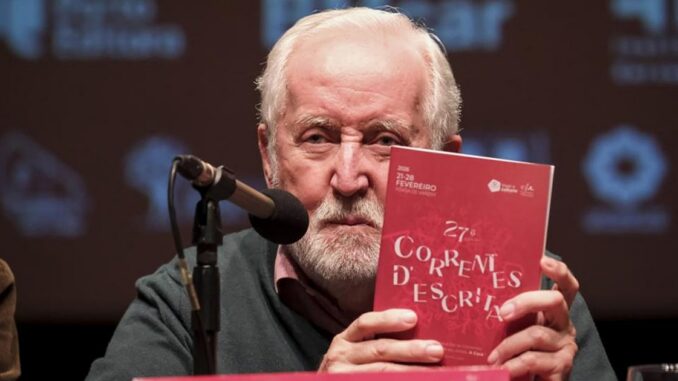
Even if it were possible to obtain a self-portrait of the poet José Carlos de Vasconcelos through the work published since 1960, the image would always be out of focus because each time he makes a collection of poems and publishes them, what is read comes from a cutting down to the bone of the original poem. He gives as an example a poem he wrote during a train journey between Póvoa de Varzim and Coimbra and which contained more than fifty verses, however, when he published it, only seven remained. But the poet does not avoid this self-portrait, and in his most recent book, The Seven Senses and Other Places right at the beginning there is a Self-portrait attempt in which he describes himself as “lyrical, not imbecile”. A justification for its leap publication.
Vasconcelos publishes his first poem in Songs for Spring (1960), a book that has two very positive reviews: one by the poet António Ramos Rosa in Seara Nova and another by João José Cochofel in Gazeta Musical. He is surprised by these criticisms because, he says, “I started very early; my first book came out when I was 19 years old and no one knew who I was, but it was very well received”. From this launch, five books will follow in the following fifteen years: Elegy time (1961), Body of hope (1964), Elegy (1965), From poem to hand (1970) e Poems for the revolution (1975). Then, a gap of 26 years opens until The sea to Póvoa (2001), becoming from that moment on less disappearing from the editorial panorama, even if the fingers of a single hand are enough to enumerate the books that exist until reaching this The Seven Senses.
Recently, with the suspension of the Journal of LettersVasconcelos had enough time to put together a selection of his work that had been preserved for decades, after intense pressure from the publisher Maria do Rosário Pedreira, a situation he had already experienced with the publisher José da Cruz Santos, responsible for several previous books. A return that should continue in the coming years, more intense than the delivery of a book to readers almost every seven years. Which he explains with his refusal to write poetry during the Salazar dictatorship: “It was a moral betrayal to publish lyrical problems. Then, in 1964, I published Body of hopewhich is a book very marked by the student struggles of those years, in which I had a very active intervention. Until the 25th of April I published little else…»
The story of an absence is interrupted to question the poet about this new book. José Carlos de Vasconcelos explains his method of creation: “For me, the poem starts from a central nucleus, an act that gives birth to it and can continue over the years. This is one of the reasons why, in general, I only publish the poem long after the first version, after several changes to give it clarity and conciseness.” The word “clarity” is used to compare it with the obligation to have clarity in your other profession, that of a journalist. Will the poet and the journalist be able to separate these two writings? Answer: “Yes, because There are two languages. What distinguishes poetry is that what is in the poem cannot be said with other words, as each word is like a cornerstone in the structure of a house. However, I believe that my perspective and essence as a journalist are also present in many of my poems. It is no coincidence that one of my books is titled Heart reporter; however, they will always be two distinct languages, although what I call clarity in poetry corresponds closely to clarity in journalism. Luminosity in poetry almost always has something hidden, that can only be said through those words.”
Despite making this separation between the languages of the poet and the journalist, Vasconcelos will make an exception for a poem that he included in his new book, Romance of the day when marmalade was made: “João Cabral de Mello Neto, one of the poets I really like, said that there are poems that have something descriptive. This is the case with this one, which could be a journalistic chronicle as well as a poem, and which has an ancient history as its basis dates back to the 1970s and I never stopped working on it, often in minimal parts, because The beauty of poetry has a lot to do with this continued effort.”
Not all poems by The Seven Senses are presented graphically in a traditional way, previously erratic in the distribution of verses. Not being able to fully justify why some are like this, Vasconcelos tries to explain: “The form of the poem is not always normal, but I can’t explain exactly why. As visualization is important, in some poems everything is as usual, in others some lines are longer, others with a different metric, even if the sound has a special meaning for me because the rhythm is fundamental. When I write I feel certain internal rhymes, tractions, the need to highlight a certain word, the one that gives the right reading rhythm; I’ve never had anything to do with concrete, visual poetry, but I can’t help but modify or replace a word so that the graphic taint of the poem matches the way I feel about it. – cannot harm the essence of the poem, but rather increase its effectiveness.”
The leapfrog poet will not fail to confess that he has a new project, one day not too far away to publish a book with many of his unpublished poems: “Which have to do very directly with my life and which I have been writing over the years”. One question remains: is this book a reunion with the traditional existence of an illustrator in the books of José Carlos de Vasconcelos, such as Cipriano Dourado, Graça Morais and Júlio Resende?
Leave a Reply