
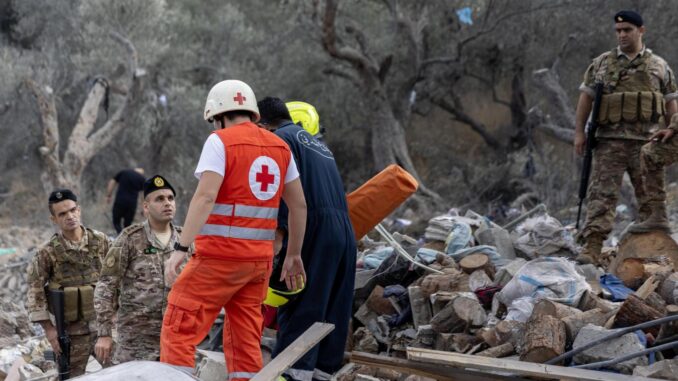
The War in the Middle East is generating instability in the region. In Lebanon, a third of the territory is under a “red evacuation area where there are direct attacks, without prior announcement,” the Spanish Red Cross delegate in Lebanon denounces to El Español. Alejandra Saved.
“The population is experiencing hostilities and attacks that occur daily with frequency and intensity,” laments Salvat.
Since the beginning of hostilities, the attacks have left almost 1,100 people diedamong them more than 100 are minors, and almost 3,000 injured.
This situation has been perpetuated continuously over time. It must be remembered that the conflict between Israel and Lebanon has been active for 77 years, with its stops and escalations.
Only 16 months have passed since the ceasefire on November 27, 2024 and the population has already been plunged back into a conflict with crossfire with Israel.
More than 1M displaced
The conflict was reactivated on March 2 in Lebanon between Israel and the Lebanese Shiite militia party, Hezbollah, close to the regime of the Ayatollahs of Iran after the death of Ali Khamenei.
Since that time, Israel has been attacking the southern part of the country, a refuge for Hezbollah cells.
Although the conflict affects the entire country “whether or not they are in the attack zones”reported Salvat.
There are more than a million displaced people in the country.
Data to be contrasted with those registered on the platform enabled by the Lebanese Government.
There are around 850,0000 people registered there but, according to the experience of the Spanish Red Cross in the 2024 conflict, “the real figure is between 30 and 40% more than the available data.”
Tension in the territory is the order of the day and can be felt among the population that lives between constant evacuation orders.
First, the Tire area began to be evacuated, then the evacuation of southern Beirut, Dahie, which is mostly Shia Muslims.
From there the city was evacuated. Saida to the Zahrani River.
The strategy is clear, a constant movement of the population and indiscriminate attacks against the territory.
Internal tensions
Andrea Salvat denounces to El Español that on many occasions the “Israeli army warns on Telegram about which buildings or specific areas it is going to attack, but not when”, something that contributes to “generate the chaos and hysteria that entails” among the population.
Although, perhaps, the bloodiest thing is their other form of attack through “collective murders.” What happens is that they are not in those red evacuation zones.
“They are usually in Christian areas, in the center of Beirut and they take place without warning. They have a target and they attack,” says the Red Cross delegate.
All this generates “internal tensions between the displaced and local population”he says, because the local population “is afraid because they don’t know who is entering their area, in a shelter or in their home.”
Something that considerably complicates the few options for displaced people to rent an apartment, mistrust is present.
“Internal tensions are exacerbated and disputes are created among the Lebanese population itself,” he laments.
Between the street and the shelters
Evacuation orders arrive daily. Although the largest concentration of displaced people according to the Spanish Red Cross is in the capital in Beirut.
Alejandra tells how walking through the streets of the capital leaves scenes of “whole families without homes, you also find them on the beach, or in parking lots.”
Hay 633 shelters open in Lebanon that are beginning to “be collapsed” due to the great humanitarian and socioeconomic crisis that the country is going through.
And, since 2019, the country has suffered a major economic crisis that has left the government with a limited capacity to respond.
Something that humanitarian aid organizations try to supply, but it is quite a challenge “due to the evolution of the context and the lack of resources.”
“The reception capacity is being a problem, it is slow, due to the continuous displacement of the population.”
The population is distributed as it can. Some have the financial resources “to pay rent, although it is increasingly difficult for them to move into buildings or rent apartments,” explains Alejandra.
Others are lucky and “stay with family or friends” in other safe parts of the country.
Many of the reception centers They are found in schools and educational centers. But this is worrying because “it generates a disruption in the country’s educational system and many children are left without classes due to the escalation.”
Although these centers are safe and are coordinated with the Ministry of Social Affairs and other humanitarian organizations, “the challenge is great to distribute water or sanitation.”
Something that even increases more with the people who are on the street: “People are much more exposed and the challenge is even greater to be able to access basic services such as water, electricity, medical care, food, etc.”
“A collective trauma”
The consequences of the prolonged war are taking their toll on the Lebanese population.
The physical consequences are evident, thousands of deaths, injuries and saturation of resources.
But, those that put pressure on the population from within are the emotional ones.
“There is a cumulative impact of being continually exposed to violence with forced displacement, enormous inequalities and cyclical wars,” and he emphasizes that “this has become a collective trauma that is difficult to heal and affects the resilience of the population.”
Now many areas from the south of the country and the capital “they are uninhabitable.”
Hay five closed hospitals and 42 primary care centers “for security reasons or direct attacks that have damaged the infrastructure,” denounces Salvat.
Help from the Spanish Red Cross
Spanish Red Cross in Lebanon works in coordination with the Lebanese Red Cross and the Palestinian Crescent. They mainly coordinate to provide emergency medical services for which the Lebanese Red Cross has a state mandate.
The delegate of the Spanish Red Cross, Andrea Salvat, says that there are two centers that depend on them. One near Beirut in el sports stadium Kamil Shamun and another in Generous.
In the case of Beirut, the largest of the two, they establish “the space, the tents, tents, hygiene, water and sanitation and supervise that everything is in acceptable conditions,” says Andrea.
At the Antelias public school they are also in charge of “distribution and coordination.”
Although this goes much further. For example, they have basic medical care centers through mobile units.
This is one of the most worrying complaints that Alejandra Salvat makes are the attacks on emergency teams that travel to places that are difficult to access or to places where there have been attacks.
“Last week there was an injury and another of our colleagues died in an attack on a mission in Majdal Zoun.
Violating International Humanitarian Law puts the population at risk and they claim that “the humanitarian space must be protected and preserved to be able to carry out work safely.”
Red Cross has carried out 10,340 missions of patient transfer and care after attacks since the beginning of the conflict.
Although the response from Salvat’s team goes further. For example, they have made more than 96,000 distributions in 232 centers with food, bottles of water, bread, etc.
In addition to offering basic care, hygiene, pillows, blankets, mattresses, menstrual hygiene kits, etc.
But resources are increasingly scarce, according to Andrea Salvat, and “the centers are beginning to be overwhelmed” due to the very nature of the conflict and the large volume of refugees.
Blood bank coordination
Spanish Red Cross in Lebanon is also responsible for coordinating the blood bank together with the Lebanese Red Cross. Are 13 centers who are in charge of transporting them to hospitals when they need it.
“In this context of continuous attacks, the blood bank is essential to be able to care for all the wounded.”
However, he claims that “the important thing is that security is preserved in all types of missions” because the Red Cross’s priority is “accompany the suffering population and leave no one behind.”
Leave a Reply