
After the first attack by the United States and Israel against Iran on February 28, the conflict has escalated to the point of daily bombing exchanges between the three territories involved and their allies, as well as the closure of the Strait of Hormuz by Iran.
This escalation produced “deep concern” among several countries that “condemned the Iranian attacks in the strongest terms,” thus preparing, on March 19, a joint statement by 35 world leaders—not including Spain.
In it, they urged Iran to “immediately” cease its actions and expressed their willingness to “contribute to the efforts necessary to guarantee safe passage through the Strait.”
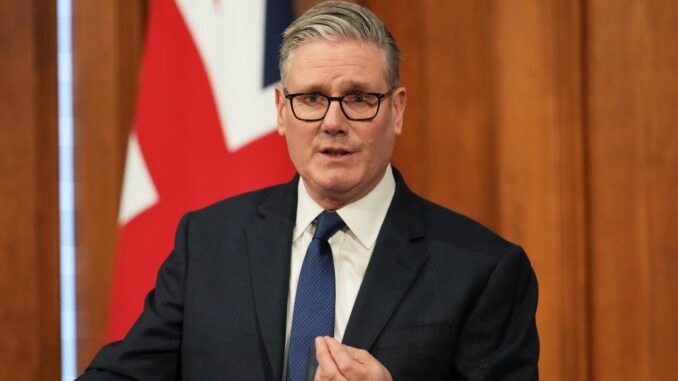
It was this Wednesday when the British Prime Minister, Keir Starmer, announced a summit at the end of this week with these allies to study “diplomatic and political measures” that contribute to reopening the Strait of Hormuz.
“We are exploring each and every one of the diplomatic channels that are within our reach,” the British leader reported in a press conference from London in which he claimed contacts within the G7 and with chiefs of staff of the aforementioned coalition to act in a coordinated manner in favor of maritime security.
In this context, he has announced a meeting at the end of this week sponsored by the British Foreign Office “that will bring together these countries for the first time.”
“We will evaluate all feasible diplomatic and political measures that we can take to restore freedom of navigation, ensure the safety of stranded ships and sailors and resume the movement of essential goods,” he said.
Starmer has indicated that the coalition’s next step will be to convene military officials to “coordinate capabilities” and make the Strait of Hormuz “accessible and safe,” although he has set this horizon for when “the fighting stops.”
“I must be honest with the people: this will not be easy,” he said about the task of reopening the Hormuz Pass, pointing out that the main factor for free navigation has to do with the duration of the conflict in Iran but that the end of the war and free passage are not necessarily linked. “The two things do not necessarily go hand in hand,” he noted.
In any case, he has asked not to assume that a reduction in the intensity of the conflict “necessarily implies” the total reopening of the strait controlled by Tehran. “That is why we are moving to the next level of planning in relation to Hormuz,” he stressed, indicating that this initiative must also involve Washington.
Regarding the continued friction with the American president, Donald Trump, due to the lack of involvement of the United Kingdom and other European countries in the war in Iran, the British leader has insisted that despite “the pressure and noise” he must act in defense of the British interest “in all the decisions” he makes. “I have been absolutely clear that this is not our war and we are not going to let ourselves be dragged into it,” he concluded.
News in update
We are working on expanding this information. Shortly, the editorial staff of EL ESPAÑOL will offer you an update on all the data on this news.
To receive the latest news on your mobile phone, you can download our newspaper application for iOS and Android devices, as well as subscribe to access all exclusive content, receive our Newsletters and enjoy the Ñ Zone, only for subscribers.
Leave a Reply