
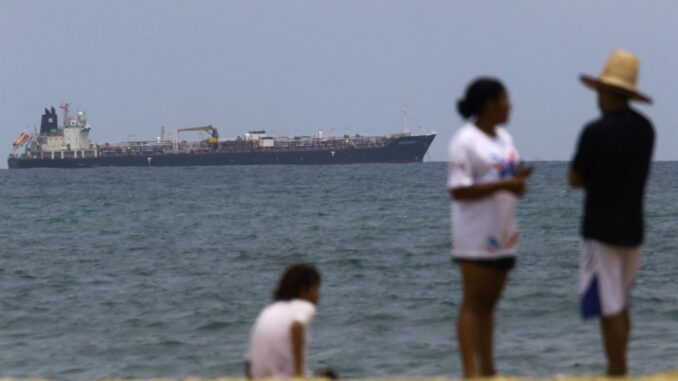
Three months after cutting off the supply of Venezuelan oil to Cuba and threatening to impose tariffs on any country that breaks the embargo, US President Donald Trump opens his hand and allows a Russian oil tanker to deliver its cargo.
The tanker Anatoly Kolodkin It has arrived on the island loaded with 100,000 tons of crude oil without the Coast Guard having blocked its path. International sanctions weigh on the ship for belonging to the ‘ghost fleet’ of oil tankers that operates irregularly for Russia.
Trump responded to questions from reporters aboard Air Force One by stating that he no longer had a problem with countries sending oil to Russia again. He cited humanitarian reasons: “People need heating and air conditioning“.
“Cuba is finished. They have a very bad regime, corrupt leadersand whether or not a ship with oil arrives is not going to make a difference,” he continued. The American president has expressed on several occasions his intention to cause a change in Cuba as in Venezuela.
However, the plan would not involve a military operation like the one ordered to capture Nicolás Maduro and install a similar government in Caracas. The energy blockade, which has plunged the island into shortages and is the cause of blackouts, punishes Cubans and pushes Havana to the limit.
In an unusual appearance, Miguel Díaz-Canel, president of Cuba, announced that talks are being held with Washington. Presumably, the US Secretary of State himself, Marco Rubio, would pressure in favor of political reforms in exchange for lifting sanctions.
That is why Trump’s announcement has caused surprise, since it is equivalent to lift the lock y give a break to the Castro regime. Kremlin spokesman Dmitri Peskov had announced that Russia had agreed with the US on delivery in terms of humanitarian aid.
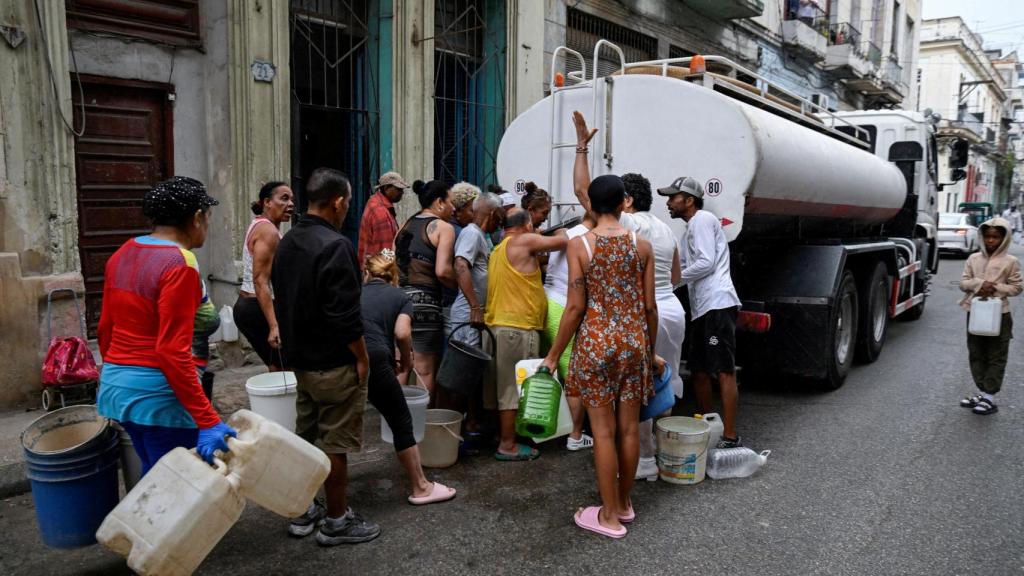
Queues to obtain drinking water from a tanker truck in Havana.
However, the American president has been permissive with shipments, “whether from Russia or anyone else.” Hours later, the president of Mexico, Claudia Sheinbaumannounced that they would once again supply the oil to Cuba that they interrupted to avoid tariffs.
The White House Press Secretary, Caroline Leavittfinished qualifying the conditions: the blockade would remain in force, but decisions will be made “case by case” when new ships approach the island.
Oil for one month
Although the cargo of the Kolodkin would barely be enough to cover Cuba’s needs for two and a half weeks“Havana doesn’t need much to function,” explains Brett Erickson, of the consulting firm Obsidian Risk Advisors, to Reuters. With rationing, you can last a month.
The permissiveness with the Russian “ghost fleet” must be interpreted from the crude oil shortage caused by the war in Iran, specifically by the closure of the Strait of Hormuz. Recently, London allowed one of these ships, the VAYU 1, to cross the English Channel.
In mid-March, the US ordered the lifting of sanctions on Russian oil that was already loaded on ships to try to inject volume into the global flow of hydrocarbons. But transactions with countries such as Cuba, Iran or North Korea remained prohibited.
Silk glove with Moscow
In conversation with Washington PostErickson points out that the decision to let the Kolodkin pass would have another explanation. The Coast Guard would have been forced to assault himsomething they already did with ‘ghost tankers’ before the coup against Maduro in Venezuela.
However, the context has changed. “Seizing or boarding a Russian ship while maintaining an active military conflict with Iran would fan the flames of already volatile energy markets“explains the analyst.
“The geopolitical cost of a direct confrontation with Russia It would be a step beyond what Washington is willing to assume,” Erickson assesses. “It is a direct consequence of an erratic foreign policy. “When you expand on multiple fronts, you lose the ability to focus.”
Russia, for its part, has suffered a significant blow to its export capacity due to Ukrainian attacks on its ports and fleets in the Baltic Sea. However, the rise in the price of crude oil is helping cleanse the coffers of the Kremlin, and Cuba presents itself as one of its last allies.
Díaz-Canel recently denounced that the island had not received an oil tanker in more than three months, which was increasing the energy crisis. Both the gasoline like diesel They are strictly rationed and blackouts are becoming more frequent.
The lack of supplies has irremediably deteriorated the Cuban healthcareonce the flagship of Castroism, and has worsened the life expectancy of the 10 million Cubans who live in these circumstances.
Although Trump’s latest messages towards Cuba have been compassionate in tone, there has been no shortage of threats. The president has promised “take care of” the island “as soon as I finish with Iran”.
Leave a Reply