
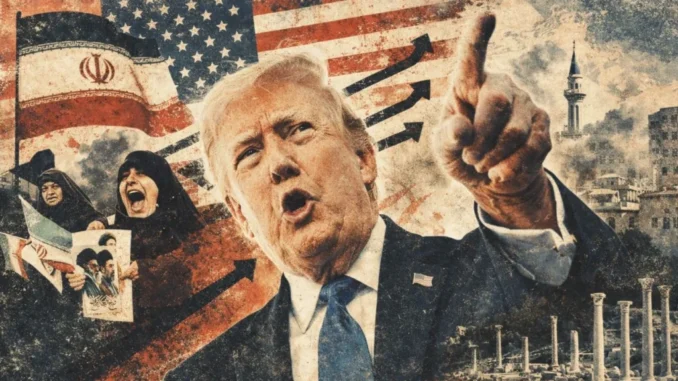
Washington’s decision to temporarily suspend attacks on Iran’s infrastructure does not necessarily point to a de-escalation, but to a possible phase of military preparation which could anticipate a greater conflict in the Middle East, in a context where cross bombings and diplomatic uncertainty continue, according to specialists.
Invasion of Iran in uncertainty
You may also be interested in: The US sent Iran a 15-point plan to end the war: according to NYT
The internationalist Agustín H. Berea, professor at the Iberoamerican University, maintains that the pause announced by US President Donald Trump responds to operational rather than diplomatic logic: “Trump is literally killing time while completing what in English is called staging: the preparation, logistical and positional deployment necessary to eventually mobilize troops.”
Although Washington claims to have sent a 15-point plan to negotiate the end of the
war through Pakistan, the continuity of Iranian missile attacks against Israel, Iraq and Gulf countries, as well as the increase in victims on several fronts, reinforce the
perception that the military dynamic remains active.
The White House confirmed that the military operation continues while avenues are explored
diplomacy, which suggests that both strategies advance in parallel. For Berea, the analytical key lies in observing actions and not statements: ““What is seen on the ground is the accumulation of capabilities, which points to a continuation of the escalation.”
“This indicates that Trump is seriously considering an invasion – at least in a certain area – or a landing on the coast,” he added.
According to the media Axios, Iranian officials informed the mediating countries
in the dialogue with the United States that they consider to have been “deceived” twice by the American president. According to a source with direct knowledge of the contacts, the Iranian side made it clear that “she doesn’t want to be deceived again,” which shows a further deterioration of confidence in the diplomatic process.
Market manipulation
The conflict has had immediate effects on global energy markets, especially after the effective closure of the Strait of Hormuz, through which it transits near
a fifth of the world’s oil. The price of Brent crude oil exceeded 100 dollars per barrel, while Asian governments activated emergency measures due to rising energy costs.
In this context, Berea interprets the pause as a factor that introduces strategic volatility in the markets. “Threats are issued that raise prices and then signals of calm are sent that modify expectations,” states.
The specialist points out that this pattern can generate fluctuations that benefit early positions in the energy markets, in a scenario where the
Geopolitical uncertainty impacts investment decisions and global supply chains.
Economists and energy analysts warn that even if the conflict were resolved in the short term, prices could take weeks to stabilize due to damage to infrastructure and the persistence of risk in strategic maritime routes.
Plausible military objective
According to the internationalist, one of the plausible objectives of an operation
American would be the Iranian island of Khark, a strategic enclave for the export of
oil. However, warns that occupying the territory would first require neutralizing
threats on the southwestern Iranian coasthistorically the scene of intense fighting
during the war between Iran and Iraq.
“You cannot occupy Khark without securing the perimeter. Otherwise, any contingent—whether 2,500 or 5,000 troops—would be exposed to constant losses,” explains Berea. The viability of an operation would depend on the ability to control surrounding areas and reduce risks of attacks with missiles or from coastal positions.
The specialist emphasizes that, in democratic systems, “The political cost of military casualties often limits tolerance for prolonged operations without clear results, which could
encourage an initial deployment phase that is broader than planned.”
Leave a Reply