
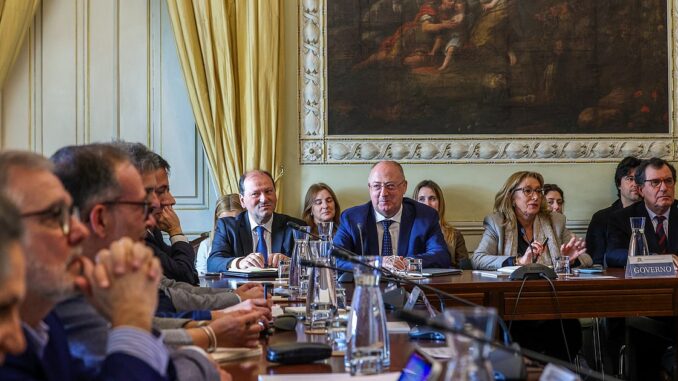
The business confederations and the UGT said this Tuesday, March 24, that they need “more time” to discuss changes to the labor law and stressed that the negotiation “is not concluded”, not committing to a deadline.
“We are in a negotiation phase that is not concluded” and to continue “in this negotiation phase we need more time”, indicated the president of the CIP – Portuguese Business Confederation, after leaving the meeting between the Government, UGT and the four business confederations, which took place at the Ministry of Labor, in Lisbon, flanked by the president of the Confederation of Commerce and Services (CCP) and the general secretary of UGT.
Asked if they were closer to an agreement, the president of the CCP, João Vieira Lopes, stated that at each meeting they “always make something forward”, even if it was not “enough” to be able to say that they are “in a position to close an agreement”.
Despite stressing that he will not address “concrete aspects”, given that he considers that “it is not beneficial for negotiation”, João Vieira Lopes considered that “the attitude” that has been observed is “constructive”.
“We continue the negotiations. The meetings are not over”, confirmed the general secretary of the UGT, Mário Mourão, indicating that it was agreed that they would not make any further statements, particularly regarding possible ongoing progress.
In this context, the president of the CCP also said that there will be “more meetings, but they are not scheduled”.
The president of the CIP, who at the start of this meeting had mentioned that he hoped to “quickly conclude” the negotiation process on changes to labor law and that the country is “a little tired of this negotiation”, said that the objective is to find “a solution that is better than the starting point”, even though he admits that “the vision” of each social partner “is different”.
But “it is in this dialogue and it is in this cooperation that we are trying to find a solution”, he insisted.
Both UGT and the business confederations did not commit to a deadline for completing this negotiation process, and Mário Mourão sent the response to the Government.
Asked about the national secretariat of the UGT, scheduled for April 9, Mário Mourão indicated that at this meeting “several matters” will be addressed and that “naturally an evaluation will also be made” of the negotiation process on changes to the labor law, which has been going on for eight months.
It should be noted that the final decision on a possible agreement will always have to go through a plenary meeting of Social Concertation, and the general secretary of the UGT has been stressing that the ratification of any decision by the union center will have to be taken to the national secretariat.
“There are many things that still need to be discussed and it would be premature for us to be here asking questions (…) because I also have to be accountable to the UGT leaders”, reiterated Mário Mourão.
Regarding the income plan that will be proposed by the CIP, the leader of the UGT stressed that “anything to increase workers’ purchasing power is good”, but considered it “premature” to talk about it, given that there has not yet been “any discussion on this matter”.
The Minister of Labor did not give statements to journalists, nor did the representatives of the Confederation of Farmers of Portugal (CAP) and the Confederation of Tourism of Portugal (CTP).
The Government has had several technical meetings with the four employers’ confederations (CIP, CCP, CTP and CAP) and the UGT to negotiate the more than 100 changes to the labor law, and the CGTP, which also has a seat in this headquarters and even presented a counter-proposal in a bilateral meeting on September 3, has not been called to the meetings, with the executive arguing that the trade union central placed itself on the sidelines of the negotiations from the beginning by asking for the proposal to be withdrawn from discussion.
Since the draft reform project, entitled “Work XXI”, was presented by the Government (PSD and CDS-PP) on July 24, 2025, more than 50 meetings have been held (plenary, trilateral and bilateral), making it possible to reach consensus on more than 76 articles, of which 24 were proposed by the UGT, a source linked to the process told Lusa.
Leave a Reply